Depreciation Recapture Explained Step-by-Step Guide for 2026
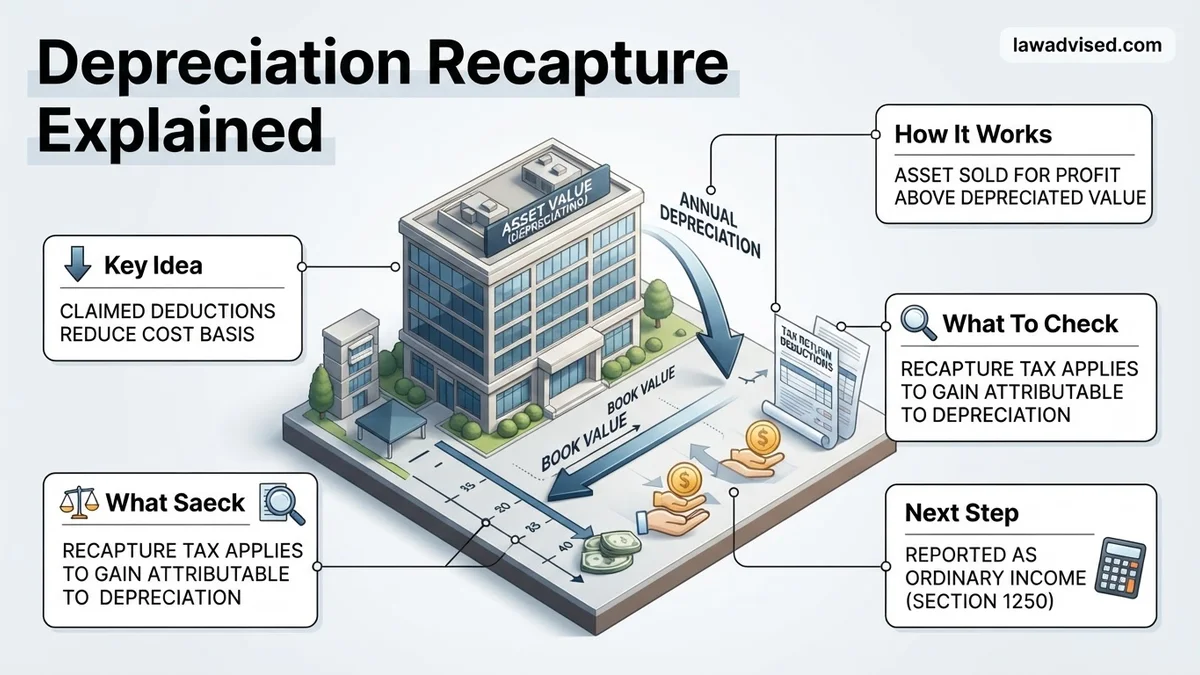
Depreciation recapture is an IRS rule that taxes the previously claimed depreciation deductions when you sell an income-producing asset for a profit. When you sell, that prior tax savings is clawed back and taxed at ordinary income rates up to a maximum of 25% for real estate. Knowing how this tax is calculated allows property owners to utilize legal strategies like 1031 exchanges to defer the liability.
Depreciation recapture is an IRS rule that forces real estate investors to pay taxes on the depreciation deductions they previously claimed when they sell a property for a profit. When you own rental property, the IRS lets you deduct the cost of the asset over time. But when you cash out in 2026, the government wants that tax break back, taxing those cumulative deductions as unrecaptured Section 1250 gain at a maximum rate of 25 percent.
This tax surprise catches many property owners off guard because it applies even if you did not actively take the depreciation deductions on your tax returns. The IRS assumes you took them anyway. Understanding how this mechanism works and how to calculate your exposure before listing your property prevents massive, unexpected tax bills.
Key Takeaways
- Depreciation recapture taxes previously claimed deductions as ordinary income upon sale.
- The maximum federal tax rate for real estate depreciation recapture is capped at 25%.
- A 1031 exchange allows real estate investors to fully defer depreciation recapture taxes.
- Holding property until death triggers a stepped-up basis, eliminating recapture entirely.
- Section 1250 governs real estate recapture, while Section 1245 applies to business equipment.
What Causes Depreciation Recapture Tax Liabilities Upon Asset Sale
Depreciation recapture triggers automatically whenever you sell a depreciable business or investment asset for more than its adjusted basis. The IRS views your past depreciation deductions as paper losses that artificially lowered your taxable income during your ownership years. When the sale proves that the property actually maintained or grew its market value, the IRS claws back those tax savings.
The Mechanics of Adjusted Basis
Your adjusted basis determines your total profit and your recapture amount during a 2026 property sale.
- Start with your original purchase price plus buying costs.
- Add the cost of major capital improvements made during ownership.
- Subtract the total cumulative depreciation you claimed (or could have claimed) over the years.
- The resulting figure is your adjusted basis, which directly dictates your capital gains and recapture totals.
Real Estate vs. Equipment Recapture Rules
Different asset classes trigger different tax treatments when sold.
- Real estate falls under Section 1250, where recaptured depreciation is taxed at a maximum rate of 25 percent.
- Personal property or equipment like appliances and vehicles fall under Section 1245.
- Section 1245 recapture is taxed at ordinary income tax rates, which can reach up to 37 percent in 2026.
How to Calculate Depreciation Recapture Step-by-Step
Calculating your exact depreciation recapture liability requires following a precise sequence using your transaction and tax records. Let us walk through a practical scenario for a commercial or residential rental property sold in 2026.
Step 1: Gather Your Historical Depreciation Totals
First, tally up every dollar of depreciation you claimed on your tax returns across all the years you owned the property. Imagine you purchased a small commercial building for 500,000 dollars, and over ten years of ownership, you claimed a total of 150,000 dollars in depreciation. Your adjusted basis drops by that exact 150,000 dollar amount, making your new adjusted basis 350,000 dollars before factoring in capital improvements.
Step 2: Determine Your Realized Gain
Next, subtract your adjusted basis from your net selling price. Suppose you sell the building in 2026 for 700,000 dollars after paying 40,000 dollars in selling costs, netting 660,000 dollars. Subtract your 350,000 dollar adjusted basis from the 660,000 dollar net sale price to find your total realized gain of 310,000 dollars.
Step 3: Separate Recapture from Capital Gains
Finally, split your total gain into depreciation recapture and standard capital gains. The IRS mandates that the portion of your gain equal to your total claimed depreciation (150,000 dollars) is taxed as unrecaptured Section 1250 gain at the 25 percent maximum rate. The remaining profit (160,000 dollars) is treated as long-term capital gains, taxed at standard 2026 capital gains rates of 0, 15, or 20 percent depending on your total taxable income.
How to Fix or Avoid Depreciation Recapture Using Proven Legal Strategies
Navigating depreciation recapture in 2026 requires proactive tax planning. Property owners can leverage specific legal mechanisms to defer or permanently eliminate this tax liability. According to real estate tax experts, failing to plan for depreciation recapture can unexpectedly consume up to 25 percent of a seller’s capital gains.
1. Utilize a Section 1031 Exchange
A Section 1031 tax-deferred exchange allows investors to roll both capital gains and depreciation recapture into a like-kind replacement property. IRS guidelines mandate strict timelines for this process. To execute a successful 1031 exchange, follow these procedural steps:
- Identify a qualified intermediary before closing the sale of the relinquished property.
- Close on the sale and ensure cash proceeds go directly to the intermediary, not the seller.
- Identify potential replacement properties within 45 days of the initial sale.
- Acquire the replacement property within 180 days of the original sale.
2. Leverage Step-Up in Basis Through Estate Planning
Holding real estate until death remains a powerful strategy for avoiding depreciation recapture entirely. Under current tax code provisions, heirs receive a step-up in property basis to current market value. This mechanism effectively wipes out all accumulated depreciation recapture obligations for beneficiaries.
3. Offset Recapture with Passive Losses
Investors holding passive activity losses (PALs) can use them to offset passive income generated by real estate transactions. When disposing of a passive activity entirely, any remaining suspended losses can offset ordinary income, softening the financial blow of depreciation recapture taxes.
What If It Still Doesn’t Work and You Owe the Tax Bill
If legal avoidance strategies fail or fall outside your timeline, you may face an unexpected tax liability. According to financial compliance data from major CPA firms, resolving unpaid real estate tax assessments requires immediate, structured action. When a depreciation recapture bill cannot be avoided, implement these fallback steps:
- Request an IRS Installment Agreement to spread the liability into manageable monthly payments over a period of up to 72 months.
- Explore an Offer in Compromise (OIC) if financial hardship prevents full payment of the assessed recapture tax.
- Consult a certified public accountant (CPA) or a specialized tax attorney to review your return for missed deductions that could offset the liability. Professional advisory fees typically range from $1,500 to $4,000 depending on complexity.
- File Form 9465 along with your tax return to formally request payment relief and avoid severe failure-to-pay penalties.
Conclusion
Depreciation recapture presents a substantial financial hurdle for property owners and real estate investors. However, strategic tools like Section 1031 exchanges and estate planning offer reliable pathways to mitigate or eliminate these taxes. According to verified research and expert sources from leading financial institutions, proactive coordination with qualified tax professionals remains the most effective safeguard against unexpected liabilities. Your actionable next step is to review your current depreciation schedule with a certified CPA before initiating any property sale in 2026.
❓ Frequently Asked Questions
How does the IRS calculate depreciation recapture on commercial or residential real estate?
The IRS calculates recapture based on the total depreciation allowed or allowable during the time you owned the property, regardless of whether you actually claimed the deductions on your tax return. This cumulative depreciation amount is then taxed at your ordinary income tax rate, up to a strict statutory cap of 25%.
What is the difference between capital gains tax and depreciation recapture tax?
Capital gains tax applies to the actual appreciation in an asset’s market value above its original purchase price. Depreciation recapture, on the other hand, taxes the artificial paper loss you claimed over the years to account for wear and tear, effectively turning past tax savings back into taxable income.
How does a Section 1031 exchange help bypass depreciation recapture?
A 1031 exchange allows you to roll both your capital gains and your accumulated depreciation over into a like-kind replacement property. Because you are rolling the equity forward instead of cashing out, the IRS defers the tax event until you eventually sell the replacement property without exchanging it.
What happens to depreciation recapture if I pass away while owning the property?
If you hold the depreciated property until your death, your heirs receive a stepped-up basis that values the property at current market rates. This legal reset effectively wipes out all accumulated depreciation recapture liabilities and past capital gains forever.
Can I use the Section 121 primary residence exclusion to avoid recapture?
If you converted a rental property into your primary residence and lived in it for two out of the five years prior to the sale, you may exclude up to $250,000 (single) or $500,000 (married) of capital gains. However, any depreciation claimed after May 6, 1997, cannot be shielded by this exclusion and must still be recaptured.
What happens if I sell equipment or business assets subject to Section 1245?
Unlike real estate capped at 25%, Section 1245 property (such as machinery, vehicles, or office furniture) requires all gain up to the total amount of depreciation claimed to be recaptured and taxed at standard ordinary income tax rates, which can be much higher than 25%.

Ismail Hossain is the founder of Law Advised. He is an Divorce, Separation, marriage lawyer. Follow him.