
Primary Residence Capital Gains Exclusion Expert 2026 Guide
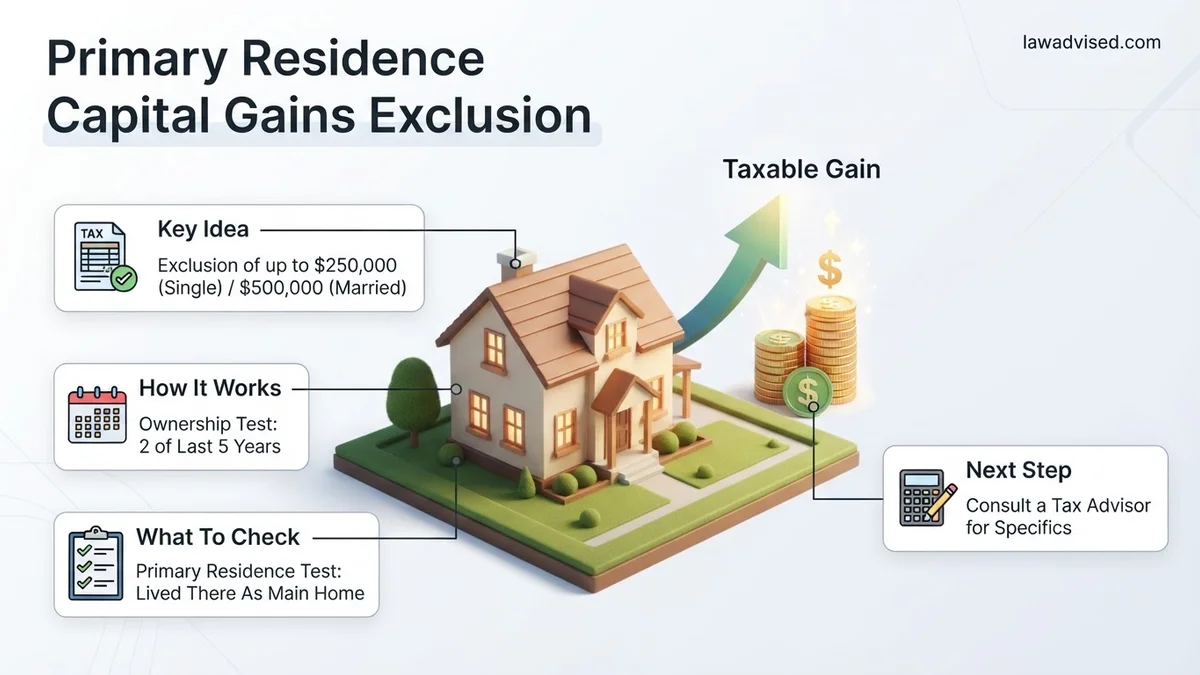
Homeowners can exclude up to $250,000 of profit (or $500,000 for married couples filing jointly) from their taxable income when selling their home. To qualify, you must pass the IRS ownership and use test by living in the property as your primary home for at least two of the five years preceding the sale.
If you sell your home in 2026 for a profit, you can exclude up to $250,000 of that gain from your taxes if you file as single, or up to $500,000 if you are married filing jointly. Under Section 121 of the Internal Revenue Code, this exclusion can save you tens of thousands of dollars in capital gains taxes.
Maximizing this tax break requires strict adherence to specific IRS criteria. By understanding the core rules of ownership, residency, and profit calculation well before you list your property, you can legally shelter a massive chunk of your real estate earnings from the government.
Key Takeaways
- Single filers can exclude up to $250,000 of home sale profits from taxes.
- Married couples filing jointly can exclude up to $500,000 in capital gains.
- You must meet the IRS ownership and use test for two out of the last five years.
- The exclusion can generally only be used once every two years.
- Partial exclusions apply for unexpected job changes, health issues, or unforeseen circumstances.
What Qualifies for the Primary Residence Capital Gains Exclusion
To claim this exclusion, you cannot just sell any piece of real estate. The IRS enforces strict residency and ownership thresholds that you must prove using official documentation.
The 2-Out-Of-5-Year Ownership and Use Rule
You must meet the two-part residency test during the five-year period ending on the date you sell your home. This means:
- Ownership Test: You must have owned the property for at least 24 full months out of the last 5 years.
- Use Test: You must have lived in the property as your primary home for at least 24 full months out of those same 5 years.
These months do not need to be consecutive. You can accumulate the 24 months through various shorter stays, as long as the total adds up to 730 days within the 5-year window.
Exceptions and Special Circumstances
Life is unpredictable, and the IRS provides partial exclusions if you must sell early due to unforeseen events. You may qualify for a prorated tax break if you move because of:
- A change in place of employment that meets distance requirements.
- Health issues certified by a licensed physician.
- Unforeseen circumstances like a divorce, job loss, or multiple births from the same pregnancy.
How to Calculate Your Home Sale Profit and Claim the Tax Break
Calculating your actual taxable profit is not as simple as subtracting your purchase price from your sale price. You need to determine your adjusted basis to find your true capital gain.
Calculating Your Cost Basis and Capital Gains
Your capital gain is the difference between your net sales price and your adjusted basis. Follow this formula to find your numbers:
- Start with your original purchase price.
- Add eligible capital improvements, such as a major room addition, a new roof, or a built-in HVAC system.
- Subtract any casualty losses or depreciation claimed if you used part of the home for business.
- Subtract selling costs like real estate agent commissions and legal fees from your final sale price to get your net proceeds.
Dollar Limits and Filing Status
Once you calculate your profit, apply your tax filing status to see how much is shielded. If your calculated gain exceeds the limit, the excess is taxed as a capital gain:
- Single Filers: Up to $250,000 of profit is tax-free.
- Married Filing Jointly: Up to $500,000 of profit is tax-free, provided at least one spouse meets the ownership test and both spouses meet the use test.
How to Fix Failed 2-Year Requirements Using Partial Exclusions
Life events often disrupt standard 2-year ownership and use timelines, potentially triggering unexpected tax liabilities for property sellers. When homeowners fall short of the baseline requirements under Internal Revenue Code Section 121, the IRS allows for a partial capital gains exclusion in specific, highly regulated scenarios. Understanding these statutory exceptions prevents significant financial loss during a 2026 property sale.
Unforeseen Circumstances Exception
According to IRS guidelines and Treasury regulations, taxpayers can claim a reduced exclusion if the sale occurs due to a change in place of employment, health issues, or unforeseen circumstances. The safe harbor provisions automatically grant partial relief if the primary reason for the sale matches IRS-approved triggers. Tax experts emphasize maintaining thorough documentation, such as medical records or employer relocation letters, to substantiate these claims successfully.
Calculating the Partial Exclusion Ratio
The maximum allowable exclusion of $250,000 for single filers or $500,000 for married couples filing jointly is prorated based on the portion of the two-year period met. Homeowners must apply a specific mathematical formula to determine their exact tax-free threshold.
- Determine the total number of days or months the property was used as a primary residence during the 5-year window preceding the sale.
- Divide that operational number by 730 days (or 24 months) to establish the eligibility ratio.
- Multiply the standard maximum exclusion amount ($250,000 or $500,000) by the resulting percentage to calculate the final tax-free capital gains limit.
What If It Still Doesn’t Work?
When statutory partial exclusions and standard rules fail to eliminate a substantial capital gains tax liability, property owners must pursue advanced financial and legal strategies. Navigating complex IRS compliance requires specialized guidance to protect assets during a 2026 transaction.
- Consult a certified public accountant or tax attorney specializing in real estate transactions to review alternative relief options. Professional fees for specialized tax consultations typically range from $300 to $600 per hour.
- Evaluate the feasibility of a 1031 exchange if the property was used partly for business or rental purposes, though strict replacement property timelines apply.
- Consider converting the property into a rental for a designated period to offset future gains with depreciation deductions, keeping Section 121 eligibility rules in mind.
- Explore installment sales to spread capital gains tax liability across multiple tax years, reducing the immediate financial impact of a single-year spike in income.
Conclusion
Failing to meet the standard two-year residency requirement does not automatically guarantee a massive tax burden when selling a home. By utilizing statutory partial exclusions for employment changes, health concerns, or unforeseen life events, homeowners can successfully shelter a significant portion of their profits. According to verified research and expert tax sources, proactive calculation and meticulous documentation remain the most effective defenses against unexpected IRS liabilities. The next actionable step is to audit your exact occupancy timeline and consult a licensed tax professional before listing your property in 2026.
❓ Frequently Asked Questions
What counts as living in the home to satisfy the use test?
You must use the property as your primary residence. Vacations, short-term rentals, or renting the home out for extended periods during the 5-year window may impact your eligibility.
Do I need to report the sale of my home on my taxes if it qualifies for the full exclusion?
Generally, if your capital gain is completely covered by the exclusion and you did not receive a Form 1099-S, you do not need to report the sale on your tax return.
How are married couples treated if they file separately?
If married filing separately, each spouse is generally eligible for a $125,000 exclusion rather than the full $500,000 joint limit.
Can I add home improvements to my cost basis?
Yes, major capital improvements like adding a room, a new roof, or permanent landscaping increase your cost basis, which lowers your calculated profit from the sale.
What constitutes an unforeseen circumstance for a partial exclusion?
Unforeseen circumstances include a change in employment location, health issues requiring a move, or natural disasters that damage the home, allowing for a prorated tax exclusion.
Does the exclusion apply to second homes or investment properties?
No, the capital gains exclusion strictly applies to your primary residence and cannot be used for vacation homes or pure rental properties without converting them first.

Ismail Hossain is the founder of Law Advised. He is an Divorce, Separation, marriage lawyer. Follow him.