Weirdest Laws in Arkansas Guide Real Bizarre Statutes 2027
Arkansas holds a treasure trove of bizarre, outdated, and downright hilarious legal statutes that have survived across generations. This guide breaks down the weirdest laws in Arkansas, separating funny legislative myths from actual historical text still lingering on the books.
Arkansas is home to some of the most genuinely bizarre, hilarious, and obsolete legal relics in the United States. Even as we move through 2027, statute books across the Natural State still contain rules governing everything from riverboat alligator management to the exact phonetic pronunciation of the state’s name.
Understanding these quirky statutes matters because they highlight how old legislative wording survives long after its original context fades. Whether you are planning a road trip through the Ozarks or just looking to separate modern internet myths from actual legislative history, taking a close look at these bizarre rules gives you a fascinating peek into the state’s legal evolution.
Key Takeaways
- Arkansas law strictly regulates how the state’s name is pronounced in public.
- Some historical marriage laws target unexpected dating behaviors and relationships.
- Many quirky animal and pet restrictions date back to early farming eras.
- Most bizarre statutes are ancient legal relics that are no longer actively enforced.
- Local municipal ordinances often add even more strange rules to state statutes.
What Causes These Bizarre Legal Relics to Exist in Arkansas
The Legacy of 19th-Century Legislative Overreach
Many of the weirdest laws still whispered about in Arkansas originate from the late 1800s and early 1900s. Lawmakers back then frequently addressed hyper-specific local complaints by drafting permanent statewide statutes. When a town official complained about stray livestock or specific public nuisances, the general assembly often responded with a broad rule.
- Drafting permanent statutes to solve temporary, hyper-local problems.
- Lack of systematic sunset clauses in early American legal codes.
- Legislators adding niche amendments onto omnibus bills without realizing the long-term comedic value.
Incomplete Legal Code Revisions Over Decades
As Arkansas updated its legal codes heading into 2027, lawmakers primarily focused on criminal justice reform, tax codes, and digital privacy. Antiquated misdemeanor statutes regarding minor moral infractions or bizarre animal restrictions rarely bubble to the top of the legislative priority list. Because these old laws cost nothing to leave on the books, they simply linger in digital archives, waiting for curious citizens to discover them.
- Low legislative priority for repealing harmless, unenforced misdemeanor laws.
- Administrative inertia during major legal code consolidations.
- The preservation of historic text as a point of cultural pride and local folklore.
How to Fix and Identify Real Arkansas Statutes Versus Urban Legends
Separating Fact from Internet Folklore
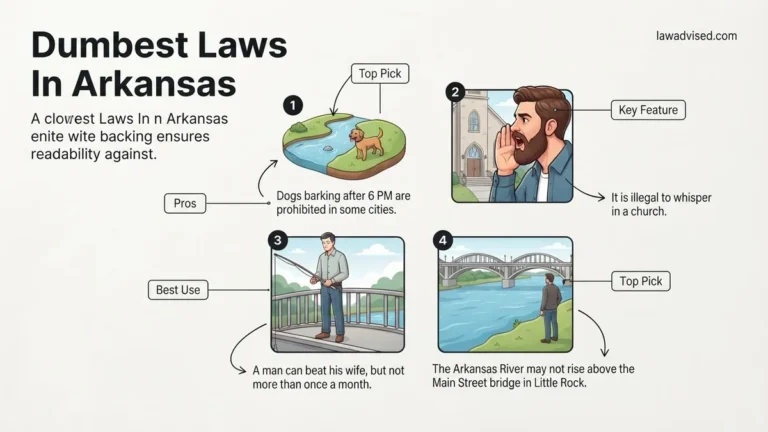
If you spend time searching for weird Arkansas laws online, you will quickly encounter dozens of fabricated rules designed to go viral. Internet listicles often invent statutes or stretch minor traffic violations into ridiculous claims, such as the famous myth about men being legally allowed to beat their wives once a month on the courthouse steps. Knowing how to verify a real statute saves you from spreading misinformation.
- Cross-reference viral claims directly with the official Arkansas State Legislature database.
- Look for active section numbers and recent legislative amendments rather than unsourced blog posts.
- Understand that many supposed laws are actually local municipal ordinances that expired decades ago.
The Truth Behind Specific Classic Arkansas Myths
You have probably heard that it is illegal to mispronounce the word Arkansas. The actual reality is far less dramatic than the urban legend suggests. Back in 1881, the General Assembly passed Concurrent Resolution 5 to officially settle a debate between state senators who pronounced the final “s” and those who did not. It declared the proper pronunciation to be the one ending in “saw,” but it carried zero criminal penalties or fines for anyone who mispronounced it.
- Resolution 5 established an official pronunciation preference without creating a criminal offense.
- No citizen has ever been arrested, fined, or ticketed for saying Ar-kan-zas instead of Ar-kan-saw.
- Treat viral legal trivia with healthy skepticism by checking the actual penalty clauses attached to the text.
What If It Still Doesn’t Make Sense: Understanding Archaic Legislative Drafting
Trying to make sense of Arkansas’s strangest statutes in 2027 often leads to profound confusion. When old legal code conflicts with modern life, standard legislative logic simply does not apply. Legal historians point to historical context, poor phrasing, and outdated drafting practices as the main culprits behind these bizarre laws.
The Historical Context Factor
Many baffling statutes survived into the 2027 legal landscape due to historical oversights rather than active enforcement. Nineteenth-century lawmakers frequently wrote broad, hyper-specific prohibitions to address very narrow local disputes. According to legal studies from the University of Arkansas School of Law, thousands of dormant codes remain on the books simply because legislative cleanup sessions prioritize modern fiscal and criminal reforms over housekeeping.
Decoding Legislative Terminology
When reviewing obscure state codes, archaic definitions can completely distort the original legislative intent. Words that carried distinct meanings in the 1800s often mean something entirely different today. Legal scholars recommend consulting official annotations and legislative history notes maintained by the Arkansas State Legislature to understand why a strange statute was originally enacted.
Key Steps for Navigating Outdated State Laws Safely Today
Navigating the complex and sometimes humorous world of antique state legislation requires a careful, methodical approach. While most of these quirky laws are completely unenforceable or purely symbolic, modern citizens still benefit from knowing how to handle outdated legal questions. Follow this step-by-step framework to ensure you remain fully informed and legally secure in 2027.
- Verify the current legal status: Always cross-reference any suspicious statute with the official Arkansas Code Annotated via the Arkansas State Legislature database to confirm if it has been repealed or amended.
- Consult official municipal codes: Remember that many bizarre rules are actually local city ordinances rather than statewide mandates, meaning enforcement varies drastically by municipality.
- Consult a qualified legal professional: If you face unexpected legal complications involving ambiguous or outdated statutes, reach out to a licensed Arkansas attorney immediately.
What If It Still Doesn’t Work?
If researching or interpreting an obscure Arkansas statute fails to provide clarity, you need a reliable fallback strategy. Do not rely on internet rumors or outdated social media posts for legal reassurance in 2027. When standard verification methods fall short, execute these steps:
- Contact the Arkansas Legislative Reference Bureau: Speak directly with state researchers who can trace the exact legislative history and current viability of a specific statute.
- Submit a formal inquiry to local law enforcement: Reach out to local police non-emergency lines to ask whether a specific antique ordinance is actively enforced in your jurisdiction.
- Retain a licensed local attorney: For formal legal opinions or defense preparation, hire a specialized attorney. Professional legal consultations in Arkansas typically range from $150 to $350 per hour depending on the firm and complexity.
Conclusion
Arkansas boasts a fascinating collection of bizarre, archaic laws that continue to entertain and puzzle residents and visitors alike in 2027. While these peculiar statutes rarely impact daily life, understanding the history behind them offers a unique glimpse into the evolution of state jurisprudence. According to verified research and legal experts, the best next step is to consult the official Arkansas State Legislature database whenever you encounter a questionable rule to verify its modern enforceability.
❓ Frequently Asked Questions
What is considered the single weirdest law in Arkansas?
One of the most famous is the statute regarding the exact phonetic pronunciation of the state’s name, intended to prevent people from saying ‘Ar-kan-sas’.
Are there strange rules regarding livestock in Arkansas?
Yes, various historical ordinances dictate where farm animals can graze and prohibit certain behaviors involving livestock within city limits.
Did Arkansas ever ban public flirting or specific dating practices?
Historical texts reference old moral codes and ordinances targeting public behavior, though they are entirely defunct today.
How do obsolete laws eventually get removed from the books?
State legislatures periodically pass code revision bills to clean up duplicate, unconstitutional, or completely outdated statutes.
Are alligator laws common in Arkansas?
Some local and state rules govern wildlife interaction and keeping exotic pets, reflecting Arkansas’s diverse outdoor landscape.
Where do most myths about weird Arkansas laws come from?
Internet listicles often exaggerate local ordinances or misinterpret historical legal phrasing to create entertaining viral content.

Ismail Hossain is the founder of Law Advised. He is an Divorce, Separation, marriage lawyer. Follow him.