10 Weird Laws in Arizona The Real 2027 Guide to Quirky Rules
Many states retain quirky, outdated regulations, and Arizona is no exception with its bizarre historical ordinances. This guide examines 10 weird laws that highlight the state’s eccentric legislative past and legal oddities.
Arizona is famous for its scorching deserts, the Grand Canyon, and a legal code filled with absolute head-scratchers. Even as we move through 2027, the Grand Canyon State maintains a collection of bizarre, highly specific statutes that make locals laugh and visitors scratch their heads. Whether you are planning a desert road trip this year or just love local trivia, understanding these quirky ordinances reveals a lot about the state’s eccentric legislative history.
You might wonder why these weird rules persist in modern times. Many of these strange statutes stem from early territorial days, moral panics of the mid-20th century, or hyper-specific municipal codes meant to solve temporary local problems. While you are unlikely to be arrested for most of them today, knowing your legal trivia keeps your 2027 travels entertaining and historically informed.
Key Takeaways
- Arizona retains several quirky, outdated historical laws.
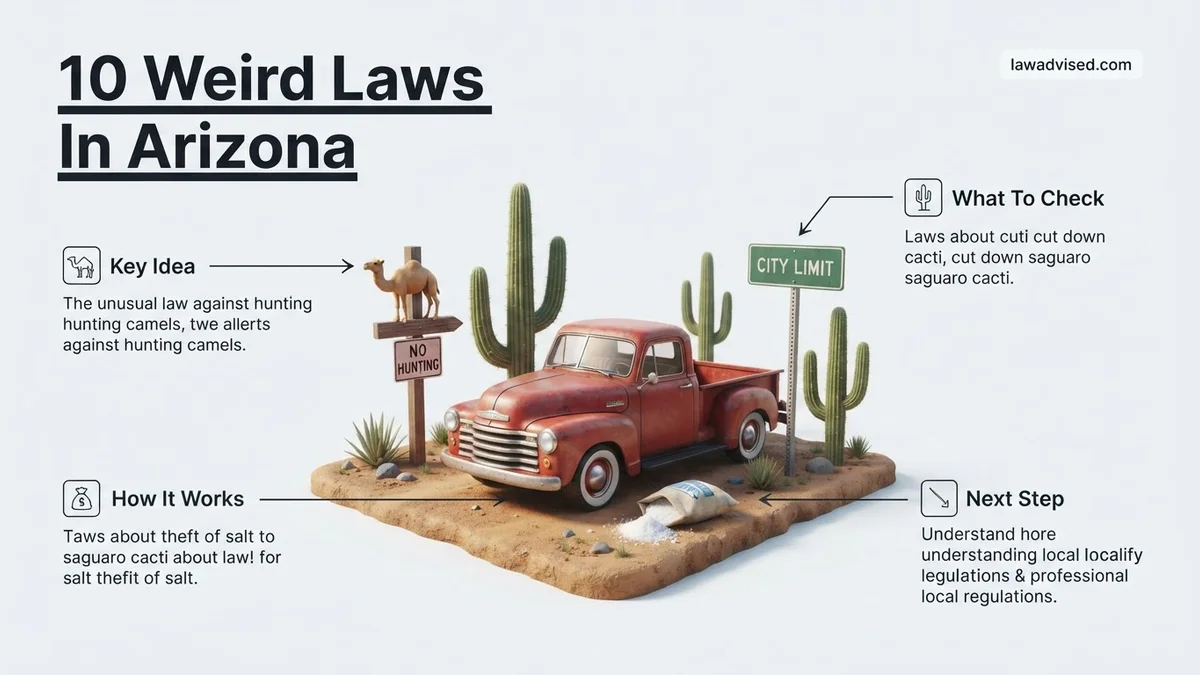
- Hunting camels was once strictly regulated in the desert.
- Cutting down certain cacti carries severe state penalties.
- Some local ordinances banned bizarre public behaviors entirely.
- Many old rules are urban legends rather than enforced statutes.
What Causes Outdated Legislation and Weird Laws in Arizona
The Legacy of Territorial and Frontier Days
Arizona achieved statehood relatively late, in 1912, but its territorial era laid down harsh or eccentric rules to tame the Wild West. Lawmakers back then focused heavily on public safety, property protection, and moral standards that simply do not apply to contemporary life. When legislatures drafted these massive legal codes, repealing old language rarely became a priority unless a specific lawsuit forced the issue. As a result, relics from the 1800s quietly survived decade after decade.
- Early statutes often targeted specific types of frontier behavior, such as livestock theft or public nuisances.
- Rapid population booms left behind old municipal codes that cities simply forgot to clean up.
- Legislative inertia means inactive laws sit on the books indefinitely rather than getting formally voted out.
Municipal Overreach and Hyper-Specific City Ordinances
Beyond state-level statutes, individual cities in Arizona have historically passed wild local ordinances to address micro-issues. A city council might pass a rule regarding animal behavior or public decorum to appease a vocal neighborhood group. By 2027, these ordinances often look completely ridiculous compared to modern societal norms. They remain technically enforceable on municipal books unless a local challenge strikes them down.
- Towns like Tombstone, Tucson, and Phoenix generated unique localized rules during different boom decades.
- Council members historically used quick ordinances to stop annoying trends without considering long-term consequences.
How to Identify the Top 10 Weird Laws Still Found in Arizona
Separating Urban Legends from Actual Legal Code
Internet lore loves to invent fake laws about camels, cacti, and donkeys to draw traffic. When you look for genuine Arizona oddities, you have to separate viral myths from actual text found in the Arizona Revised Statutes or municipal codes. Real weird laws usually feature surprisingly specific language, monetary fines, or petty misdemeanor classifications that highlight a very particular historical moment.
- Always check if an old rule is an active state statute or a defunct city ordinance.
- Look for specific penalties, such as petty offenses or minor fines, which prove the law had teeth.
- Beware of viral internet myths that attribute entirely fake rules to Arizona towns.
The First Wave of Quirky Rules to Watch For
When diving into the top 10 weird laws, you find everything from cactus protection acts with massive penalties to bizarre prohibitions on property usage. Arizona law takes its natural environment seriously, but it also contains surprising rules about property and public conduct. Here are the first few notable examples you will encounter when exploring the state’s eccentric legal side in 2027:
- Cutting down certain protected cactus species, like the Saguaro, can land you with severe prison time under strict state conservation laws.
- Old municipal codes in certain Arizona towns technically regulate what kind of items you can keep on your front porch.
- Historic spitting ordinances from early public health panics still linger in municipal archives across the desert.
Step-by-Step Guide to Verifying Real Versus Fake Arizona Legal Myths
Separating actual Arizona statutes from internet urban legends requires a systematic approach. Legal researchers and local archivists recommend a structured verification process to avoid spreading misinformation online or in casual conversation.
H3: Accessing the Arizona Revised Statutes (ARS)
The primary source for all current state laws is the official Arizona Legislature website. Follow these steps to research a specific statute:
- Navigate to the official Arizona State Legislature portal at azleg.gov.
- Select the “Laws” tab from the top navigation menu and click on “Arizona Revised Statutes.”
- Use the keyword search function to look up specific terms like “donkey,” “bathtub,” or “caring for cacti” to check for active code.
H3: Cross-Referencing Municipal Codes
Many quirky rules originate at the city level rather than the state level. Perform these steps to check local ordinances for 2027:
- Identify the specific municipality, such as Phoenix, Tucson, or Scottsdale, where the rule allegedly applies.
- Visit the city’s official municipal code repository, typically hosted on platforms like Municode or American Legal Publishing.
- Search the local code index for animal control, public nuisance, or property maintenance ordinances that may have inspired the myth.
What If It Still Doesn’t Make Sense: Understanding Historical Context
When an Arizona statute or ordinance appears entirely illogical to a modern reader, historical context usually provides the explanation. Legislative drafting in the territorial and early statehood eras often addressed hyper-specific local issues that no longer exist today.
For instance, laws regulating livestock on public thoroughfares or restrictions on firearms near mining camps solved acute safety crises of the late 19th and early 20th centuries. Over time, statutory cleanup bills remove obsolete language, but some archaic phrases remain dormant in historical digests.
What If It Still Doesn’t Work?
If online database searches and municipal code reviews fail to clear up a confusing legal rumor, alternative investigative steps are necessary. Try these fallback measures:
- Contact the Arizona State Library, Archives and Public Records division to speak with a reference archivist regarding historical territorial laws. Estimated cost: Free for public inquiries.
- Submit a formal public records request under the Arizona Public Records Law to a city clerk’s office for clarification on active local ordinances. Estimated cost: $10 to $50 for administrative processing fees.
- Consult a licensed Arizona attorney specializing in municipal or administrative law for a definitive legal opinion. Estimated cost: $250 to $500 per hour for a formal consultation.
- Reach out to university political science or legal history departments where regional experts study state statutory evolution. Estimated cost: Free for academic outreach.
Conclusion
Navigating the boundary between real Arizona statutes and persistent internet myths requires consulting primary legal sources rather than relying on viral social media posts. According to verified research and expert sources from the Arizona State Library, most bizarre legal claims are misconstrued municipal codes or complete fabrications. The best actionable next step is to bookmark the official Arizona Revised Statutes portal to independently verify any unusual legal claim you encounter.
❓ Frequently Asked Questions
What is the most famous weird law in Arizona?
The prohibition against cutting down saguaro cacti, which carries strict penalties, is widely considered the most prominent.
Are donkey-related laws still active in Arizona?
Older regulations regarding putting donkeys in bathtubs or sleeping in public spaces are generally local municipal relics.
Did Arizona ever actually use camels for transportation?
Yes, the U.S. Army imported camels for the U.S. Camel Corps in the American Southwest during the 1850s.
Why are so many state laws considered urban legends?
Internet virality often exaggerates or completely invents quirky legal restrictions that were never actual state statutes.
Do local cities in Arizona have their own bizarre ordinances?
Individual municipalities often passed specific nuisance laws that contributed to the state’s reputation for weird rules.
Can tourists get arrested for breaking these old laws?
Law enforcement agencies focus on modern criminal codes, so tourists face zero risk of arrest for outdated quirks.

Ismail Hossain is the founder of Law Advised. He is an Divorce, Separation, marriage lawyer. Follow him.