Taxes for Virtual Assistants Step-by-Step 2026 Guide
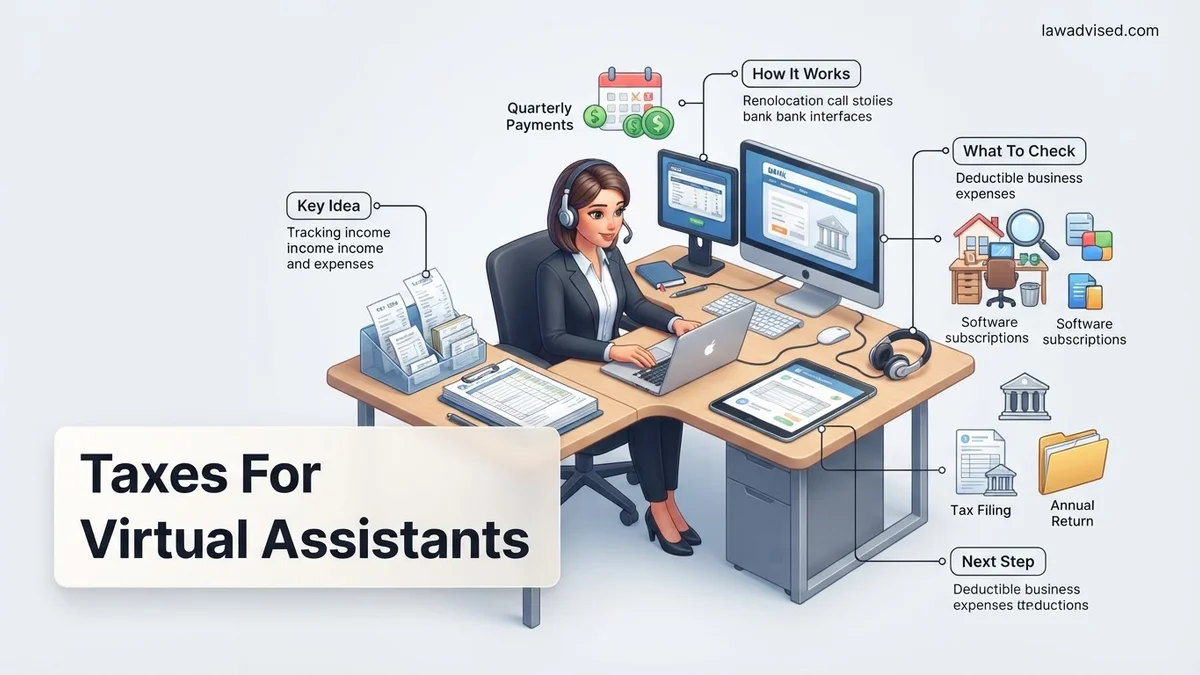
Navigating taxes for virtual assistants requires understanding your independent contractor status, self-employment tax obligations, and deductible business expenses. Most VAs operate as sole proprietors or LLCs, meaning you must proactively track income and pay quarterly estimated taxes to avoid IRS penalties.
As a virtual assistant, handling your own taxes means navigating self-employment tax, quarterly payments, and maximizing write-offs for software, home office space, and hardware. Unlike traditional employees, nobody is withholding taxes from your weekly payouts, leaving you entirely responsible for tracking revenue and paying Uncle Sam.
Mastering your 2026 tax obligations protects your profit margins and prevents painful end-of-year penalties. By setting up the right business structure and tracking every eligible deduction from day one, you keep more money in your pocket while staying completely compliant with current tax laws.
Key Takeaways
- Track all business income and keep client payments separate from personal funds.
- File Schedule C with your Form 1040 to report annual business earnings.
- Pay quarterly estimated taxes to the IRS by April, June, September, and January.
- Deduct standard business expenses like software, internet, and home office space.
- Set aside 25% to 30% of every client payout strictly for upcoming tax liabilities.
What Causes Tax Confusion and Penalties for Virtual Assistants
Most virtual assistants run into trouble with the IRS due to a fundamental misunderstanding of how freelance income is taxed. When you work online for multiple clients, you are legally an independent contractor, meaning your tax responsibilities extend far beyond a standard W-2 employee setup.
The Self-Employment Tax Trap
As a solopreneur, you must pay the self-employment tax rate of 15.3% to cover Social Security and Medicare. Traditional employees only pay half of this amount because their employers cover the rest. You pay both halves as a virtual assistant, making this often the biggest shock on your tax bill.
Quarterly Estimated Tax Penalties
Waiting until April to pay your taxes results in steep underpayment penalties. The IRS requires freelancers earning over $1,000 in net self-employment income to make quarterly estimated tax payments. If you skip these deadlines in April, June, September, and January, you will face interest charges and late fees.
- April 15: Q1 estimated payment due
- June 15: Q2 estimated payment due
- September 15: Q3 estimated payment due
- January 15 (2027): Q4 estimated payment due
How to Establish Your Business Structure and Tax Classification
Your business structure dictates how your virtual assistant income gets reported and taxed. Choosing the right entity during your setup phase simplifies your bookkeeping and reduces your overall liability.
Sole Proprietorship Versus Single-Member LLC
Most virtual assistants start out as sole proprietors by default. This means you and your business are legally the same entity, and you report your business income on Schedule C of your personal Form 1040. Forming a Single-Member Limited Liability Company (LLC) provides legal protection for your personal assets without changing how you file your taxes, as it remains a “disregarded entity” for tax purposes.
When to Consider S-Corp Election
Once your virtual assistant business consistently nets over $60,000 to $80,000 a year, you should look into electing S-Corporation status with the IRS. An S-Corp lets you pay yourself a reasonable salary and take the remaining business profit as distributions. This strategy helps you avoid paying the 15.3% self-employment tax on every dollar of your business earnings.
- Start as a sole proprietor or LLC to keep things simple.
- Track your net income carefully throughout 2026.
- Consult a certified public accountant once your profit crosses the threshold for S-Corp savings.
Step-by-Step Guide to Calculating and Paying Quarterly Estimated Taxes
As a self-employed virtual assistant in 2026, you cannot wait until April to settle your tax obligations. The IRS requires quarterly estimated tax payments if you expect to owe at least $1,000 in annual taxes. According to the IRS Small Business and Self-Employed Tax Center, missing these deadlines incurs underpayment penalties.
Calculating Your Quarterly Burden
To determine your quarterly payment, use IRS Form 1040-ES. Financial experts at the AICPA recommend the following sequence to calculate accurate payments:
- Project your total gross earnings for the 2026 tax year based on current monthly contracts.
- Subtract your allowable business deductions, such as home office expenses, software subscriptions, and high-speed internet.
- Calculate your estimated net self-employment income, applying the 15.3% self-employment tax rate alongside federal income tax brackets.
- Divide your total estimated annual tax liability by four to find your quarterly payment amount.
Submitting Your Payments
Once calculated, you must submit your payments by the federally mandated deadlines. For the 2026 tax year, quarterly payments are due on April 15, June 15, September 15, and January 15, 2027. Use the official IRS Direct Pay portal to transfer funds securely from your checking or savings account without incurring third-party processing fees.
What If Your Deductions Are Audited or You Still Owe Back Taxes
Even with meticulous record-keeping, virtual assistants occasionally face scrutiny from tax authorities or struggle to clear past tax liabilities. Navigating an IRS notice requires strict adherence to official protocols rather than panic.
Handling an IRS Audit Notice
If the IRS flags your return for a deduction audit, utilize this systematic recovery procedure:
- Review the specific IRS notice (such as a CP2000 or correspondence audit) to identify which deductions require verification.
- Gather digital receipts, client invoices, bank statements, and mileage logs corresponding strictly to the tax year in question.
- Submit your documentation through the online IRS Document Upload Tool or via certified mail before the stated deadline.
- Avoid amending past returns independently until you consult a certified tax professional regarding the disputed items.
Resolving Back Taxes
If you discover an unpaid tax balance from previous years, delaying action compounds penalties and interest. According to National Taxpayer Advocate reports, proactive communication with tax agencies yields significantly better resolution outcomes than avoidance.
What If It Still Doesn’t Work?
When DIY tax software falls short or complex multi-state virtual assistant income triggers severe compliance issues, fallback strategies are necessary. Try these steps if standard filing methods fail:
- Hire a Certified Public Accountant (CPA) or Enrolled Agent (EA) who specializes in freelance and remote digital businesses. According to the National Society of Accountants, professional tax preparation for small business owners typically ranges from $300 to $1,000+ depending on complexity.
- Contact the IRS directly via their dedicated helpline for businesses (1-800-829-4933) to request a temporary penalty abatement if you have a clean compliance history.
- Apply for an IRS Installment Agreement (Form 9465) to establish an affordable monthly payment plan for back taxes, avoiding aggressive collection actions like levies.
- Utilize professional tax resolution services if facing an active audit or severe liability exceeding $10,000, ensuring legal representation before tax authorities.
Conclusion
Managing taxes as a virtual assistant requires shifting from passive year-end filing to active quarterly tracking, disciplined expense segregation, and strict adherence to IRS deadlines. By accurately calculating self-employment tax, leveraging every legitimate remote work deduction, and utilizing official payment portals, you protect your business from costly penalties. According to verified research and expert sources from the U.S. Small Business Administration, proactive tax planning reduces audit risks and improves long-term cash flow predictability. Your actionable next step for today is to open a dedicated business bank account and set aside 30 percent of every incoming client payment specifically for your 2026 tax liabilities.
❓ Frequently Asked Questions
What is self-employment tax and why do virtual assistants have to pay it?
Self-employment tax covers your contributions to Social Security and Medicare. Because virtual assistants are independent contractors rather than W-2 employees, they must pay both the employer and employee portions of these taxes, which totals 15.3% on net earnings up to the annual limit.
What specific business expenses can virtual assistants deduct?
Virtual assistants can write off ordinary and necessary expenses incurred to run their business. Common write-offs include software subscriptions (like Zoom, Canva, and Asana), high-speed internet, a dedicated home office square footage, laptop hardware, phone bills, and professional development courses.
What happens if a client does not send a Form 1099-NEC?
Even if a client fails to send a Form 1099-NEC, you are still legally required to report all income earned on your tax return. The IRS expects you to track your own revenue through bank statements, invoices, and payment processor records.
How does the home office deduction work for virtual assistants?
The home office deduction allows you to write off a portion of your rent, utilities, and internet if you use a specific space in your home exclusively and regularly for conducting virtual assistant work. You can use either the simplified method ($5 per square foot up to 300 square feet) or the actual expense method.
Can virtual assistants deduct health insurance premiums?
Yes, self-employed virtual assistants can often deduct 100% of their health, dental, and qualifying long-term care insurance premiums for themselves, their spouse, and dependents as an adjustment to income on their tax return.
Are software subscriptions and digital tools tax-deductible?
Yes, any software, apps, or digital subscriptions you pay for exclusively to perform your virtual assistant tasks—such as bookkeeping tools, project management software, and email marketing platforms—are 100% deductible as business expenses.

Ismail Hossain is the founder of Law Advised. He is an Divorce, Separation, marriage lawyer. Follow him.