Dependent Support Test Explained Step-by-Step Guide 2026
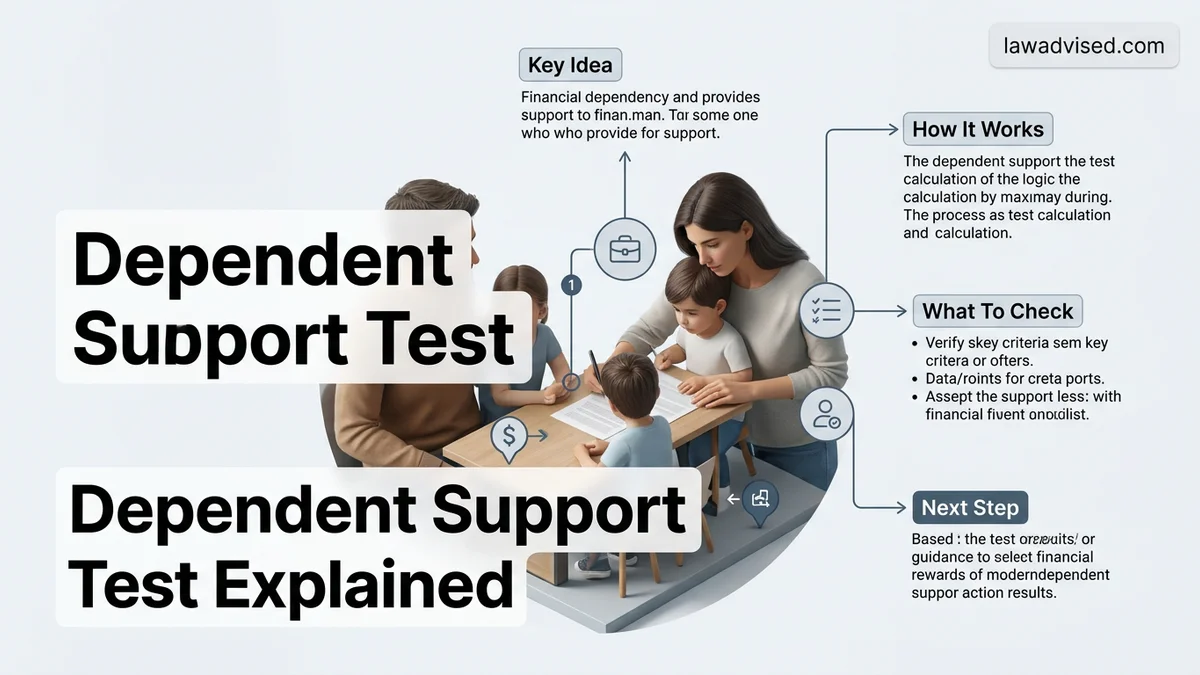
The dependent support test requires you to prove you provided more than 50% of a person’s total financial upkeep during the tax year. Using the correct calculation for housing, food, and medical expenses prevents costly IRS claim rejections. This guide breaks down the exact formula and rules you need to qualify your dependent.
The dependent support test requires you to prove that you provided over 50 percent of a person’s total financial upkeep during the 2026 tax year. If you fail to meet this mathematical threshold, you cannot claim them as a qualifying relative dependent, even if they lived with you all year and earned very little income.
Navigating this rule incorrectly leads to rejected tax returns, delayed refunds, and costly IRS audits. Calculating financial support accurately ensures you legally claim the deductions and credits you deserve while avoiding mistakes that trigger penalties.
Key Takeaways
- You must provide more than 50% of the person’s total financial support for the calendar year.
- Total support includes housing, food, clothing, medical care, education, and transportation costs.
- A dependent’s own income counts against your support only if they actually spend it on themselves.
- Scholarships received by a full-time student do not count as support provided by the student.
- Multiple support agreements allow relatives to claim someone even if no single person hits 50%.
What Causes IRS Support Test Confusion and Failed Claims
Mixing Up Gross Income With Total Support
Taxpayers often confuse a dependent’s gross income limit with the support test. For 2026, a qualifying relative cannot make more than the statutory gross income limit, but income is only one piece of the puzzle. Even if your relative earns zero dollars, you still fail the test if you cannot prove you funded more than half of their actual living expenses.
Omitting Hidden Costs From the Math
Another major trap is missing hidden financial contributions. People usually count rent and groceries, but they forget to factor in health insurance premiums, medical bills, and recreation. When the IRS audits a dependent claim, they look at the grand total of everything spent on that person from all sources combined.
- Forgetting to track contributions made by third parties like grandparents or ex-spouses.
- Assuming that providing a free place to live automatically satisfies the 50 percent threshold.
- Failing to keep receipts and canceled checks for out-of-pocket medical expenses.
Master the Dependent Support Test in 6 Simple Steps
Navigating tax season can be stressful, especially when trying to figure out who you can legally claim as a dependent. The dependent support test is a crucial IRS rule that determines whether you provided enough financial backing for a qualifying relative or child to claim them on your tax return. Failing to understand this test can lead to rejected returns or costly audits. This comprehensive walkthrough provides a clear, actionable roadmap to correctly evaluate financial support, ensuring you maximize your tax benefits while remaining fully compliant with IRS regulations.
Step 1: Identify the Type of Dependent You Are Claiming
What you need: Your previous year’s tax return, social security numbers or ITINs for potential dependents, and basic knowledge of your relationship to the individual.
Instructions: Before calculating any financial contributions, you must establish whether the person is a “Qualifying Child” or a “Qualifying Relative.” Generally, children, stepchildren, and eligible foster children fall under the Qualifying Child rules. Extended family members, non-family members living with you for the entire year, and older dependents typically fall under the Qualifying Relative category. This distinction is vital because a Qualifying Child does not technically have to pass the support test in the same way (they only need to not have provided more than half of their own support), whereas a Qualifying Relative must strictly meet the 50% support threshold.
Pro Tip: Do not guess the classification. Check IRS Publication 501 to confirm specific relationship guidelines before proceeding to financial calculations.
Step 2: Gather All Financial Records for the Calendar Year
What you need: Bank statements, utility bills, rent or mortgage statements, medical receipts, school tuition records, and W-2s or income statements for both you and the potential dependent.
Instructions: To prove you provided more than half of the dependent’s total support, you need concrete numbers. Collect all receipts, invoices, and bank records representing money spent during the standard tax year (January 1 through December 31). This includes tracking every dollar spent on housing, food, clothing, education, medical and dental care, transportation, and recreation. If you live in the same household, calculate the fair market value of housing, including utilities, and divide it proportionally among all household members to find the exact share attributable to the potential dependent.
Pro Tip: Create a digital spreadsheet to categorize expenses immediately. Having an organized ledger makes the math infinitely easier and serves as audit-proof documentation.
Step 3: Calculate the Total Cost of Support for the Dependent
What you need: Your completed expense spreadsheet, calculator, and regional cost-of-living data if estimating shared household costs.
Instructions: Total support is the entire sum of all expenses spent on the dependent from all sources combined. Add up everything spent on their behalf, regardless of who paid for it. Include money spent by you, money spent by the dependent themselves (from jobs, savings, or allowances), and money contributed by third parties like grandparents, non-custodial parents, or state assistance programs. For instance, if a college student’s total yearly expenses (tuition, food, rent, books, and insurance) equal $20,000, that is the total cost of support baseline you will use for the next step.
Pro Tip: Remember to include scholarship money in the total cost of support calculations, but note that tax-free scholarships received by a student do not count as support provided by the student themselves.
Step 4: Tally Your Specific Financial Contributions
What you need: Receipts and payment confirmations showing every dollar you personally spent on the dependent throughout the calendar year.
Instructions: Now, isolate the specific amounts that you paid out of your own pocket toward that total support figure. If you pay rent, calculate the dependent’s pro-rata share of shelter costs. If you buy groceries that the household shares, estimate the dependent’s portion of the food bill. Add your direct out-of-pocket payments for their doctor visits, car insurance, clothing, and entertainment. Divide your total financial contribution by the overall total cost of support calculated in Step 3. Your goal is to prove this resulting fraction is greater than 50% (0.50).
Pro Tip: Personal loans or money borrowed by you to pay for the dependent’s expenses count as your contribution, provided you are legally liable for repaying that debt.
Step 5: Account for the Dependent’s Own Funds and Third-Party Contributions
What you need: The dependent’s W-2 forms, 1099s, bank statements, records of government assistance (like welfare, food stamps, or SSI), and contributions from other relatives.
Instructions: You must verify that the dependent did not provide more than half of their own support. Check if they used their own earned income, savings, or inheritances to pay for their living expenses. Additionally, factor in any money contributed by outside parties. For example, if a divorced parent pays child support, that money counts as support provided by the other parent, not you. If the dependent’s own funds plus third-party contributions exceed 50% of the total cost of support, you fail the dependent support test, and you cannot claim them.
Pro Tip: Government benefits like Temporary Assistance for Needy Families (TANF) or food stamps count as support provided by the state, not by the dependent or you, when calculating the percentages.
Step 6: Handle Multiple Support Agreements If Applicable
What you need: IRS Form 2120 (Multiple Support Declaration) and signed agreements from other eligible individuals who contributed to the support.
Instructions: In scenarios where no single person provides more than 50% of a dependent’s support—such as siblings jointly caring for an aging parent—you may still be able to claim the dependent using a multiple support agreement. To qualify, you must have provided more than 10% of the total support, the combined contributions of you and the other eligible people must exceed 50%, and everyone else who qualifies must agree in writing not to claim the person for that tax year by signing Form 2120.
Pro Tip: Coordinate with family members early in the tax season. Form 2120 must be attached to your tax return, and taking turns claiming a dependent requires clear, annual communication.
✅ Final Checklist
- Verified the dependent classification (Qualifying Child vs. Qualifying Relative)
- Collected all receipts, bank statements, and housing cost estimates
- Calculated the absolute total cost of support from all sources
- Confirmed that your personal financial contributions exceed 50% of the total
- Verified the dependent did not spend more than 50% of their own funds on themselves
- Completed and attached Form 2120 if utilizing a multiple support agreement
Important Notes:
- Keep all financial records, receipts, and calculation spreadsheets for at least three years in case of an IRS audit.
- Consult a certified public accountant (CPA) or tax professional if dealing with complex custody arrangements or multiple support declarations.
- Estimated time to complete: 2 to 4 hours of document gathering and math. Cost: Free if self-prepared, or standard CPA hourly/service rates if outsourcing.
How to Calculate the 50% Support Test Step-by-Step
Step 1: Add Up Total Support From All Sources
To start your 2026 calculation, you must determine the absolute total cost of maintaining your dependent for the entire year. This figure combines every single dollar spent on the person by you, by the dependent themselves, and by any other outside parties. If the grand total is thirty thousand dollars, your magic number for the 50 percent rule is fifteen thousand dollars plus one penny.
Step 2: Compare Your Contributions to the Total
Next, isolate the specific funds you provided out of your own pocket for that person. Divide your total financial contribution by the grand total cost calculated in step one. If your result is greater than 0.50, you pass the dependent support test for the 2026 tax year and can proceed with your filing.
- Calculate total support from all combined sources: $20,000.
- Calculate your specific financial contribution: $11,000.
- Divide your contribution by total support ($11,000 / $20,000 = 55%).
- Result: You pass the 50 percent threshold.
What Expenses Count Toward Total Support Versus What Is Excluded
Calculating the total support requires careful accounting of every dollar spent on the dependent during the 2026 tax year. According to Internal Revenue Service guidelines and tax expert analyses, support includes all amounts spent to provide the dependent with food, lodging, clothing, education, medical and dental care, recreation, and transportation.
When tallying these figures, you must distinguish between items that officially count and those that must be left out of the equation. Accurate documentation prevents audit flags and ensures your calculations comply with current federal standards.
Items That Count Toward Total Support
- Housing and Utilities: The fair rental value of lodging provided, including a reasonable share of utilities like electricity, gas, and internet.
- Food and Groceries: All money spent on household groceries, school lunches, and dining out specifically for the dependent.
- Medical Expenses: Out-of-pocket doctor visits, prescription medications, and health insurance premiums paid on the dependent’s behalf.
- Education and Clothing: Tuition, school supplies, uniforms, and everyday apparel purchased throughout the year.
Items Excluded From Support Calculations
- Life Insurance Premiums: Payments toward life insurance policies do not count as support for the beneficiary.
- Scholarships: Tax-free educational scholarships received by a student dependent are excluded from the total support calculation.
- Capital Expenditures: Purchase costs for automobiles or major home improvements are generally treated separately from basic annual support items.
- Own Funds Not Spent: Income earned by the dependent that is saved rather than spent on their own upkeep does not factor into the support provided.
What If Multiple People Provide Support or Your Math Falls Short
Sometimes financial responsibility for a dependent is shared among multiple family members, yet no single person crosses the 50 percent support threshold. If your independent calculations show your financial contribution falls short, or if you need to coordinate with other providers, specific tax provisions apply for the 2026 filing season.
Understanding how to handle joint support arrangements or insufficient contribution percentages prevents the accidental loss of valuable tax credits. Follow these procedural steps when dealing with shared or borderline support situations.
Resolving Support Shortfalls and Shared Arrangements
- Execute a Multiple Support Declaration: If a group collectively provides over 50 percent of the support—and no single person contributes more than half—use IRS Form 2120 to designate one eligible person to claim the exemption.
- Audit Your Expense Records: Re-examine omitted receipts, medical copays, and the fair rental value of housing to ensure every legitimate contribution was captured.
- Adjust Year-End Spending: If you are evaluating support before the tax year closes, strategically increase direct contributions toward medical or educational needs to clear the 50 percent hurdle.
What If It Still Doesn’t Work?
If your calculations still fail to meet the dependent support test after reviewing all expenses and potential shared arrangements, you must take corrective action to remain compliant. Consider these fallback steps:
- Consult a Certified Public Accountant: Engage a licensed tax professional to review complex support scenarios involving multiple households or divorced parents. Professional consultation fees typically range from $200 to $500 depending on the complexity.
- Explore Alternative Filing Statuses: Verify whether you qualify for Head of Household status even if a specific dependent cannot be claimed under the support test.
- Review State-Level Guidelines: Check if your state tax agency utilizes different thresholds or offers localized credits for dependent care that bypass federal limitations.
- File an Amended Return: If new financial documentation surfaces after filing, prepare IRS Form 1040-X to correct your support claims legally.
Conclusion
Mastering the dependent support test requires precise tracking of living, medical, and educational expenses to prove you crossed the mandatory 50 percent threshold for the 2026 tax year. Failing to meet this standard means losing vital dependency benefits, but structured record-keeping and proper utilization of multiple support declarations resolve most discrepancies. According to verified research and expert tax sources, maintaining meticulous receipts throughout the year remains the single most effective safeguard against audit adjustments. Your immediate next step is to audit your 2026 expense log against official IRS publication guidelines to finalize your filing strategy.
❓ Frequently Asked Questions
How do I calculate the fair rental value of lodging for the dependent support test?
Fair rental value is the amount you could reasonably expect to receive from a stranger for the same living space, including utilities. You divide this annual total by the number of occupants to determine the dependent’s specific share of housing support.
Does money saved by the dependent count as support they provided?
No, only funds that the dependent actually spends on their own support during the calendar year count against your total. Money placed in savings accounts does not factor into the support calculation.
What happens if a dependent provides more than 50% of their own support?
If an individual provides more than half of their own financial support for the year, they fail the support test and cannot be claimed as your dependent, regardless of how much money you contributed.
How does a multiple support agreement work when siblings share expenses?
If a group of people together provide more than 50% of a dependent’s support—but no single person provides more than 50%—one person who contributes more than 10% can claim the dependent if the others sign a waiver.
Are medical insurance premiums and out-of-pocket costs included in support?
Yes, both health insurance premiums and unreimbursed medical or dental expenses paid for the dependent count directly toward the total support calculation for that year.
Does food bought with government assistance count as support you provided?
No, benefits like SNAP (food stamps) or welfare payments provided by the state or federal government count as support provided by the government, not by you or the dependent.

Ismail Hossain is the founder of Law Advised. He is an Divorce, Separation, marriage lawyer. Follow him.