1099 vs W2 Taxes A Step-by-Step Guide to Real 2026
Navigating 1099 vs W2 taxes reveals a massive impact on your take-home pay, primarily driven by who pays the 15.3% FICA tax. While W-2 employers split this cost and withhold income taxes automatically, 1099 contractors must pay the entire amount themselves via quarterly estimates. Understanding these distinctions is critical for accurate budgeting and tax compliance.
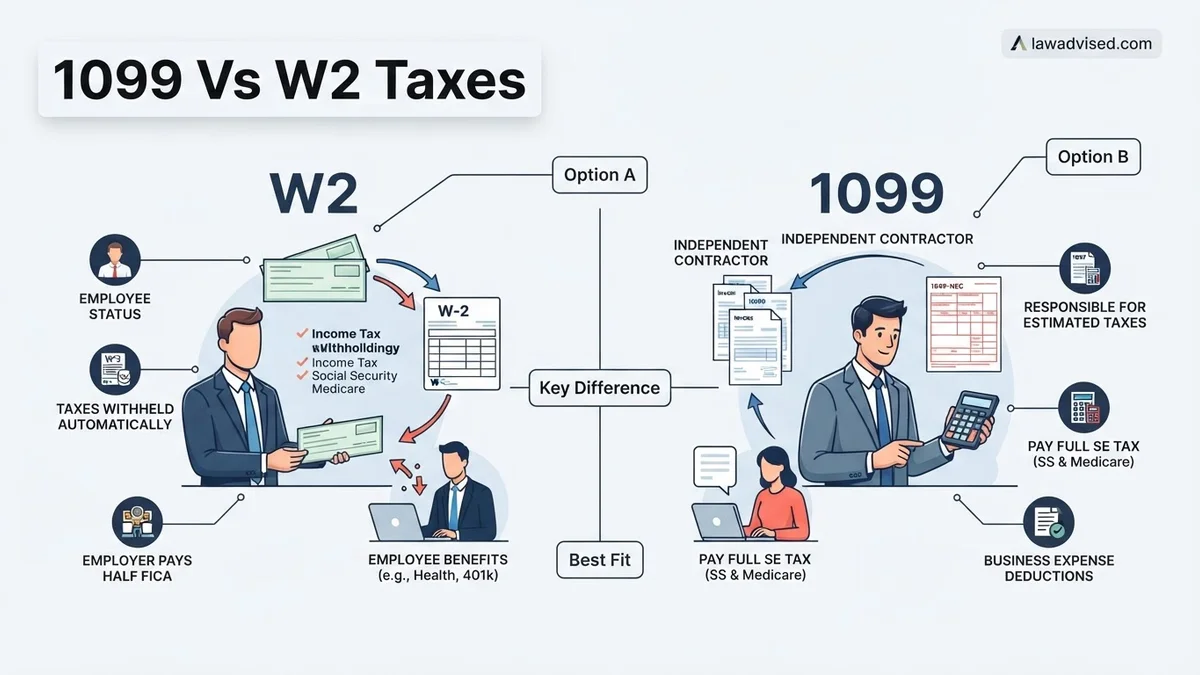
The core difference between 1099 and W-2 taxes comes down to who pays the government. As a W-2 employee, your employer automatically withholds income taxes, Social Security, and Medicare from your paycheck. As a 1099 contractor, you receive your gross pay with zero withholdings, and you are entirely responsible for calculating and paying those taxes yourself.
This distinction changes your tax liability dramatically and directly impacts your real take-home pay. Navigating your tax obligations correctly in 2026 prevents costly underpayment penalties and helps you keep more of your hard-earned money.
Key Takeaways
- 1099 contractors pay a 15.3% self-employment tax covering both Social Security and Medicare.
- W-2 employees have taxes automatically withheld from every paycheck by their employer.
- 1099 workers can deduct ordinary business expenses to lower their taxable income.
- Contractors must make quarterly estimated tax payments to avoid IRS penalties.
- W-2 employees receive employer-subsidized benefits like health insurance and paid time off.
What Causes Tax Liability Differences Between 1099 and W2 Workers
The FICA Tax Burden Shift
Your tax liability changes significantly because of how Social Security and Medicare taxes are handled. W-2 employees split these Federal Insurance Contributions Act (FICA) taxes evenly with their employers. You pay 7.65 percent through payroll deductions, and your employer matches that exact same 7.65 percent behind the scenes.
As a 1099 contractor, you carry the full weight of these taxes through the Self-Employment tax. You must pay both the employee and employer halves, totaling 15.3 percent on your net earnings up to the Social Security wage base limit for 2026. This single difference is why 1099 workers often face a much higher tax bill than W-2 workers making the exact same gross income.
Income Tax Withholding Mechanics
The mechanics of how you pay the IRS create another major divergence in your financial life.
- W-2 Withholding: Your employer acts as a tax collector, skimming income tax out of every single paycheck and sending it straight to the IRS.
- 1099 Estimated Payments: You have no safety net or automatic deductions. You must calculate your income and send quarterly estimated tax payments to the IRS and state tax agencies.
- Year-End Reckoning: W-2 workers usually get a refund or owe a small amount in April. 1099 workers who miss quarterly payments face steep underpayment penalties and massive lump-sum bills.
How to Calculate and Pay Your Taxes Step-by-Step for 1099 and W2
Calculating Your Taxable Income
Computing what you owe requires entirely different formulas depending on your classification. For a W-2 worker, the math is simple because your taxable income is basically your gross box 1 wages minus your standard deduction. Your employer reports this neatly on your Form W-2 in January.
For a 1099 contractor, the calculation starts with your gross receipts on Schedule C, but you get a powerful advantage: business deductions. You subtract ordinary and necessary business expenses—like your home office, software subscriptions, equipment, and a portion of your vehicle use—from your gross income. You only pay income tax and self-employment tax on your net profit.
Executing Your Payment Obligations
Moving from calculation to actual payment involves distinct steps for each worker type.
- Review your paystubs or ledgers: Check your W-2 to ensure year-to-date withholdings match your expectations, or tally your 1099 income minus deductible expenses for the current quarter.
- Determine your filing status and brackets: Apply the 2026 federal income tax brackets to your adjusted gross income.
- Settle the balance: W-2 workers do nothing here as taxes are automated. 1099 workers must log into IRS Direct Pay or use EFTPS to submit quarterly estimated payments by April 15, June 15, September 15, and January 15.
What If Your Take-Home Pay Still Falls Short Due to Self-Employment Costs
When operating under a 1099 classification, overhead expenses can quickly erode net income. Standard W2 workers rarely face business software subscriptions, professional liability insurance, or high-tier self-employment tax obligations out of pocket. If calculated take-home pay still falls short of baseline financial requirements for 2026, structured adjustments are necessary.
Evaluate Rate Structures and Project Pricing
Independent contractors frequently undercharge because they calculate rates based on traditional W2 hourly equivalents. According to industry pricing studies, 1099 professionals must generally charge 25% to 30% more per hour than a comparable W2 salary to account for unpaid time off, health insurance, and administrative overhead. Recalibrating client contracts ensures that gross revenue absorbs the 7.65% matching deficit of the self-employment tax.
Streamline Operational Overhead
Minor recurring software subscriptions and workspace expenses accumulate rapidly. Auditing monthly business expenditures often reveals redundant tools or inefficient vendor pricing. Eliminating unnecessary overhead immediately preserves capital without requiring immediate rate increases across existing client accounts.
How to Maximize Deductions and Optimize Net Income as an Independent Contractor
Strategic tax planning provides the most effective lever for reducing the 1099 tax burden in 2026. Because independent contractors pay both halves of FICA taxes, capturing every legitimate business write-off directly translates to lower adjusted gross income (AGI).
- Track Home Office Expenses Diligently: Calculate deductions using either the simplified method ($5 per square foot up to 300 square feet) or the actual expense method to write off a proportional share of rent, utilities, and internet.
- Utilize Qualified Business Income (QBI) Deductions: Eligible self-employed individuals may deduct up to 20% of their qualified business income directly on their tax returns, subject to 2026 phase-out thresholds and service-business limitations.
- Fund Retirement Accounts Aggressively: Contribute to a Solo 401(k) or a Simplified Employee Pension (SEP) IRA. These vehicles allow high contribution limits that lower taxable income significantly for the current tax year.
What If It Still Doesn’t Work?
If self-employment tax liabilities and operational costs continue to overwhelm cash flow despite strategic deductions, alternative interventions are required. Implement these sequential steps to stabilize financial health:
- Restructure as an S-Corporation: Consult a CPA to evaluate whether electing S-Corp status makes sense once net earnings exceed $80,000 to $100,000, which can significantly reduce self-employment tax exposure.
- Hire a Certified Public Accountant (CPA) or Enrolled Agent (EA): Professional tax representation prevents costly compliance errors and uncovers advanced sheltering strategies. Expect to invest between $400 and $1,200 annually for comprehensive business tax preparation.
- Establish a Dedicated Tax Savings Reserve: Automatically transfer 25% to 30% of every incoming client payment into a separate, high-yield savings account to completely remove the temptation to spend tax-destined funds.
- Re-examine Employment Classification: If a client exercises extensive behavioral and financial control over daily routines, the arrangement may violate independent contractor rules. Request a conversion to W2 status if control matches employee criteria.
Conclusion
Navigating the financial differences between 1099 and W2 taxes requires proactive planning, rigorous expense tracking, and realistic rate-setting. While independent contracting offers operational freedom, the burden of self-employment tax demands disciplined cash flow management and aggressive deduction strategies. According to verified research and tax experts, combining strategic retirement contributions with precise quarterly estimates ensures long-term fiscal stability. Take action today by setting up a dedicated business savings account to automatically withhold your tax obligations.
❓ Frequently Asked Questions
Why do 1099 contractors pay self-employment tax?
Since 1099 contractors are technically self-employed business owners, they do not have an employer to pay the matching half of FICA taxes. Therefore, they must pay both the employer and employee portions, which equals 15.3% for Social Security and Medicare.
How can a 1099 contractor lower their taxable income?
Contractors can significantly lower their tax burden by tracking and deducting legitimate business expenses such as home office use, software subscriptions, professional development, and equipment.
What happens if a 1099 worker misses a quarterly tax payment?
Missing quarterly estimated tax deadlines can result in underpayment penalties and interest charges assessed by the IRS when you file your annual tax return.
Are health insurance premiums deductible for 1099 workers?
Yes, self-employed individuals can often claim the self-employed health insurance deduction, allowing them to deduct premiums paid for medical, dental, and qualifying long-term care insurance.
Can an employer choose whether to classify me as W-2 or 1099?
No, worker classification is determined by the IRS and Department of Labor based on the degree of behavioral and financial control the company exercises over your work, not by mutual agreement.
How does W-2 tax withholding get calculated?
W-2 withholding is determined by the information you provide on Form W-4 when you start a job, including your filing status, dependents, and any additional withholding amounts requested.

Ismail Hossain is the founder of Law Advised. He is an Divorce, Separation, marriage lawyer. Follow him.