Taxes on Bond Income A Step-by-Step Guide to 2026
Navigating taxes on bond income requires understanding how different issuers—such as the federal government, municipalities, and corporations—are taxed at various government levels. Interest income is typically taxed at ordinary income rates, while municipal bond interest often enjoys federal and state tax exemptions. Capital gains apply differently depending on whether bonds are sold before maturity or held to the end of their term.
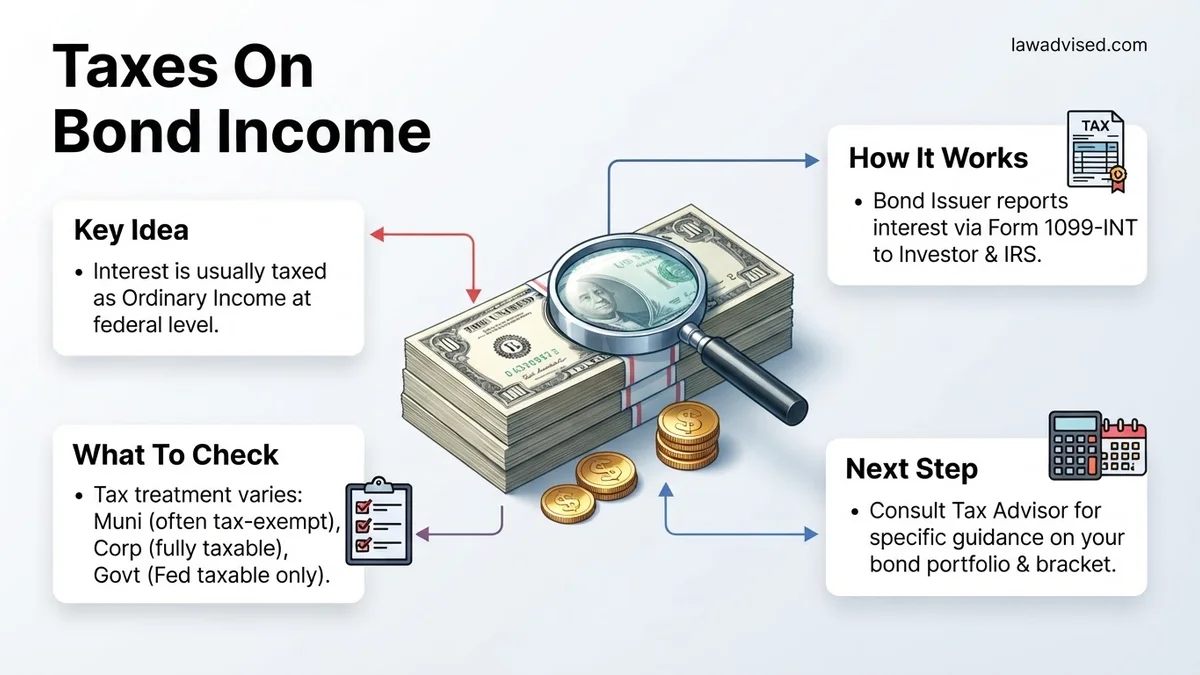
Bond income is taxed based entirely on who issues the debt. U.S. Treasury bonds are subject to federal income tax, but completely exempt from state and local taxes. Corporate bonds, on the other hand, get hit with taxes at every single level: federal, state, and local.
Municipal bonds typically offer complete freedom from federal taxes, and often state taxes if you live in the issuing state. Navigating these rules in 2026 requires understanding your specific portfolio mix to avoid unexpected tax bills. Knowing how each tier treats your interest changes your actual net yield.
Key Takeaways
- Corporate bond interest is fully taxable at federal, state, and local levels.
- U.S. Treasury interest is subject to federal income tax but exempt from state and local taxes.
- Municipal bond interest is generally exempt from federal taxes and often state taxes if issued in your home state.
- Selling a bond before maturity triggers capital gains or losses rather than standard interest taxation.
- Zero-coupon bonds and TIPS require paying taxes on ‘phantom’ interest before receiving cash payouts.
What Causes High Taxes on Bond Income: Understanding Issuer Rules
Federal, State, and Local Tax Intersections
Your ultimate tax liability depends on the intersection of government jurisdictions. Corporate bonds face the harshest treatment because federal tax brackets can reach up to 37 percent in 2026, plus your state and local income taxes.
- Treasuries: Taxed at federal rates only; exempt from state and local levies.
- Corporates: Fully taxable across federal, state, and local returns.
- Municipalities: Generally exempt from federal taxes and state taxes if you reside where they were issued.
Special Cases: TIPS and Zero-Coupon Bonds
Some bonds create phantom income that you must pay taxes on before you actually receive the cash. Treasury Inflation-Protected Securities (TIPS) adjust their principal upward with inflation, and that adjustment is taxed as interest income annually.
Zero-coupon bonds do not pay periodic interest. Instead, you pay taxes on imputed “phantom” interest annually through Original Issue Discount (OID) rules, even though the cash is only paid out at maturity in 2026 or later.
How to Calculate and File Taxes on Bond Interest Income Step-by-Step
Step 1: Gathering Form 1099-INT and OID Documents
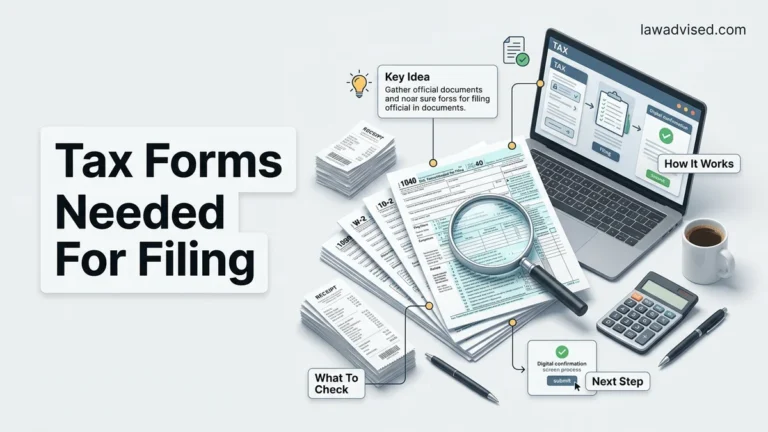
Your broker will issue tax forms in early 2026 detailing your bond earnings for the previous year. Form 1099-INT reports standard interest payments, while Form 1099-OID details original issue discount income for zero-coupon or discounted bonds.
- Box 1 of Form 1099-INT shows taxable interest income.
- Box 3 reports US Treasury interest, which you must manually subtract on your state tax return.
- Box 8 shows tax-exempt interest from municipal bonds, which you still must report on your federal return for informational purposes.
Step 2: Completing Schedule B and Form 1040
Once you have your totals, transfer the data to your tax software or paper forms. If your total taxable interest exceeds 1,500 dollars, you must itemize individual payers on Schedule B of your Form 1040.
Double-check your state tax software inputs to ensure Treasury interest is properly excluded from your state adjusted gross income. For municipal bond holders, ensure tax-exempt amounts flow correctly to line 2a of Form 1040 to keep your modified adjusted gross income accurate.
How to Manage Capital Gains and Losses When Selling Bonds Before Maturity
Selling a bond on the secondary market before its maturity date introduces a new layer of tax complexity for 2026. Unlike holding a bond to term, an early sale triggers either a capital gain or a capital loss. Understanding these dynamics helps you offset tax liabilities and maximize your net returns.
Step 1: Calculate Your Cost Basis
Your capital gain or loss depends entirely on your adjusted cost basis. Follow these steps to determine your exact profit or loss:
- Start with the original purchase price of the bond.
- Add any accrued market discount that you have already reported as taxable income, if applicable.
- Subtract any amortized bond premium that you previously used to offset interest income.
- Compare this final adjusted cost basis against your actual sale price on the secondary market.
Step 2: Apply the Holding Period Rules
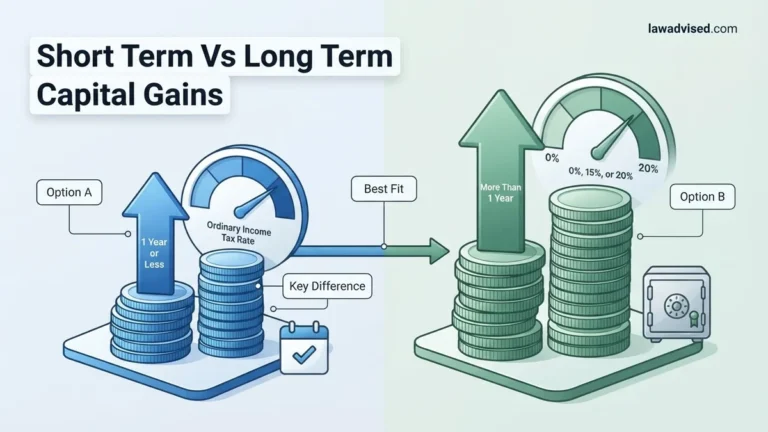
Once you establish your net gain or loss, classify it based on how long you held the asset. According to Internal Revenue Service guidelines, bonds held for one year or less generate short-term capital gains, which are taxed at ordinary income rates up to 37 percent in 2026. Bonds held for longer than one year qualify for long-term capital gains rates of 0, 15, or 20 percent, depending on your total taxable income. You can use capital losses to offset capital gains dollar-for-dollar, plus up to $3,000 of ordinary income per year.
What If Your Bond Yields Trigger Unexpected State or Local Tax Liabilities
Many investors assume that municipal bonds are entirely tax-free, but this assumption often leads to unexpected state and local tax bills. While federal tax exemptions apply to most municipal bond interest, state-level exemptions typically require you to purchase bonds issued within your specific state of residence.
Step 1: Review Out-of-State Municipal Holdings
If you live in high-tax states like California, New York, or New Jersey and hold municipal bonds issued by other states, your interest income remains subject to state and local income taxes. Follow these steps to audit your portfolio:
- Examine the prospectus or your brokerage 1099-INT form to identify the geographic origin of each municipal bond holding.
- Isolate the portion of your interest income generated by out-of-state municipal issuers.
- Calculate your effective state tax rate applied to that specific out-of-state interest stream.
- Reallocate your fixed-income portfolio toward in-state municipal bond funds if state tax minimization is a primary objective for 2026.
What If It Still Doesn’t Work?
Navigating complex fixed-income taxation rules can occasionally lead to reporting discrepancies or unresolved tax exposure. If standard software and self-audit steps fail to clarify your 2026 bond tax liabilities, use the following fallback measures:
- Request a corrected Form 1099-INT or 1099-OID directly from your brokerage firm if cost basis tracking appears inaccurate.
- Cross-reference your brokerage statements with historical secondary market transaction confirmations to manually verify original purchase prices.
- Consult a Certified Public Accountant or a Certified Financial Planner who specializes in fixed-income tax strategies. Professional tax preparation fees for complex investment portfolios typically range from $400 to $1,500 depending on the volume of transactions.
- File for an IRS tax extension if unresolved reporting errors prevent you from submitting an accurate return by the standard deadline.
Conclusion
Managing taxes on bond income requires careful attention to federal brackets, state residency rules, and secondary market capital gains. By systematically tracking your cost basis and leveraging tax-advantaged municipal allocations, you can protect your fixed-income returns from unnecessary erosion. According to verified research and expert tax sources, proactive portfolio structuring remains the most effective method for minimizing total tax liability. Take the next step today by downloading your latest brokerage tax statements and auditing your current bond allocations for 2026.
❓ Frequently Asked Questions
How does the de minimis rule affect bond discount taxation?
The de minimis rule dictates that if a bond is purchased at a discount smaller than a specific statutory threshold, the discount is taxed as capital gain upon sale or maturity rather than ordinary income. If the discount exceeds this threshold, it must be accreted and taxed as ordinary income annually.
What are the tax implications of holding bonds in tax-advantaged accounts?
Holding bonds inside a traditional or Roth IRA shields your interest income and capital gains from immediate taxation. Traditional IRAs defer taxes until withdrawal, while Roth IRAs allow for completely tax-free withdrawals in retirement.
Are Treasury Inflation-Protected Securities (TIPS) subject to unique tax rules?
Yes, TIPS require you to pay annual federal income tax on both the periodic coupon interest and the inflation-adjusted increase in the bond’s principal value, even though you do not receive the principal adjustment in cash until maturity.
How do bond mutual funds and ETFs handle tax reporting?
Bond funds distribute interest dividends and capital gains to investors annually, typically reported on a Form 1099-DIV. Even if you reinvest these distributions into more shares, you must report and pay taxes on them for that tax year.
What happens to bond tax obligations when a bond is called early?
When a callable bond is redeemed early by the issuer, you receive the principal plus any call premium. Any unamortized bond premium or original issue discount rules are finalized at that point, triggering immediate tax events on the realized gains or losses.
Does out-of-state municipal bond interest ever face taxation?
Yes, if you purchase municipal bonds issued by a state other than your state of residence, the interest is typically exempt from federal income tax but subject to your home state’s income tax.

Ismail Hossain is the founder of Law Advised. He is an Divorce, Separation, marriage lawyer. Follow him.