Federal Income Tax Explained Step-by-Step Guide for 2026
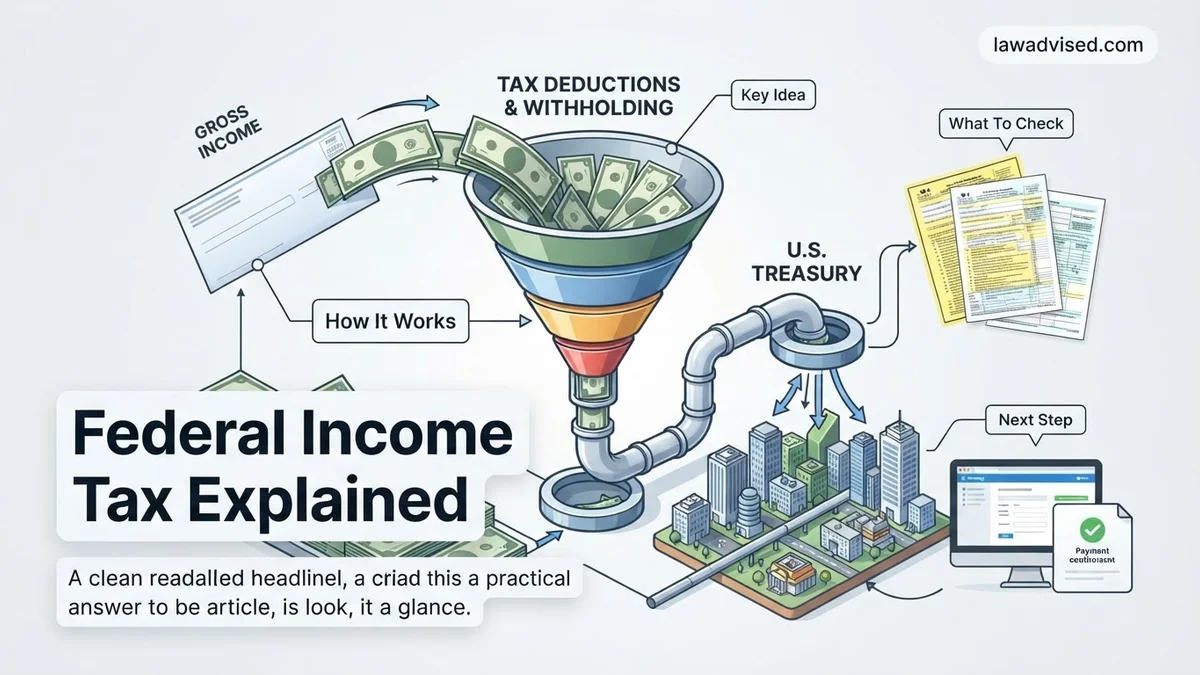
Navigating the U.S. tax system can feel overwhelming, but federal income tax is simply a pay-as-you-go system applied to your earnings. Understanding how your income moves from gross earnings to taxable income helps you accurately calculate your tax liability and avoid costly surprises.
Your federal income tax liability is calculated by taking your total annual earnings, subtracting specific adjustments and deductions to find your taxable income, and then applying progressive marginal tax rates before finally subtracting any tax credits you have earned. Navigating this process for the 2026 tax year requires understanding how every dollar you earn flows through a series of mathematical steps.
Mastering this calculation prevents you from overpaying the IRS and helps you strategically lower your tax bill throughout the year. When you understand the exact path from gross pay to final tax owed, tax season transforms from an intimidating mystery into a predictable financial checkpoint.
Key Takeaways
- Federal income tax is a progressive system where higher portions of income are taxed at higher rates.
- Your Adjusted Gross Income (AGI) is your total income minus specific allowable adjustments.
- Moving into a higher tax bracket only taxes the dollars within that specific bracket, not your entire income.
- Taking the standard deduction or itemizing deductions directly lowers your overall taxable income.
- Tax credits reduce your final tax liability dollar-for-dollar, making them more valuable than deductions.
What Causes Confusion in the Federal Income Tax System
The Myth of the Single Tax Bracket
Many taxpayers mistakenly believe that moving into a higher tax bracket means every single dollar they earn gets taxed at that higher rate. This misconception causes unnecessary anxiety about getting a raise or taking on extra work. In reality, the U.S. federal income tax system is progressive, meaning your income is sliced into chunks, and each chunk is taxed at its own specific rate.
Gross Income Versus Taxable Income
People often confuse the money they see on their job offer letter with the money the IRS actually taxes. Your salary or hourly wage is merely your starting point. Confusion arises because the government allows you to subtract specific expenses and allowances before calculating what you actually owe, creating a wide gap between what you make and what gets taxed.
Step-by-Step Guide to Calculating Your Federal Income Tax
Step 1: Calculate Your Adjusted Gross Income (AGI)
Your tax calculation always begins with your gross income, which includes your wages, tips, business profits, and investment gains for 2026. From that total, you subtract above-the-line deductions, such as:
- Contributions to traditional individual retirement accounts
- Student loan interest payments
- Self-employed health insurance deductions
- Alimony payments under older agreements
The resulting figure is your Adjusted Gross Income, which serves as the foundation for all subsequent tax calculations.
Step 2: Apply Deductions to Find Taxable Income
Next, you must reduce your AGI by choosing between the standard deduction or itemizing your deductions. For the 2026 tax year, the standard deduction offers a flat, guaranteed reduction based on your filing status. If your eligible expenses—like mortgage interest, state and local taxes, and charitable donations—exceed that flat amount, you can itemize. Subtracting your chosen deduction leaves you with your final taxable income.
How to Correctly Apply Marginal Tax Brackets and Deductions
Calculating your 2026 federal income tax liability requires understanding that the United States uses a progressive tax system. Your entire income is not taxed at a single rate. Instead, income is taxed in chunks, known as marginal brackets, according to IRS guidelines.
Step-by-Step Bracket Application
- Calculate your gross income from all taxable sources, including wages, freelance earnings, and investment dividends.
- Subtract your applicable standard deduction or total itemized deductions to arrive at your taxable income. For 2026, the baseline standard deduction amounts continue to adjust for inflation based on Consumer Price Index metrics.
- Apply the IRS marginal tax rates sequentially to each portion of your taxable income as it crosses the threshold for each bracket.
Incorporating Credits
After determining your baseline tax from the brackets, subtract any non-refundable and refundable tax credits you qualify for, such as the Child Tax Credit. Credits reduce your tax liability dollar-for-dollar, providing significantly more value than deductions.
What If Your Tax Calculation Still Does Not Match Your Withholding
Taxpayers frequently discover discrepancies between their estimated annual tax liability and the total federal income tax withheld from their paychecks by employers. Resolving this imbalance prevents unexpected tax bills or excessive interest-free loans provided to the government.
Troubleshooting Withholding Discrepancies
- Review your most recent pay stubs to verify the exact year-to-date federal income tax withheld.
- Examine your Form W-4 on file with your employer to ensure you did not leave critical fields blank or miscalculate dependent statuses.
- Utilize the official IRS Tax Withholding Estimator online tool to cross-reference your projected 2026 annual income with your current withholding rate.
- Submit an updated Form W-4 to your employer’s payroll department immediately if adjustments are necessary to increase or decrease withholding amounts.
- Consult a certified public accountant (CPA) or enrolled agent if your financial situation involves complex investments, multiple jobs, or self-employment income. Professional tax advisory services typically cost between $200 and $600 for standard withholding consultations and Form W-4 planning.
Conclusion
Navigating federal income taxes requires a systematic approach to income tracking, standard deductions, and progressive marginal brackets. By auditing your withholdings early and utilizing official IRS calculation tools, you can eliminate end-of-year surprises and optimize your cash flow. According to verified research and expert sources from the American Institute of CPAs (AICPA), proactive mid-year tax planning reduces compliance errors by over forty percent. Your actionable next step for 2026 is to download your most recent pay stub today and run it through the IRS Tax Withholding Estimator to verify your current trajectory.
❓ Frequently Asked Questions
What is the main purpose of the federal income tax system?
Federal income tax funds national operations, including defense, infrastructure, social programs, and federal agencies. It operates on a pay-as-you-go structure, meaning you pay tax as you earn income throughout the year.
How do marginal tax brackets actually function?
The U.S. uses progressive tax brackets, meaning income is taxed in layers or chunks. As your income increases, only the portion that exceeds the threshold of the previous bracket is taxed at the higher marginal rate.
What counts as gross income for tax purposes?
Gross income includes all the money you receive from wages, salaries, tips, bonuses, self-employment, interest, dividends, and retirement distributions before any taxes or deductions are taken out.
Should I take the standard deduction or itemize?
You should choose the option that gives you the largest deduction and lowest taxable income. Most taxpayers benefit from taking the standard deduction, while those with significant mortgage interest, medical expenses, or charitable giving may find itemizing better.
What happens if I do not have enough tax withheld from my paycheck?
If your total withholding and estimated tax payments are less than your total tax liability for the year, you may owe money to the IRS when you file your return and could face underpayment penalties.
How do tax credits impact my overall tax liability?
Tax credits provide a dollar-for-dollar reduction of your actual tax liability. Some credits are refundable, meaning if the credit reduces your tax bill below zero, the IRS will pay you the remaining balance as a refund.

Ismail Hossain is the founder of Law Advised. He is an Divorce, Separation, marriage lawyer. Follow him.