Tax Filing Status Explained 2026 A Proven Expert Guide
Your tax filing status determines your standard deduction amount, tax brackets, and eligibility for key tax credits. Choosing the correct IRS status is critical to ensuring you never overpay or underpay on your annual return.
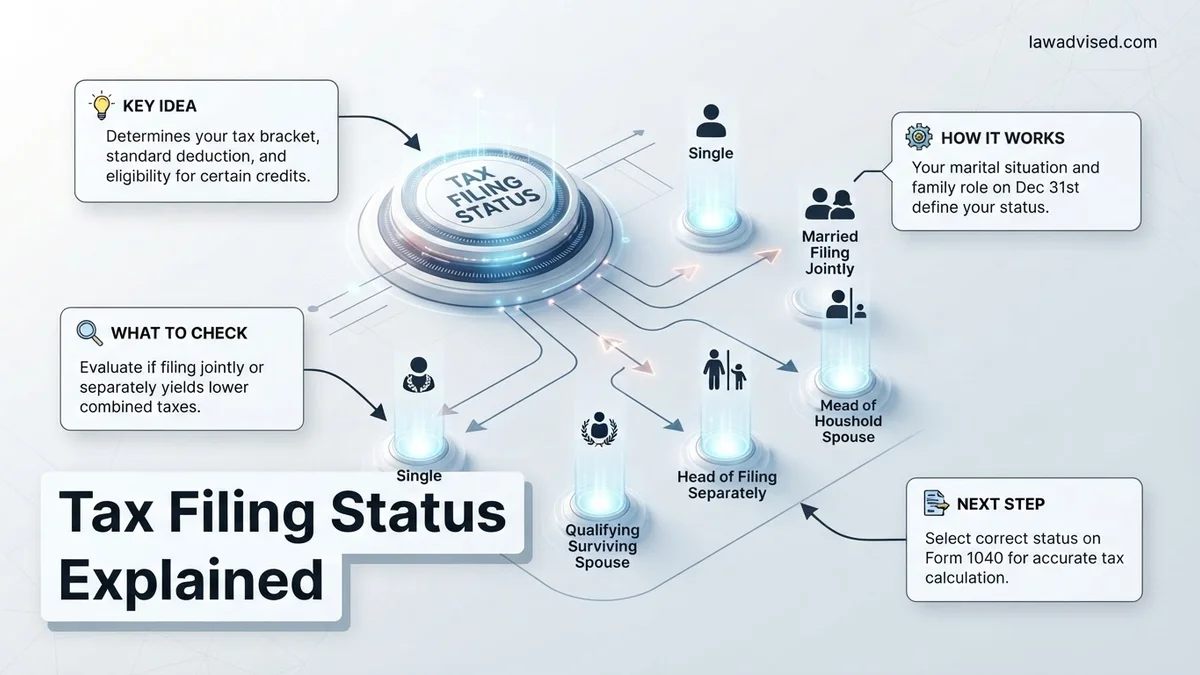
Your federal tax filing status determines your standard deduction amount, your tax brackets, and your eligibility for valuable credits like the Earned Income Tax Credit. The IRS recognizes five distinct filing statuses: Single, Married Filing Jointly, Married Filing Separately, Head of Household, and Qualifying Surviving Spouse.
Your status is legally locked in based on your marital status and household situation on the exact last day of the tax year, December 31, 2026. Choosing the correct status prevents costly processing delays, IRS audits, and ensures you never pay a dollar more in taxes than legally required.
Key Takeaways
- Your marital status on the last day of the tax year dictates your options.
- Head of Household offers higher standard deductions than Single status for qualifying unmarried individuals.
- Married Filing Jointly typically provides the lowest overall tax liability for married couples.
- Qualifying Surviving Spouse allows widows or widowers to use joint tax rates for two years.
- If more than one filing status applies, strict IRS tie-breaker rules determine the correct category.
What Causes Filing Status Errors on Your Tax Return
Filing status mistakes trigger automated IRS notices and delay your tax refund. Most errors happen because taxpayers misunderstand legal definitions or assume their status changes mid-year.
Misunderstanding Marital Status Rules on December 31
The IRS does not care what your status was for the first eleven months of the year. If you finalized a divorce on December 30, 2026, you are considered unmarried for the entire 2026 tax year.
- Legal separation: Living apart from your spouse without a finalized decree of divorce or separate maintenance means you are still married in the eyes of the IRS.
- Annulments: An annulment legally erases the marriage, requiring you to amend past returns to a Single or Head of Household status.
Misapplying Head of Household Criteria
Head of Household offers a higher standard deduction than Single status, making it a frequent target for incorrect filings. Claiming this status requires meeting strict household support tests.
- Dependent requirement: You must pay more than half the cost of keeping up a home for a qualifying dependent, such as a child or parent.
- The deserted spouse exception: Married individuals can sometimes file as Head of Household if they lived apart from their spouse for the last six months of 2026 and paid over half the home maintenance costs.
How to Fix Your Tax Filing Status Selection Step-by-Step
Selecting the right status requires a systematic review of your life events and household finances. Follow this decision framework before submitting your 2026 return.
Step 1: Evaluate Your Legal Marital Status
Start by identifying your legal status on December 31, 2026. This eliminates three of the five options immediately.
- If you were unmarried, legally divorced, or legally separated under a decree, choose Single (or Head of Household if you support dependents).
- If you were legally married, decide whether to file a joint return to maximize tax savings or separate returns to isolate liability.
Step 2: Test for Head of Household Qualification
If you are unmarried or considered unmarried, test your household expenses against IRS guidelines to claim Head of Household.
- Calculate your annual rent, mortgage interest, utilities, property taxes, and grocery costs to prove you paid over 50 percent.
- Verify that your qualifying dependent lived with you in the main home for more than half of 2026, barring temporary absences for school or medical care.
How to Navigate Complex Head of Household Qualification Rules
The Head of Household filing status offers a higher standard deduction and more favorable tax brackets than filing as Single. However, IRS compliance audits on this status remain exceptionally stringent for the 2026 tax year. Taxpayers must meet three strict criteria: being unmarried on the last day of the year, paying more than half the cost of keeping up a home, and having a qualifying dependent living in that home for more than half the year.
Meeting the Cost of Keeping Up a Home
According to Internal Revenue Service guidelines, maintaining a home means paying more than 50 percent of the total household expenses. Eligible expenses include rent, mortgage interest, real estate taxes, property insurance, utilities, repairs, maintenance, and groceries consumed on the premises. Quantifying these numbers requires meticulous record-keeping. Tax experts recommend compiling annual expense ledgers before beginning the 2026 tax preparation process to withstand potential compliance checks.
Qualifying Person Requirements
The qualifying person must generally be your unmarried child, grandchild, or stepchild whom you can claim as a dependent. Alternatively, a dependent parent can qualify you for Head of Household status even if they do not live in your household, provided you pay more than half the cost of maintaining their main home. Bureau of Labor Statistics and tax research data indicate that incorrect dependent classifications account for a significant percentage of filing errors, making careful verification essential.
What If It Still Doesn’t Work and You Qualify for Multiple Statuses?
Taxpayers occasionally discover they qualify for more than one filing status, such as both Qualifying Surviving Spouse and Head of Household. When a taxpayer meets the criteria for multiple statuses in 2026, navigating the rules requires a structured approach to ensure maximum tax savings and complete regulatory compliance. Use these steps to resolve ambiguous filing status scenarios:
- Review the official IRS priority rules for overlapping statuses, noting that specific designations like Married Filing Jointly almost always supersede individual categories.
- Run dual tax calculations using certified software or a worksheet to compare the effective tax liability and standard deduction amounts of each eligible status.
- Consult a certified public accountant (CPA) or an enrolled agent if your marital status changed late in 2026 or involves complex multi-state dependent residency rules.
- Budget for professional tax advisory fees, which typically range from $300 to $750 for complex individual returns involving contested filing statuses.
- File an amended return using Form 1040-X if a status error is discovered after submission, keeping in mind the standard three-year statute of limitations.
Conclusion
Choosing the correct tax filing status is the foundational step for accurate return preparation, directly influencing your standard deduction and tax bracket for 2026. Selecting an incorrect category triggers automated processing delays and potential IRS correspondence. According to verified research and expert sources from leading financial institutions, reviewing your specific household and marital dynamics annually prevents costly adjustments. Your single actionable next step is to evaluate your 2026 living arrangements and financial support contributions against current IRS guidelines before finalizing your paperwork.
❓ Frequently Asked Questions
How does my tax filing status impact my overall tax brackets?
Each filing status applies to a distinct set of income thresholds that define your tax brackets. For example, married couples filing jointly face wider income brackets for each tax rate compared to single filers, which often results in lower overall tax liability.
What if my spouse and I get divorced on December 31?
Under IRS rules, if your divorce is finalized by the last day of the tax year, you are considered unmarried for the entire year. You must file as Single or Head of Household if you meet the specific dependent requirements.
Can I change my tax filing status after I file my return?
Yes, you can change your filing status by filing an amended return using Form 1040-X. This must generally be done within three years of the original filing deadline or two years from the date the tax was paid.
What criteria make someone a qualifying dependent for Head of Household status?
To qualify for Head of Household, your dependent must generally be a qualifying child who lived with you for more than half the year, or a qualifying relative whom you can claim as an exemption and who meets specific financial support tests.
Is Married Filing Separately ever better than Married Filing Jointly?
While Married Filing Jointly is financially advantageous for most couples, filing separately may make sense if you want to be responsible only for your own taxes, or if one spouse has exceptionally high medical expenses relative to their income.
How long can a widowed taxpayer use the Qualifying Surviving Spouse status?
You can use the Qualifying Surviving Spouse status for the two tax years following the year your spouse passed away, provided you did not remarry and you maintain a home for a dependent child.

Ismail Hossain is the founder of Law Advised. He is an Divorce, Separation, marriage lawyer. Follow him.