Seatbelt Laws in Arkansas 2027 Expert Compliance Guide
Navigating seatbelt laws in Arkansas requires understanding strict primary enforcement rules that apply to drivers and front-seat passengers. Failing to comply results in mandatory fines and legal penalties that every motorist must know to stay compliant.
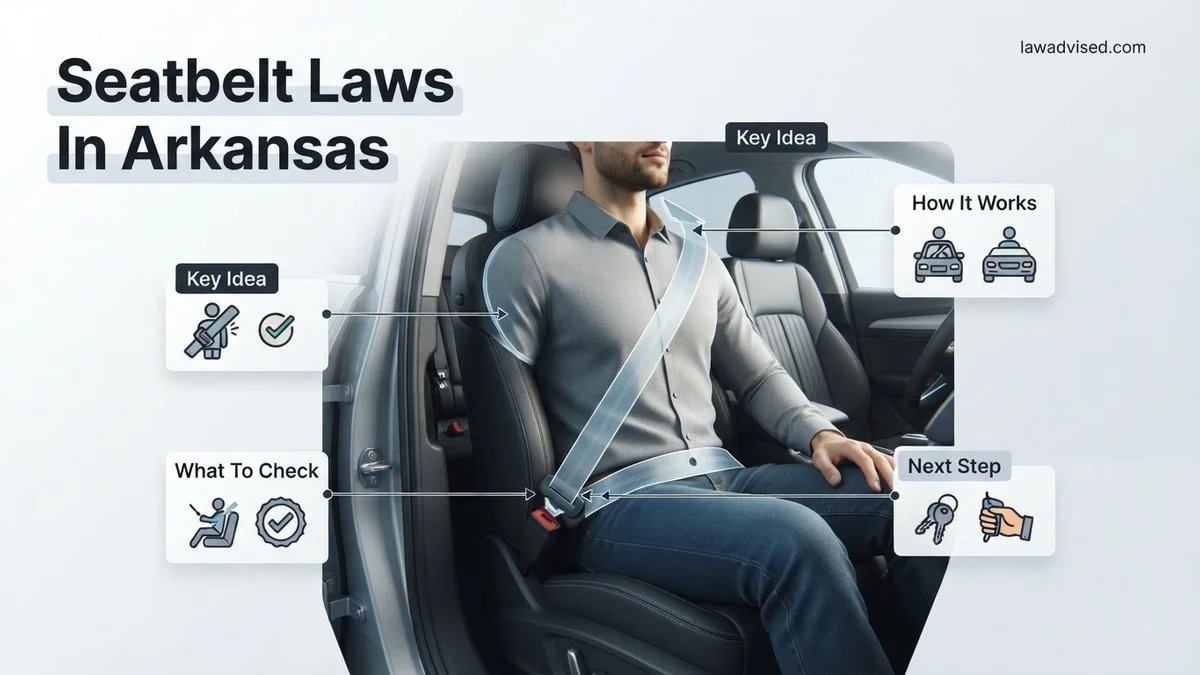
Arkansas law mandates that every driver and front-seat passenger must wear a properly adjusted and fastened seatbelt whenever the vehicle is in motion on public streets and highways. As of 2027, the Arkansas Office of Highway Safety maintains strict primary enforcement rules, meaning law enforcement officers can pull you over solely for observing an unbuckled occupant, even if no other traffic violation occurred.
Understanding these specific legal requirements helps you avoid costly traffic stops, steep fines, and potential liability issues during accidents. Whether you are driving your daily commute or navigating a road trip through the Natural State, staying compliant with local restraint statutes keeps you legally protected and financially secure.
Key Takeaways
- Arkansas utilizes primary enforcement laws for front-seat occupants.
- Drivers and front-seat passengers must wear seatbelts at all times.
- Standard seatbelt violation fines are typically $25 plus court costs.
- Children under age 15 must be properly restrained in the rear seat.
- Specific medical exemptions require a signed physician statement.
What Causes Seatbelt Violations and Legal Penalties in Arkansas
Primary Enforcement and Officer Stop Triggers
Arkansas operates under a primary enforcement seatbelt law. If a police officer spots you or your front-seat passenger driving without a belt in 2027, they have the legal authority to initiate a traffic stop immediately. You do not need to be speeding or swerving for an officer to issue a citation. This makes consistent buckling an absolute priority every time you put your vehicle in drive.
Fine Structures and Ticket Costs
Fines for violating Arkansas seatbelt laws remain straightforward, but they can still impact your wallet. A standard citation for failing to wear a seatbelt typically carries a fine of 25 dollars. While the base fine might seem modest, court costs and administrative fees often push the total out-of-pocket expense much higher. Furthermore, multiple violations or non-compliance regarding child passengers can trigger escalated scrutiny from traffic courts.
- Base fine of $25 for adult front-seat violations
- Additional court costs and local fees apply
- Primary enforcement allows stops without other infractions
How to Fix Compliance Issues and Understand Arkansas Restraint Rules
Age and Seating Position Requirements
Arkansas law divides restraint requirements strictly by age and where a person sits inside the vehicle. Drivers and front-seat passengers must always wear seatbelts. For younger passengers, the rules scale according to physical development:
- Children under the age of 6 or weighing less than 60 pounds must ride in an approved child safety seat in the rear of the vehicle.
- Children ages 6 through 15 must be secured in a seatbelt or an appropriate booster seat regardless of where they sit.
- Back-seat adult passengers are not currently covered by primary enforcement laws for general seatbelts, but all minors must be properly restrained at all times.
Corrective Steps After Receiving a Citation
If you receive a seatbelt ticket in Arkansas, ignoring it leads to harsher penalties like a suspended driver’s license. To resolve the issue, you must pay the fine by the specified appearance date or appear in court to contest the charge. If the citation involved an improperly installed child safety seat, many local jurisdictions allow you to dismiss the ticket by proving you have since acquired and correctly installed an approved device.
Step-by-Step Guide to Child Safety Seat Requirements in Arkansas
Navigating Arkansas child passenger safety laws requires strict adherence to age, weight, and height milestones. According to the Arkansas Department of Transportation and pediatric safety experts, transitioning a child prematurely increases the risk of severe injury during a collision.
Rear-Facing Seat Mandates
State regulations dictate that infants and toddlers must ride in a rear-facing child safety seat until they reach at least two years of age. Safety advocates strongly recommend keeping children rear-facing until they outgrow the maximum height and weight limits specified by the seat manufacturer, often extending well past their second birthday.
Forward-Facing and Booster Transitions
Once a child outgrows the rear-facing limits, caregivers must follow a precise progression to maintain full legal compliance under 2027 standards:
- Utilize a forward-facing harness restraint system from age two until at least age five, ensuring the internal harness is properly snug.
- Transition to a belt-positioning booster seat when the child exceeds the forward-facing weight limits, maintaining booster use until they reach 4 feet 9 inches in height.
- Verify that the vehicle lap and shoulder seat belt fits across the upper thighs and chest correctly without resting on the neck or stomach.
What If You Get Pulled Over: Managing Citations and Fines
Being stopped by law enforcement for a seatbelt violation in Arkansas triggers specific legal and financial consequences. Because Arkansas enforces a primary seatbelt law, officers can pull motorists over solely for observing an unbuckled occupant.
Understanding Fine Structures and Court Costs
Failing to comply with Arkansas seatbelt statutes results in standard statutory penalties. Drivers should anticipate the following administrative realities:
- Receive a standard fine of $25 for a driver or front-seat passenger infraction, which applies per unbuckled occupant in the vehicle.
- Incur additional mandatory court costs and administrative fees that frequently push the total financial out-of-pocket expense past $100 per citation.
- Understand that secondary enforcement applies to rear-seat passengers aged 15 and older, though primary enforcement covers all front-seat occupants regardless of age.
What If Your Child Safety Compliance Check Fails?
If initial attempts to properly install a child safety seat or resolve a compliance issue fail during an inspection, motorists must take immediate corrective action. Ignoring a faulty setup compromises both child safety and legal standing on Arkansas roadways.
- Visit a certified Child Passenger Safety (CPS) inspection station, typically hosted at local fire stations or hospitals, for a hands-on professional evaluation.
- Utilize community resources where technicians inspect installations at no charge, though replacing a damaged or expired seat may incur costs.
- Purchase a replacement child restraint system if the current model is expired, structurally compromised, or was involved in a moderate-to-severe crash, with replacement costs ranging from $50 for basic boosters to $300 for all-in-one convertible seats.
- Consult the vehicle owner manual alongside the car seat manual to resolve persistent LATCH system incompatibilities or improper seatbelt routing errors.
Conclusion
Adhering to Arkansas seatbelt and child passenger laws protects vehicle occupants and prevents costly traffic citations. By maintaining proper restraints for every passenger, drivers ensure maximum protection on the road. According to verified research and expert sources from the National Highway Traffic Safety Administration, consistent seatbelt use reduces the risk of fatal injury to front-seat passenger car occupants by 45 percent. Take the actionable next step today by inspecting every seatbelt and child safety restraint in your vehicle to guarantee total compliance.
❓ Frequently Asked Questions
What is the primary enforcement policy for seatbelts in Arkansas?
Arkansas enforces a primary seatbelt law for the driver and front-seat passengers. This grants law enforcement officers the authority to stop a vehicle solely because an occupant in the front seat is not wearing a seatbelt.
Who is legally required to wear a seatbelt in an Arkansas vehicle?
The driver and all front-seat passengers of any motor vehicle operated on Arkansas streets and highways must wear a properly adjusted and fastened seatbelt at all times while the vehicle is in motion.
What happens if a passenger under 15 is unbelted?
Drivers can be cited if any passenger under the age of 15 is not properly restrained by a seatbelt or appropriate child safety seat anywhere in the vehicle.
Do out-of-state drivers have to follow Arkansas seatbelt laws?
Yes, all motorists and visitors driving within Arkansas state borders must strictly adhere to local traffic and seatbelt regulations, regardless of where their vehicle is registered.
Does a seatbelt ticket in Arkansas add points to your driver’s license?
Seatbelt violations in Arkansas generally do not add driving record points to your license, but they do result in standard monetary fines and court costs.
What specific child car seat stages are mandated in Arkansas?
Arkansas law requires rear-facing seats for infants, forward-facing seats for toddlers meeting weight limits, and booster seats for older children until they reach age 6 or 60 pounds, transitioning to standard belts thereafter.

Ismail Hossain is the founder of Law Advised. He is an Divorce, Separation, marriage lawyer. Follow him.