Motorcycle Laws in Arkansas 2027 Expert Safety Guide
Understanding motorcycle laws in arkansas is essential for staying legal and safe on the road. This guide covers mandatory helmet rules for riders under 21, proper licensing steps, and necessary equipment regulations for 2027.
Arkansas motorcycle laws in 2027 demand your strict attention if you want to avoid costly traffic citations and keep your riding privileges intact. Whether you are carving through the Ozark twisties or commuting through Little Rock, compliance with state statutes regarding safety gear, licensing, and machine modifications is mandatory.
Navigating the legal framework of the Natural State does not have to be complicated. By breaking down Arkansas statutes into clear operational rules, you can protect yourself legally and financially while enjoying the open road.
Key Takeaways
- Arkansas law requires riders and passengers under age 21 to wear a DOT-approved helmet.
- All operators must hold a valid Class M motorcycle license or endorsement to ride legally.
- Mandatory equipment includes at least one rearview mirror, working headlights, and taillights.
- Lane splitting and filtering are strictly illegal on all Arkansas roadways and highways.
- Eye protection, such as safety glasses or a face shield, is required unless the bike has a windscreen.
What Causes Legal Violations and Confusion Regarding Arkansas Motorcycle Laws
Misunderstandings About the Arkansas Helmet Mandate
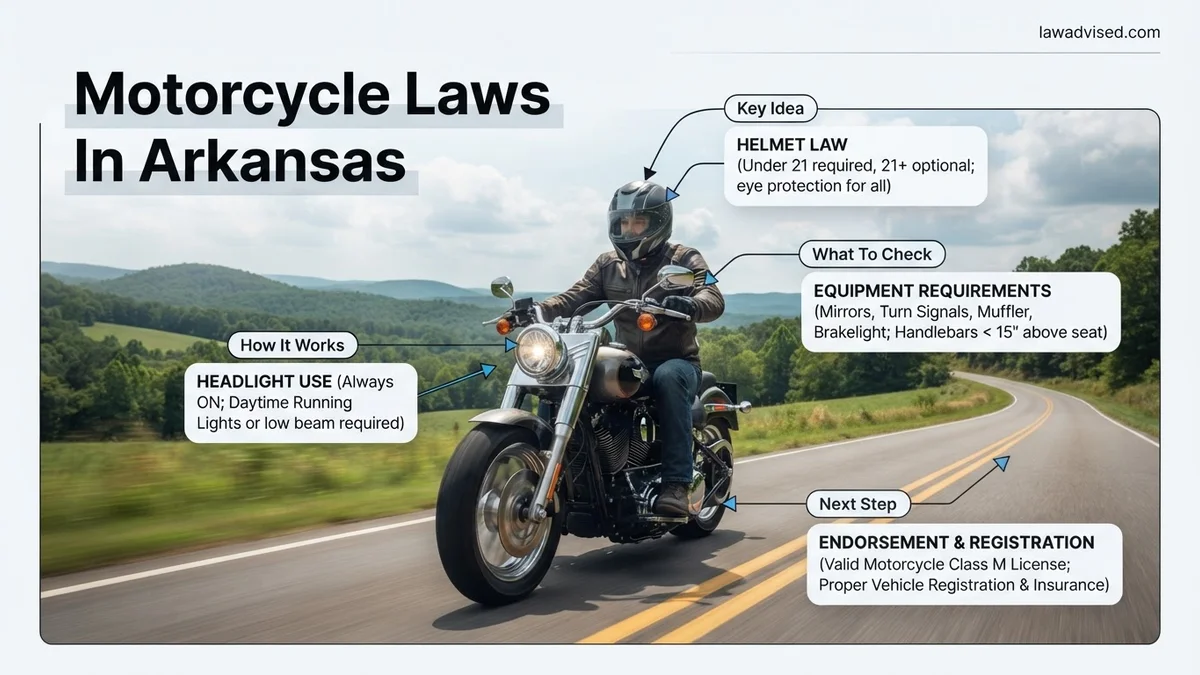
The single greatest source of confusion for riders in Arkansas involves the mandatory helmet law. Under current Arkansas law, you must wear a Department of Transportation (DOT)-approved helmet only if you are under the age of 21. Riders aged 21 and older legally can ride without a helmet. However, choosing not to wear a helmet shifts heavy legal scrutiny onto your eye protection gear.
Equipment Compliance Failures
Many riders receive citations simply because their motorcycle equipment fails to meet state inspection standards. Arkansas law requires specific hardware on every street-legal bike. Common violation triggers include:
- Missing or broken rearview mirrors (Arkansas requires at least one mirror on the handlebar).
- Exhaust systems that lack effective muffling, creating excessive or unusual noise.
- Inadequate lighting, including a working taillight, brake light, and license plate light.
- Improper handlebar height, which cannot rise higher than the shoulders of the seated operator.
How to Comply with Arkansas Helmet, Licensing, and Safety Regulations
Meeting Arkansas Eye Protection and Passenger Rules
Even if you are over 21 and legally exempt from wearing a helmet, Arkansas law strictly requires you to wear protective eyewear unless your motorcycle has a functioning windscreen. This means shatter-resistant safety glasses, goggles, or a face shield attached to a helmet. If you plan to carry a passenger, your bike must be equipped with permanent passenger footpegs and a designated passenger seat. Furthermore, passengers under the age of 21 must wear a DOT-compliant helmet at all times.
Securing Your Arkansas Motorcycle Endorsement
Operating a motorcycle legally in Arkansas requires the proper credential on your driver’s license. If you are at least 14 years old, you can apply for a motorized bicycle instruction permit. For standard motorcycles, you must follow the state licensing progression:
- Learners Permit: Applicants 16 and older must pass a written knowledge test to obtain a motorcycle instruction permit, which restricts you to riding during daylight hours without passengers.
- Skills Test or MSF Course: You must pass an on-cycle skills test at an authorized state testing site or successfully complete an approved Motorcycle Safety Foundation (MSF) RiderCourse to waive the physical exam.
- Full Endorsement: Pay the required licensing fees at the Office of Driver Services to add the Class M endorsement to your standard driver’s license.
Step-by-Step Guide to Obtaining an Arkansas Motorcycle Endorsement
Securing a legal motorcycle endorsement in Arkansas requires meeting specific state licensing criteria. Riders must transition from a learner’s permit to a full Class M endorsement efficiently. The process involves both written testing and practical skill demonstrations mandated by the Arkansas Department of Finance and Administration (DFA).
Prerequisites and Testing
- Applicants must hold a valid Arkansas driver’s license and be at least 16 years of age.
- Pass the motorcycle knowledge written test at a state revenue office, which covers essential road rules and safety practices.
- Obtain a instruction permit if further practice on public roadways is necessary before the skills test.
Completing the Skills Requirement
- Schedule a physical riding skills test at an authorized testing location or enroll in an approved Motorcycle Safety Foundation (MSF) RiderCourse.
- Successful completion of the MSF Basic RiderCourse waives the state-administered on-cycle skills test for riders of all ages.
- Submit your course completion card or pass the state skills test, along with your current license and appropriate fees, to your local DFA revenue office to officially add the Class M endorsement in 2027.
What If Your Motorcycle Fails State Equipment Inspections or Requirements
Arkansas does not require an annual state-mandated safety inspection for motorcycles, but law enforcement can ticket riders for non-compliant equipment. If your bike is cited for lacking mandatory gear like mirrors, turn signals, or proper exhaust decibel limits, you must act quickly to avoid heavy fines or impoundment. Addressing equipment failures promptly keeps you legal and safe on the road.
Troubleshooting Failed Equipment Standards
- Inspect all factory and aftermarket lighting systems, ensuring that headlights, tail lights, and brake lights function properly under 2027 state standards.
- Verify that your handlebars do not exceed the maximum legal height of 15 inches above the seat mounting position.
- Install department-approved rearview mirrors on both the left and right sides if your bike was manufactured after 1973.
- Consult a certified motorcycle mechanic to diagnose persistent electrical or exhaust modifications. Professional labor rates typically range from $95 to $150 per hour.
Conclusion
Mastering motorcycle laws in Arkansas protects you from costly fines and drastically reduces your risk of serious injury on the highway. Maintaining compliant equipment and holding a proper Class M endorsement are essential legal and safety obligations for every rider. According to verified research and expert sources from the National Highway Traffic Safety Administration, adhering to strict licensing and gear protocols remains the single most effective defense against fatal road accidents. Take the next step today by auditing your current riding gear and verifying your endorsement status with the Arkansas DFA.
❓ Frequently Asked Questions
What is the minimum age to get a motorcycle instruction permit in Arkansas?
You can apply for a motorcycle instruction permit in Arkansas starting at age 14, but strict restrictions apply regarding daylight riding and supervision.
What tests are required to get an Arkansas motorcycle endorsement?
Applicants must pass a written knowledge test and either a practical on-cycle skills test or an approved Motorcycle Safety Foundation (MSF) rider course.
What are the passenger requirements for motorcycles in Arkansas?
Passengers must have a designated seat and footrests. If the passenger is under 21 years old, they must also wear a DOT-compliant helmet at all times.
Does Arkansas require turn signals on motorcycles?
Turn signals are required if the motorcycle was manufactured after 1973. Older bikes may use hand signals for turns and stopping.
What are the muffler and exhaust laws for motorcycles in Arkansas?
Arkansas law requires an effective exhaust system with a muffler to prevent excessive or unusual noise, though specific decibel limits vary by local ordinance.
What is the minimum motorcycle insurance coverage required in Arkansas?
Arkansas requires liability insurance with minimum limits of $25,000 for injury/death to one person, $50,000 for injury/death to multiple people, and $25,000 for property damage.

Ismail Hossain is the founder of Law Advised. He is an Divorce, Separation, marriage lawyer. Follow him.