Odd Laws in Arkansas 2027 Real Weird Rules Explained
Many odd laws in Arkansas persist as historical curiosities, ranging from strange pronunciation rules to quirky municipal codes. This guide examines the real statutes behind these bizarre local regulations and separates fact from urban legend.
Arkansas holds a surprisingly rich collection of bizarre, archaic, and downright confusing legal statutes still lingering on the books as of 2027. If you dive into the Natural State’s legislative history, you will quickly find rules governing everything from how you pronounce the state’s name to how you treat your livestock.
While many of these quirky regulations are harmless internet folklore, understanding the real statutes helps you separate local urban legends from actual legislative history. Let us look at what drives these strange rules and how you can separate fact from fiction.
Key Takeaways
- Arkansas has numerous historical laws that are no longer enforced.
- Mispronounced state names are technically addressed by old statutes.
- Many viral internet oddities are actually urban legends, not real codes.
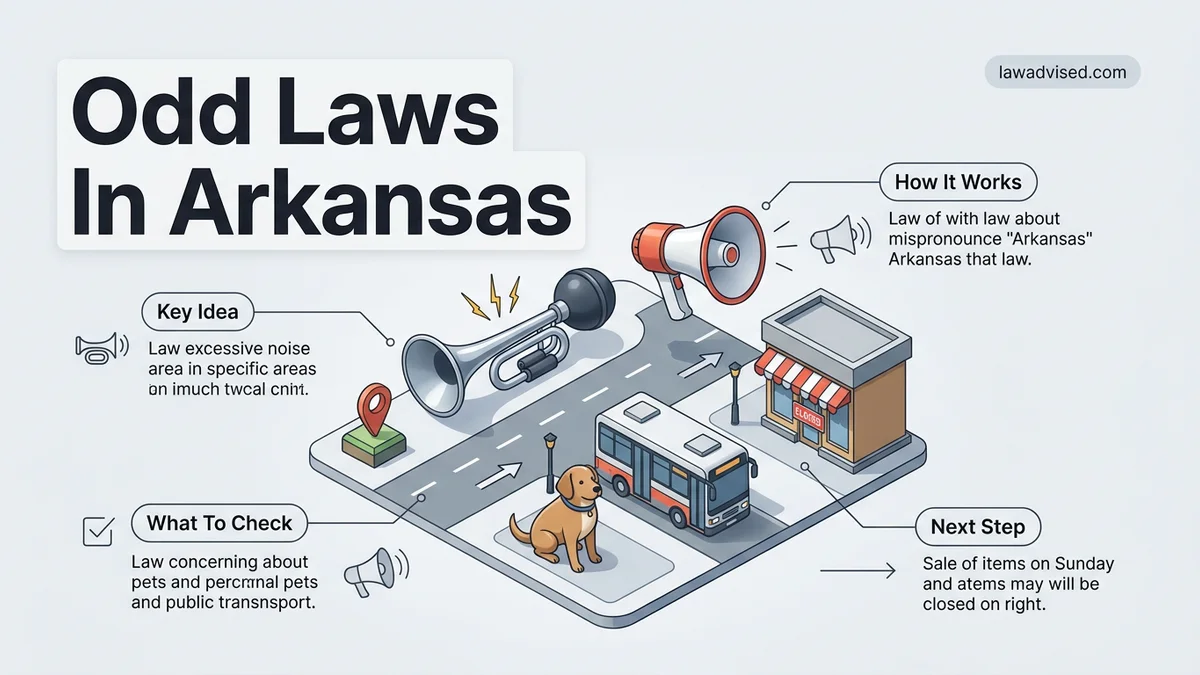
- Municipal ordinances often contain bizarre rules regarding animals and noise.
- Old domestic statutes have long been superseded by federal rulings.
What Causes Viral Myths About Odd Laws in Arkansas
Internet culture loves a good legal absurdity. Social media algorithms thrive on sharing bite-sized lists of ridiculous rules that make you shake your head at lawmakers past and present.
The Appeal of Outdated Legislative Folklore
Content creators often take obscure, highly specific municipal ordinances and present them as statewide bans. When you read that a law is banned or required, it usually stems from a specific historical context that no longer applies in 2027.
- Viral posts rarely cite actual code numbers or official 2027 legal databases.
- Out-of-context court rulings get morphed into bizarre statewide prohibitions.
- Local city ordinances from the early 1900s get mislabeled as current state felonies.
How Municipal Codes Breed Confusion
Towns and cities across Arkansas have the power to pass local ordinances. A rule about tethering your cow to a main street lamppost in a small mountain town might have made sense in 1915, but it rarely survives modern updates.
- Small towns rarely scrub their old ordinance books clean of dead laws.
- Reporters pick up these dormant rules during slow news cycles.
- The internet treats localized rules as universal state mandates.
How to Fix Misconceptions by Reviewing Real Arkansas Statutes
Clearing up legal myths requires looking directly at the Arkansas Code. When you check the actual text passed by the General Assembly, you quickly see how stories get twisted.
The Truth About Pronunciation and Grammar Statutes
One of the most famous Arkansas legal myths involves how you pronounce the state’s name. A well-known 1881 legislative resolution actually declared the correct pronunciation, but it was purely descriptive, not a punishable offense.
- The resolution aimed to settle a debate between “Ar-kan-saw” and “Ar-kansas.”
- Violating the resolution carries zero criminal penalties or fines.
- It serves as a fun historical trivia fact rather than an active restriction.
Examining Actual Antiquated Restrictions
Many old codes dealt with public morality, transportation safety, or animal control during eras with vastly different technology. Reviewing the actual legislative text helps you see the original intent.
- Early motoring laws often required drivers to warn horse-drawn carriages of their approach.
- Old Sunday blue laws restricted specific retail operations before being repealed.
- Public livestock regulations protected pedestrians from runaway farm animals in dense settlements.
Step-by-Step Guide to Verifying Historic Local Ordinances
Navigating the labyrinth of municipal codes in Arkansas requires a systematic approach. Legal researchers and archivists emphasize that many quirky rules exist only as ghost text in old codifications. Verifying whether a historic ordinance remains enforceable in 2027 involves a precise archival workflow.
Step 1: Consult the Municipal Code Library
- Access the official Arkansas Municipal League portal or the specific city’s online codification database.
- Navigate to the general provisions or police regulations section where historic statutes are typically archived.
- Search for specific keywords such as “nuisance,” “animals,” or “public conduct” to isolate legacy statutes.
Step 2: Cross-Reference State Preemption Laws
- Review the Arkansas Code Annotated to determine if the state legislature has passed preemption statutes overriding local control.
- Check recent legal updates from 2026 and 2027 regarding state versus municipal authority.
- Verify if the specific ordinance violates modern state constitutional standards or civil liberties.
What If It Still Doesn’t Make Sense: Understanding Outdated Legal Codes
When legal research yields baffling results, citizens often struggle to comprehend why bizarre rules remain on the books. Legal historians point out that repealing obsolete statutes requires legislative time and financial resources that small towns rarely prioritize. If deciphering a strange Arkansas ordinance proves difficult, several troubleshooting steps can clarify its status.
- Consult the municipal clerk’s office directly to check for unpublished repeal documentation or administrative shelving memos.
- Review county prosecutor guidelines from 2027 to see if enforcement priorities explicitly ignore the specific outdated rule in question.
- Hire a licensed Arkansas attorney specializing in municipal law to conduct a formal legal opinion audit. Professional legal consultations for municipal ordinance reviews typically range from $250 to $600 depending on the complexity of the historical code search.
- File a Freedom of Information Act (FOIA) request with the city attorney’s office to inspect records regarding the last recorded enforcement of the statute.
Conclusion
Uncovering the reality behind strange Arkansas regulations reveals a fascinating intersection of legal history, legislative oversight, and municipal evolution. While viral internet myths often exaggerate these antique statutes, understanding how to verify local ordinances prevents unnecessary confusion. According to verified research and expert legal sources, taking the time to consult official municipal databases ensures accurate comprehension of modern law. Make the next step toward legal clarity by checking your local city code portal today to see what historic statutes still linger in your municipality.
❓ Frequently Asked Questions
What is the most famous odd law in Arkansas?
The pronunciation statute from 1881 is widely considered the most famous, officially dictating that the state should be pronounced ‘Ar-kan-saw’.
Why do states like Arkansas have such strange old laws?
In the 19th and early 20th centuries, local towns and state legislatures passed hyper-specific ordinances to address niche public nuisances of the era.
Did Arkansas ever have a law allowing domestic physical discipline?
Older common-law traditions and outdated regional codes historically included lenient views on domestic matters, but modern state and federal laws entirely override them.
Are these weird laws unique to Arkansas?
Every US state has a collection of bizarre, outdated, and forgotten municipal codes or legislative acts left over from past centuries.
How can I check if an Arkansas law is currently active?
You can consult the official Arkansas General Assembly database or legal code repositories to review active statutes currently in force.
Do police officers cite people for these silly old rules?
Law enforcement agencies do not enforce obsolete statutes, as modern constitutional standards and public policy render them entirely moot.

Ismail Hossain is the founder of Law Advised. He is an Divorce, Separation, marriage lawyer. Follow him.