Knife Laws in Arizona 2027 Expert Legal Guide to Carry Rules
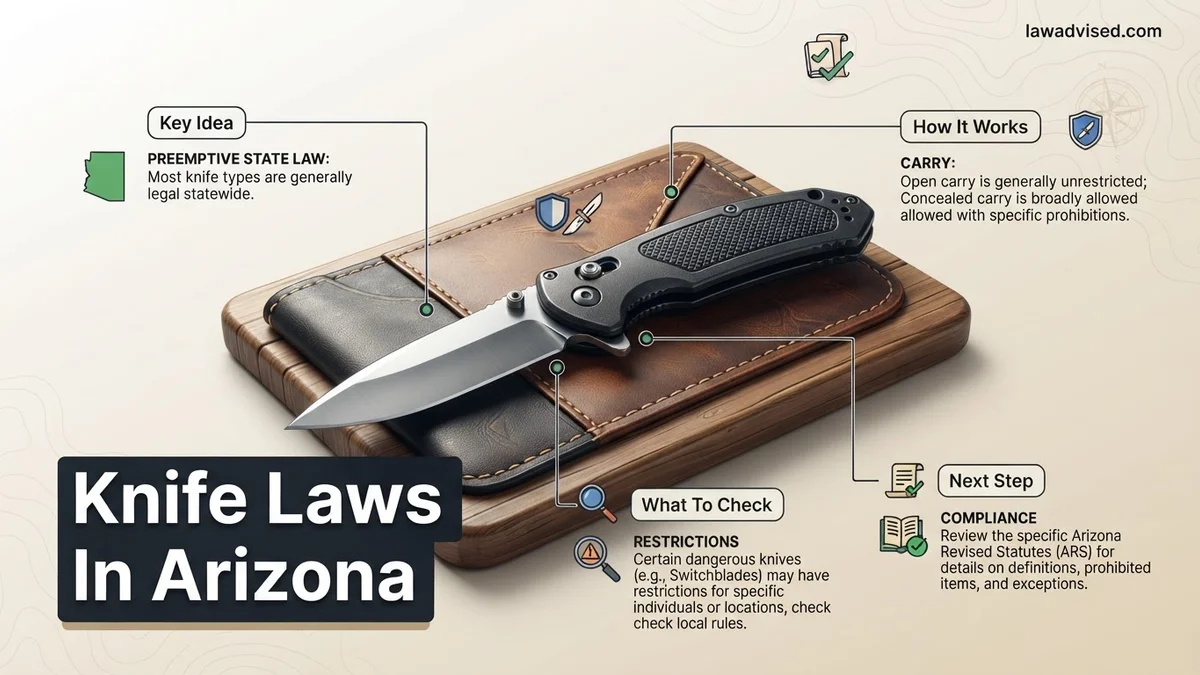
Navigating knife laws in Arizona can be straightforward because the state features some of the most permissive carry laws in the nation. Open and concealed carry of almost all knife types, including switchblades and daggers, are completely legal for adults without a permit. However, specific federal, state, and local restrictions still apply in sensitive locations like schools.
Arizona stands as one of the most permissive states in the country for carrying tools and edged instruments. Under Arizona Revised Statutes, you can legally own, carry, and conceal almost any standard blade without obtaining a special permit. Whether you prefer a traditional folding pocketknife or a modern tactical folder, state law protects your right to carry.
Navigating these regulations requires understanding the nuances of how you transport your gear. Knowing the boundaries of state statutes helps you avoid accidental legal trouble, especially as local ordinances interact with state preemption laws heading into 2027.
Key Takeaways
- Open and concealed carry of all knives are legal for adults.
- There are no state-mandated blade length restrictions in Arizona.
- Switchblades, OTF knives, and daggers are fully legal to own and carry.
- State preemption laws override any local city or county knife ordinances.
- Carrying knives in schools, polling places, and secure government buildings is strictly prohibited.
What Causes Confusion Regarding Legal Knife Types and Carry Methods in Arizona
Many carriers struggle with knife laws because they confuse historical restrictions with current statutes. Arizona completely preempted local knife ordinances. This means cities like Phoenix or Tucson cannot enforce stricter local rules than the state allows.
The Impact of State Preemption on Daily Carry
State preemption creates a uniform standard across all municipalities in Arizona. You do not need to worry about changing rules when crossing city limits. However, confusion still arises regarding the distinction between open and concealed carry methods.
- Open carry means your tool remains visible to ordinary observation on your belt or pocket clip.
- Concealed carry means the item is hidden from plain view inside a pocket, under a jacket, or in a bag.
- Arizona law treats both methods equally for almost all legal blades.
- You do not need a concealed carry permit to pack a hidden blade in this state.
Misconceptions About Prohibited Blades
Another major source of confusion involves the legality of exotic or tactical items. People often assume automatic mechanisms remain heavily restricted. In reality, Arizona law makes no distinction between a manual folder and an automatic opener for general citizens.
How to Determine Legal Carry Status for Switchblades, Daggers, and Folding Knives
Evaluating whether your specific tool is legal to carry in Arizona comes down to understanding how state statutes classify different blade configurations. The law focuses primarily on your age and your location rather than the physical design of the tool itself.
Legal Status of Switchblades, Automatics, and OTFs
Out-The-Front (OTF) knives, switchblades, and automatic openers are completely legal to own, carry, and conceal in Arizona. You do not face length restrictions or mechanical bans under state law.
- Switchblades and automatic knives carry the same legal weight as standard kitchen knives.
- You can deploy an automatic or assisted-opening blade in public without legal penalty.
- Federal restrictions regarding interstate commerce do not restrict your everyday carry rights within state borders.
Rules for Daggers, Dirks, and Fixed Blades
Fixed blade knives, daggers, and dirks are also fully legal for open and concealed carry. You can strap a large hunting knife to your belt or slide a boot knife under your trousers without violating state statutes.
Minors face strict limitations regarding certain sharp items. Individuals under the age of 21 cannot carry a deadly weapon, which includes certain types of knives, unless they have parental permission or are engaged in specific activities like hunting or shooting sports. Adults face virtually zero design-based restrictions.
Step-by-Step Guide to Complying with Arizona Restricted Locations and Age Rules
Even with Arizona’s permissive statewide knife statutes in 2027, strict boundaries remain regarding specific public properties and minor status. Federal buildings, state-operated correctional facilities, and K-12 school grounds strictly prohibit all deadly weapons, including everyday pocket knives. Adhering to these limitations prevents accidental felony charges.
Sub-Step 1: Verify Property Classifications
Always check whether a building receives federal or state funding before entry. Federal property, including post offices and courthouses, enforces strict federal prohibitions superseding state preemption. Leaving prohibited tools locked securely in a vehicle prevents federal misdemeanor charges.
Sub-Step 2: Verify Age and Minor Restrictions
Individuals under the age of 21 face distinct regulations regarding concealed carry and specific blade categories. According to state criminal code guidelines, minors possess limited defensive carry rights compared to adults. Parents and guardians must supervise youth handling edged tools in public spaces to maintain legal compliance.
- Identify if the intended destination is a school, polling place, or secure government facility.
- Secure any prohibited blade inside a locked vehicle container before stepping onto restricted grounds.
- Ensure carriers under 21 strictly adhere to open-carry parameters rather than concealed methods where ambiguity exists.
- Review updated 2027 municipal agency notices regarding temporary event restrictions, such as permitted street fairs or concerts.
What If Local Ordinances or Federal Rules Conflict with State Preemption Laws
Arizona Revised Statute Section 13-3102 establishes strict state preemption, barring local municipalities from enacting independent knife ordinances. However, certain cities periodically attempt to enforce legacy local rules that contradict state law. Resolving these discrepancies requires understanding jurisdictional boundaries and proper legal pushback.
Sub-Step 1: Assess the Enforcement Jurisdiction
Determine whether local city police or federal law enforcement personnel initiated the contact. Federal officers operate under federal code, meaning state preemption does not apply on federal enclaves like military bases or national parks. Local municipal police, conversely, must yield to Arizona state preemption statutes.
Sub-Step 2: Document and Challenge Improper Citations
If a local municipality issues an unlawful citation based on an invalidated city ordinance, do not argue aggressively during the stop. Document all badge numbers, officer details, and specific ordinance citations. Experienced defense attorneys routinely utilize state preemption statutes to dismiss municipal overreach quickly.
- Request the exact legal code or municipal ordinance number the officer uses for the citation.
- Reference Arizona Revised Statute Section 13-3102 to legal counsel to prove state preemption violation.
- File a formal administrative complaint with the police department internal affairs division if wrongful confiscation occurs.
- Preserve all receipt documentation if property retrieval requires formal legal petitioning.
What If It Still Doesn’t Work?
When legal disputes regarding knife confiscation or local ordinance violations persist despite clear state statutes, individuals must take proactive fallback steps. Resolving complex legal ambiguities safely requires qualified professional intervention.
- Consult a licensed criminal defense attorney: Speak with a local attorney specializing in Arizona weapons charges immediately if formal criminal charges are filed. Initial consultations typically range from $150 to $300, while total representation costs vary based on case complexity.
- Request formal property release: File a written petition through the local police department property room for unlawfully seized personal items.
- Contact civil rights organizations: Notify state legal defense foundations if a municipality persistently violates established state preemption laws.
- Obtain written legal opinions: Secure a formal advisory opinion from a qualified legal expert to clarify ambiguous carry scenarios in specialized commercial zones.
Conclusion
Navigating Arizona knife laws in 2027 requires balancing permissive state carry rights with strict federal and localized property restrictions. Remaining compliant protects carriers from unnecessary legal friction and costly citations. According to verified research and expert legal sources, proactive education on jurisdictional boundaries remains the ultimate defense against inadvertent violations. Review current municipal updates before traveling to ensure total compliance with modern standards.
❓ Frequently Asked Questions
What types of knives are legal to carry in Arizona?
Almost every common knife type is legal to carry in Arizona, including folding knives, fixed blades, bowie knives, daggers, stilettos, switchblades, and out-the-front (OTF) automatics. There are no bans on specific locking mechanisms or blade styles for general citizens.
Are there any restrictions on blade length in Arizona?
No, Arizona state law does not specify a maximum blade length for any knife. You can legally carry pocket knives, hunting knives, or large tactical blades of any size.
Where is it illegal to carry a knife in Arizona?
While general carry is permitted, knives are strictly prohibited in specific sensitive zones. These restricted areas include K-12 schools, universities (subject to campus policy), polling places on election days, nuclear generating stations, and secure government or correctional facilities.
Does Arizona allow concealed carry of daggers and switchblades?
Yes. Both open carry and concealed carry are fully permitted for all legal knife types without needing a concealed weapons permit.
Can local cities in Arizona pass their own stricter knife laws?
No, Arizona has a strict state preemption law regarding knives and firearms. This means local municipalities, towns, and counties cannot create ordinances that contradict or override state knife regulations.
Are there age restrictions for carrying knives in Arizona?
Yes, while adults face very few limitations, carrying certain types of knives can be restricted for minors under the age of 18 unless they are engaged in lawful activities like hunting, camping, or working under adult supervision.

Ismail Hossain is the founder of Law Advised. He is an Divorce, Separation, marriage lawyer. Follow him.