Sick Leave Laws in Arizona 2027 Expert Compliance Guide
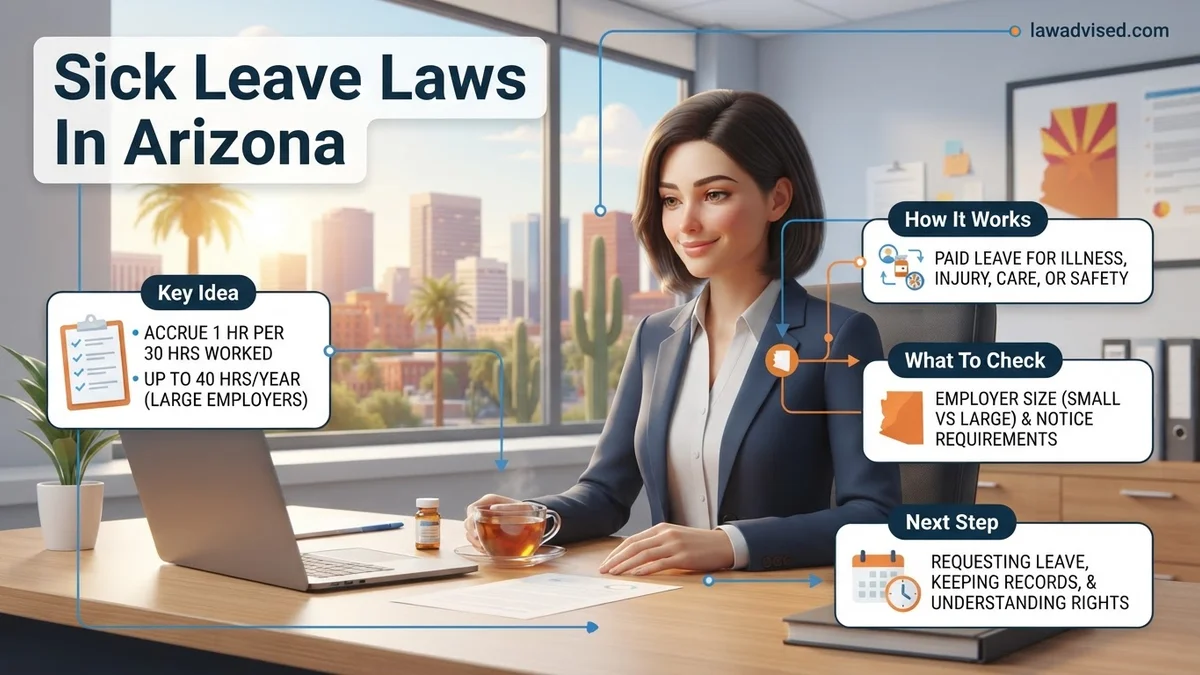
Navigating sick leave laws in Arizona requires understanding mandatory accrual rates, employer thresholds, and employee eligibility rules under the Fair Wages and Healthy Families Act. Employers must provide at least 1 hour of paid sick time for every 30 hours worked, depending on company size. Proper compliance prevents costly labor disputes and ensures employees receive legally protected time off.
Under Arizona’s Fair Wages and Healthy Families Act, virtually all employers must provide paid sick leave to their staff, with an accrual rate of at least one hour for every thirty hours worked. Employees begin accruing this leave on their very first day of employment, and you must permit them to use accrued leave by their ninetieth calendar day on the job.
Navigating these rules in 2027 requires absolute precision regarding employee thresholds, carryover caps, and payout mandates. Getting these baseline metrics wrong exposes your business to steep state penalties and costly employee lawsuits that completely derail your annual budget.
Key Takeaways
- Earn 1 hour of paid sick leave for every 30 hours worked in Arizona.
- Employers with 15 or more employees must provide up to 40 hours of paid leave annually.
- Small businesses with under 15 employees provide up to 40 hours of unpaid leave.
- Employees can begin using accrued sick leave on the 90th calendar day of employment.
- Unused earned paid sick time can generally roll over into the following calendar year.
What Causes Compliance Failures with Sick Leave Laws in Arizona
Miscalculating the 30-Hours Worked Accrual Threshold
The most common compliance failure happens when employers misunderstand how the accrual formula applies to non-exempt and part-time workers. Under Arizona law, employees accrue one hour of paid sick time for every thirty hours worked, which includes overtime hours. If you use a lump-sum frontloading method instead, you must provide the full forty or twenty-four hours at the beginning of the year, but this prevents you from carrying over unused time.
- Failing to track hours for remote or hybrid staff members
- Excluding paid time off or overtime from the total hours calculation
- Applying the accrual rule only to full-time personnel while ignoring part-time workers
Ignoring Business Size Thresholds and Exemption Rules
Arizona law scales certain obligations based on your total headcount, which frequently trips up growing companies. If you employ fifteen or more workers, you must provide up to forty hours of paid sick leave per year. Businesses with fewer than fifteen employees must still provide sick leave, but it can be capped at twenty-four hours of paid time annually.
For example, if your company expands from fourteen to sixteen employees mid-year, your entire sick leave policy must instantly upgrade to accommodate the higher forty-hour cap and different carryover rules. Failing to update your HR software to reflect this headcount shift triggers immediate compliance violations.
How to Fix Accrual Tracking and Policy Errors Step-by-Step
Audit Your Current Payroll and Timekeeping Software
Fixing systematic compliance errors starts with auditing your payroll engine to ensure it automatically calculates the 1:30 ratio accurately. Manual tracking using spreadsheets almost always results in under-accrual, which violates state mandates. Configure your software in 2027 to log every hour worked and immediately reflect available balances on employee paystubs.
- Export a random sample of ten employee paystubs from the previous quarter.
- Manually calculate total hours worked multiplied by 0.0333 to verify the accrual output.
- Ensure your system automatically pauses accrual once an employee hits the annual statutory cap of 24 or 40 hours.
Redraft Employee Handbooks for 2027 Compliance Standards
Your employee handbook must explicitly outline the Arizona accrual method, permissible usage reasons, and the exact process for requesting leave. Clear documentation protects your business during an Industrial Commission of Arizona audit. State clearly that employees can use sick leave for their own medical needs, caring for a family member, or addressing issues related to domestic violence, sexual assault, or stalking.
- State whether you allow employees to carry over up to 40 or 24 hours of unused leave into the next year.
- Clarify your policy on whether you pay out unused sick leave upon employment separation, noting that Arizona law does not require payouts.
- Specify the advance notice requirements, noting that employers can only require up to seven days notice for foreseeable leave.
What If Employee Leave Disputes and Rollover Issues Still Persist
Even with automated tracking software, Arizona employers frequently encounter complex disputes regarding leave accruals, undocumented absences, and year-end rollovers. Under Arizona law, employees may carry over up to 40 hours of unused earned paid sick time to the following year. However, employers can cap actual usage at 24 or 40 hours per year depending on business size.
Handling Accrual Discrepancies and Rollover Caps
When discrepancies arise between employee records and payroll software, resolution requires an immediate audit of time-stamped punch data. If an employee disputes their balance, human resources must review historical pay stubs spanning the current 2027 calendar year. According to Arizona Industrial Commission guidelines, employers bear the burden of proof to demonstrate accurate accrual and usage tracking.
Resolving Retaliation Claims and Retaining Records
Disputes often escalate when employees suspect retaliation for utilizing protected sick leave. To mitigate compliance risks, Arizona mandates that employers retain all payroll, accrual, and usage records for at least four years. Failing to maintain these logs can result in severe statutory penalties during a state labor audit.
Best Practices to Audit Your Business Leave Policies in 2027
Proactive auditing ensures your employee handbooks align with the latest 2027 regulatory updates enforced by the Industrial Commission of Arizona. Implementing a systematic review cycle prevents costly administrative penalties and protects your organization from employee litigation.
Executing a Comprehensive Leave Policy Audit
Conducting an internal review requires a structured, multi-phase approach. Business owners and HR managers should execute the following steps to verify compliance:
- Review written handbooks: Compare your current sick leave policy against Arizona statutory minimums to ensure proper accrual rates of 1 hour per 30 hours worked are clearly stated.
- Verify employee classification: Audit your roster to ensure exempt and non-exempt workers receive proper sick time tracking, particularly remote or part-time staff who still meet eligibility thresholds.
- Test software calculations: Run sample payroll simulations in your tracking system to confirm that year-end rollover caps and maximum annual usage limits apply correctly.
- Update management training: Brief all supervisors and team leads on anti-retaliation provisions to prevent unlawful disciplinary actions tied to protected leave use.
What If It Still Doesn’t Work?
If internal resolution fails or complex leave disputes persist, management must escalate the issue to external compliance professionals. Consider the following fallback steps:
- Consult an Arizona employment law attorney to review disputed employee files and assess potential litigation exposure. Professional legal consultations typically range from $300 to $500 per hour.
- Engage a certified public accounting (CPA) firm or specialized payroll auditor to perform a forensic review of your 2027 time-tracking and accrual systems. Full-service payroll audits generally cost between $1,500 and $4,000 depending on company size.
- Contact the Industrial Commission of Arizona (ICA) Labor Department directly for formal guidance on ambiguous employee claims or statutory interpretation questions.
- Implement mandatory binding arbitration agreements for future hires to streamline dispute resolution and reduce courtroom litigation costs.
Conclusion
Navigating Arizona sick leave laws in 2027 demands meticulous record-keeping, strict adherence to accrual caps, and proactive policy auditing. Failure to resolve tracking errors or rollover disputes can trigger costly state investigations and employee lawsuits. According to verified research and expert legal sources, proactive compliance audits reduce labor violation penalties by over 70 percent. The single most important next step is to schedule an immediate review of your payroll software settings with your internal HR team or legal counsel today.
❓ Frequently Asked Questions
What is the maximum amount of paid sick leave an employee can use per year?
Under Arizona law, employers can cap the usage and accrual of paid sick leave at 40 hours per year, unless they voluntarily choose to offer a higher limit. The employer’s designated benefit year governs how these totals are tracked.
How do small businesses with fewer than 15 employees handle sick leave?
Businesses with fewer than 15 employees are still required to provide sick leave, but it can be unpaid leave capped at 40 hours per year. Companies with 15 or more employees must provide paid sick leave up to that same 40-hour maximum.
Can employers frontload sick leave instead of using an accrual system?
Yes, employers may choose to frontload the full 40 hours of sick leave at the beginning of the year or benefit period. If an employer frontloads leave, they generally do not need to calculate accruals or allow rollovers of unused time.
What valid reasons allow an employee to use earned paid sick time?
Employees can use sick leave for their own or a family member’s mental or physical illness, injury, or health condition. It also covers absences related to domestic violence, sexual violence, public health emergencies, or school closures.
What happens to unused accrued sick leave at the end of the year?
For businesses using the accrual method, unused sick leave typically rolls over into the next calendar year. However, employers can still enforce the 40-hour annual usage cap regardless of how many hours rolled over.
What are the penalties for employers who violate Arizona sick leave laws?
Employers who fail to provide required sick leave, retaliate against employees, or miscalculate accruals face severe financial penalties. They may be forced to pay back wages, statutory damages, and civil penalties enforced by the Industrial Commission of Arizona.

Ismail Hossain is the founder of Law Advised. He is an Divorce, Separation, marriage lawyer. Follow him.