How Tax Brackets Work in USA A Step-by-Step Guide for 2026
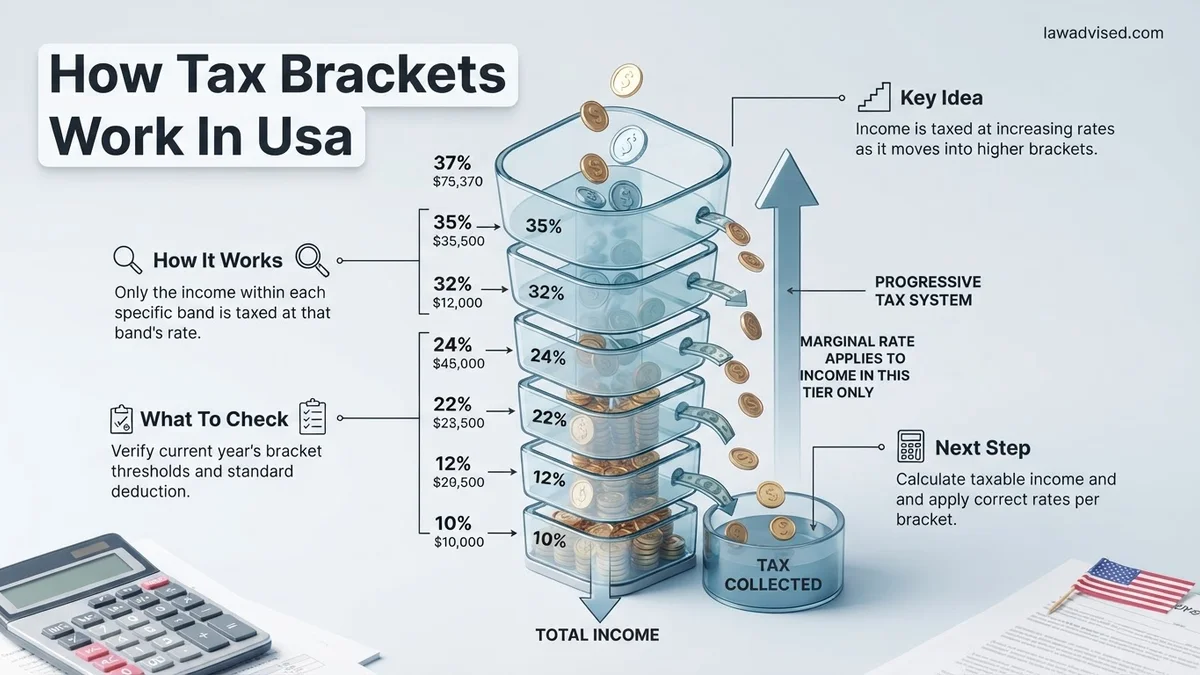
Many taxpayers fear that getting a raise will push their entire income into a higher tax bracket, but the US uses a progressive marginal tax system. This means only the income falling within a specific bracket is taxed at that higher rate, not your total earnings.
The United States uses a progressive federal income tax system, meaning your tax rate increases as your income rises. However, your entire income is never taxed at a single, higher rate. Instead, the government divides your taxable income into chunks, known as brackets, and taxes each chunk at its specific marginal rate.
Understanding this mechanism prevents you from fearing a pay raise or promotion that pushes you into a higher tax bracket. In 2026, the IRS applies marginal rates ranging from 10 percent up to 37 percent, depending on your taxable income and filing status. Knowing how these brackets layer together lets you accurately estimate your tax liability and financial growth.
Key Takeaways
- The US federal income tax system is progressive, utilizing multiple marginal tax brackets.
- Moving into a higher bracket only applies the higher rate to the dollars inside that specific range.
- Your marginal tax rate is the highest bracket your income reaches.
- Your effective tax rate represents the actual average percentage of total income paid in taxes.
- Filing status directly determines your tax bracket thresholds and standard deduction amounts.
What Causes Misconceptions About How Tax Brackets Work in the USA
The Myth of the Single Effective Rate
Many taxpayers mistakenly believe that crossing into a higher tax bracket means every single dollar they earn suddenly gets taxed at that new, higher rate. This persistent myth stops people from accepting raises, overtime, or new job opportunities because they worry they will actually take home less money. In reality, moving into a new bracket only applies the higher tax rate to the dollars that fall within that specific bracket, leaving all your previous earnings taxed at their original, lower rates.
Failing to Distinguish Between Marginal and Effective Rates
Another common point of confusion involves mixing up your marginal tax rate with your effective tax rate. Your marginal rate is simply the tax rate applied to your very last, highest dollar of income. Your effective tax rate is your total tax liability divided by your total income, expressed as a percentage. Because of the progressive nature of the US tax system, your effective rate will always be lower than your highest marginal rate. Recognizing this distinction keeps your tax planning grounded in reality.
How to Calculate Your Taxes Using Step-by-Step Marginal Brackets
The Stair-Step Tax Calculation Method
Calculating your 2026 federal income tax requires filling up each tax bracket tier sequentially, much like pouring water into a tiered set of cups. Once the lowest bracket fills up to its maximum income limit, any remaining income spills over into the next bracket up. You repeat this process until all of your taxable income has been accounted for across the applicable brackets for your filing status.
A Practical 2026 Single Filer Example
Imagine your taxable income as a single filer in 2026 totals $60,000 after taking your standard deduction. You do not pay 22 percent on the entire $60,000 just because you hit the 22 percent marginal bracket. Instead, the calculation breaks down step by step:
- First tier: The first $11,925 (hypothetical 2026 threshold) is taxed at 10 percent.
- Second tier: Income between $11,926 and $48,475 is taxed at 12 percent.
- Third tier: The remaining income from $48,476 up to your $60,000 total is taxed at 22 percent.
Adding the tax owed from each distinct tier gives you your total federal income tax liability. This progressive layering ensures that earning more money always results in keeping more money.
How to Determine Your Filing Status and 2026 Tax Thresholds
Your filing status is the foundational variable that dictates your standard deduction and exact 2026 tax bracket thresholds. The IRS recognizes five distinct filing statuses: Single, Married Filing Jointly, Married Filing Separately, Head of Household, and Qualifying Surviving Spouse. Each category applies different income boundaries to the progressive tax system.
To pinpoint your exact tax bracket for the 2026 tax year, follow these precise steps:
- Identify your legal marital status as of December 31, 2026, according to IRS guidelines.
- Calculate your projected Adjusted Gross Income (AGI) by subtracting above-the-line deductions from your total gross income.
- Subtract the applicable 2026 standard deduction (or your total itemized deductions, whichever is higher) from your AGI to arrive at your taxable income.
- Cross-reference your final taxable income figure with the official 2026 IRS tax rate schedule corresponding strictly to your designated filing status.
According to tax policy research from the Tax Foundation, failing to select the correct filing status remains one of the leading causes of IRS processing delays and unexpected tax adjustments. Selecting the optimal status ensures you leverage the highest possible standard deduction and favorable bracket limits.
What If Your Income Crosses a Bracket and You Still Owe More Than Expected
Many taxpayers experience sticker shock during tax season, falsely believing that a promotion or a higher-paying side hustle triggered a massive tax penalty due to crossing a bracket threshold. However, because marginal tax rates only apply to income falling within that specific bracket, earning more money always results in a higher net take-home pay.
If your final tax liability exceeds your withholdings and you still owe a substantial balance, consider these corrective measures to resolve the discrepancy:
- Review your year-to-date pay stubs and Form W-4 to ensure your employer is withholding federal income tax accurately for the 2026 tax year.
- Investigate whether you qualify for valuable above-the-line deductions—such as traditional IRA contributions or health savings account (HSA) deposits—that can immediately lower your taxable income before the filing deadline.
- Utilize the IRS Direct Pay service or apply for an online payment agreement if you cannot pay your total liability in a single lump sum.
- Consult a certified public accountant (CPA) or an Enrolled Agent (EA) to evaluate potential itemized deductions or complex credits you may have missed. Professional tax preparation fees typically range from $220 to $500+ depending on the complexity of your return.
Conclusion
Understanding how USA tax brackets work in 2026 eliminates the fear of earning more and empowers you to manage your personal finances strategically. By mastering your filing status, calculating your taxable income accurately, and correcting withholding errors early, you can prevent unexpected tax bills. According to verified research and expert sources from the IRS and major fiscal policy institutes, proactive tax planning is the single most effective way to optimize your net annual earnings. As your next actionable step, use the IRS Tax Withholding Estimator online today to align your current paycheck deductions with your projected 2026 tax liability.
❓ Frequently Asked Questions
Why do people think a higher tax bracket reduces take-home pay?
This common myth stems from a misunderstanding of progressive taxation. People assume earning more means the entire paycheck is taxed at the new, higher rate, which is mathematically false.
How do standard deductions interact with tax brackets?
Before your income is applied to the tax brackets, you subtract your standard deduction (or itemized deductions) to determine your taxable income.
Can I legally lower the tax bracket my income falls into?
Yes, utilizing tax-advantaged accounts like a traditional 401(k) or IRA directly reduces your adjusted gross income, potentially dropping you into a lower bracket.
What happens if tax brackets change from year to year?
The IRS adjusts tax bracket thresholds annually to account for inflation, a process known as indexing, ensuring that cost-of-living adjustments don’t artificially push you into higher brackets.
Is the highest tax bracket applied to all millionaires’ income?
No. Even the highest earners still pay the 10% rate on their first dollars earned, the 12% rate on the next block, and so on up the ladder.
Where can I find the exact official tax bracket tables for the current year?
You can find the official, IRS-approved inflation-adjusted tax bracket thresholds directly on the Internal Revenue Service website (IRS.gov).

Ismail Hossain is the founder of Law Advised. He is an Divorce, Separation, marriage lawyer. Follow him.