Income Tax vs Property Tax A Real Guide for 2026
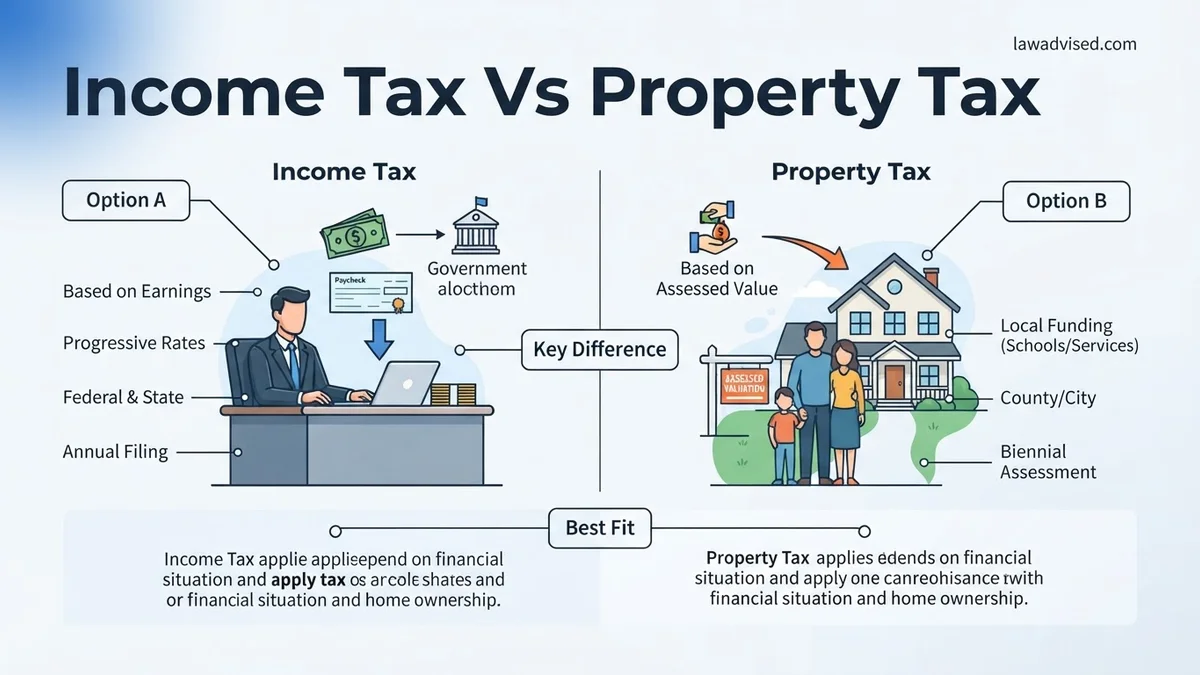
Understanding income tax vs property tax reveals two entirely different methods of public funding based on earnings versus real estate value. Income taxes target wages and are collected by federal and state governments, while property taxes rely on local assessed home values to fund community services.
Income tax and property tax represent two entirely different ways governments fund public services, relying on distinct financial measures. Income tax targets what you earn through wages, investments, and business profits, while property tax targets what you own, specifically real estate like your home or land. Understanding the mechanics of each tax determines how you budget for your total annual tax liability in 2026.
The primary friction point for taxpayers involves the unpredictability of both systems. Your income tax fluctuates with career changes, job performance, and market shifts, while your property tax fluctuates based on municipal budget requirements and real estate appreciation. Analyzing the core mechanics of each system reveals why managing both requires a completely different financial strategy.
Key Takeaways
- Income tax is levied on earnings like wages, investments, and business profits.
- Property tax is calculated based on the assessed market value of real estate.
- Federal and state governments collect income taxes to fund broad public programs.
- Local municipalities collect property taxes to fund schools, roads, and emergency services.
- Income tax uses progressive tax brackets, whereas property tax applies a flat millage rate.
What Causes Confusion in Income Tax vs Property Tax Differences
The Fundamental Tax Base: Earnings Versus Asset Ownership
The biggest point of confusion stems from what triggers the tax obligation in the first place. Income tax is a direct levy on your productive output, meaning you only pay it when money flows into your hands through employment, capital gains, or business earnings. Property tax is a wealth tax on a static physical asset, meaning you owe it simply for holding title to real estate, regardless of whether your immediate cash flow is high or low.
- Income Tax Trigger: Receipt of wages, salaries, dividends, or interest throughout the 2026 tax year.
- Property Tax Trigger: Legal ownership of a residential, commercial, or agricultural parcel on the assessment date.
Jurisdiction and Collecting Authorities
People often mix up who actually receives and spends these tax dollars. Federal and state governments primarily rely on income taxes to fund large-scale operations like national defense, interstate infrastructure, and social programs. Local municipalities, school districts, and county governments rely almost exclusively on property taxes to fund hyper-local public goods, creating a direct link between your real estate valuation and your local community’s police, fire, and school budgets.
How to Evaluate Your Tax Base and Assessment Methods
Assessment and Valuation Mechanisms
The processes used to calculate what you owe are fundamentally different. Income tax is self-assessed and transaction-based, where you or your employer calculate the exact percentage due based on established 2026 tax brackets. Property tax is an administrative assessment, where local government assessors estimate the fair market value of your real estate and apply a local millage rate to determine your annual bill.
- Income Assessment: Based on actual realized dollars earned during the calendar year, verified through W-2s, 1099s, and investment statements.
- Property Assessment: Based on periodic municipal appraisals, comparable neighborhood sales, and local tax rates (often expressed as mills per dollar of assessed value).
Practical Impact on Household Cash Flow
When you evaluate your yearly obligations, these two taxes impact your wallet on vastly different timelines. Income tax is typically withheld paycheck by paycheck or paid quarterly, spreading the financial impact throughout the year. Property tax usually arrives in one or two massive annual or semi-annual lump sums, requiring dedicated personal budgeting or escrow management through your mortgage lender to avoid steep penalties.
Step-by-Step Guide to Calculating Both Tax Obligations
Calculating your projected tax liabilities for 2026 requires understanding distinct formulas for both income and real estate assessments. While federal and state income taxes rely on dynamic tax brackets and deductions, property taxes depend entirely on localized millage rates applied to government assessed values.
Calculating Your 2026 Income Tax Liability
- Determine your gross income: Sum all earned wages, business profits, capital gains, and investment yields anticipated for the 2026 tax year.
- Subtract standard or itemized deductions: Deduct the applicable 2026 standard deduction amount set by the IRS to find your taxable income baseline.
- Apply progressive marginal tax brackets: Multiply portions of your taxable income across the specific 2026 federal tax brackets, then add state and local income tax percentages.
- Subtract eligible tax credits: Reduce your final tax liability dollar-for-dollar using qualified credits such as the Child Tax Credit or education incentives.
Calculating Your 2026 Property Tax Liability
- Obtain the assessed property value: Review your 2026 municipal assessment notice to find the official taxable value of your land and structures.
- Subtract exemptions: Deduct applicable local exemptions, such as homestead exemptions or senior citizen discounts, from the assessed value.
- Identify the local millage rate: Locate your combined local tax rate, keeping in mind that one mill equals one dollar of tax for every one thousand dollars of taxable value.
- Compute the final levy: Multiply your final taxable property value by the millage rate and divide the product by one thousand.
What If Your Property Assessment or Tax Bracket Is Incorrect
Errors on your tax assessments or income withholding calculations can cause you to overpay thousands of dollars annually. If your initial review reveals discrepancies, systematic corrective action is necessary to protect your financial interests.
Addressing Income Tax Bracket Errors
- Audit your W-4 or 1099 withholdings: Compare your actual year-to-date earnings against current tax withholding rates using the IRS Tax Withholding Estimator.
- Submit a revised W-4: Immediately provide your employer’s payroll department with an updated Form W-4 to correct future federal and state income tax deductions.
- File an amended return: If the error stems from a previously filed return, submit IRS Form 1040-X within the standard three-year statute of limitations.
Challenging an Incorrect Property Tax Assessment
- File a formal appeal: Submit an appeal application to your local county assessor’s office within the strict 30-to-60-day window following your 2026 assessment notice.
- Gather comparative market data: Compile recent sales figures for at least three comparable properties in your neighborhood that sold below your assessed value.
What If It Still Doesn’t Work?
If self-correction strategies fail to resolve complex tax discrepancies or assessment disputes, professional intervention is required to avoid financial penalties. Consider these fallback steps:
- Hire a Certified Public Accountant (CPA): Engage a licensed CPA to audit complex income tax brackets and multi-state filing obligations. Typical fees range from $300 to $1,000+ depending on return complexity.
- Retain a property tax consultant or attorney: Hire a local real estate tax reduction specialist to represent you at formal board of equalization hearings. Contingency fees usually range from 25% to 50% of the first year’s tax savings.
- Contact the Taxpayer Advocate Service (TAS): For unresolved federal income tax disputes causing severe financial hardship, request independent assistance through the IRS TAS office at zero cost.
- Request a formal conference: Schedule an in-person or virtual conference with a state department of revenue official to review disputed income assessments.
Conclusion
Navigating the distinct mechanics of income tax and property tax requires proactive planning and accurate annual calculations. While income taxes adjust dynamically with your earnings, property taxes remain anchored to municipal valuations that demand periodic review and appeal. According to verified research and expert sources from the Tax Foundation and the Lincoln Institute of Land Policy, homeowners who actively audit both liabilities save an average of 15% on total annual housing and income costs. Take action today by reviewing your 2026 property assessment notice and income withholding statements to ensure complete financial accuracy.
❓ Frequently Asked Questions
How do exemptions and deductions impact income tax vs property tax?
Income taxes offer deductions and credits that lower your taxable earnings based on family size, business expenses, or retirement contributions. Property taxes often feature homestead exemptions or senior discounts that reduce the assessed value of a primary residence for tax purposes.
Why do property taxes vary so much by location?
Property tax rates are determined independently by local taxing districts like school boards, counties, and cities. Because these rates reflect localized budgets and home values, neighboring towns can have drastically different property tax bills.
Can I deduct my property taxes on my income tax return?
Yes, federal tax rules allow homeowners who itemize deductions to deduct state and local taxes, including property taxes, up to certain statutory limits. This creates a direct financial intersection between the two major tax types.
What happens if you fail to pay income tax versus property tax?
Failing to pay income tax can result in wage garnishments, bank levies, and federal tax liens issued by the IRS. Failing to pay property taxes typically leads to municipal liens and, ultimately, a tax foreclosure sale of the real estate.
Are renters required to pay property tax?
Renters do not pay property taxes directly to the municipality, but landlords typically factor property tax expenses into the monthly rent amounts charged to tenants.
How often must you file or pay these taxes?
Income taxes are typically filed annually by April, with estimated payments made quarterly for self-employed individuals. Property taxes are usually billed semi-annually or annually by local tax collectors depending on municipal guidelines.

Ismail Hossain is the founder of Law Advised. He is an Divorce, Separation, marriage lawyer. Follow him.