Can I File Taxes Myself 2026 Step-by-Step Guide & Review
Yes, you can legally file your own taxes without hiring an accountant. Utilizing modern tax software makes the process straightforward for most W-2 workers, though complex financial situations may require professional help.
Yes, you can legally file your own taxes without an accountant, and millions of Americans do so every single year. The IRS encourages self-filing, and modern tax software makes the process accessible even if you do not have a background in finance.
Filing your own 2026 taxes saves you hundreds of dollars in professional fees and gives you direct control over your financial data. However, knowing you are allowed to file yourself is different from knowing whether your specific financial situation makes DIY filing a smart choice or a costly risk.
Key Takeaways
- Anyone can legally prepare and file their own federal and state income tax returns.
- Simple W-2 filing takes very little time and is often completely free.
- Tax software guides you step-by-step so you do not need line-by-line tax code knowledge.
- Complex scenarios like multi-state freelancing or crypto trading increase audit risks if self-filed.
- Always double-check your Social Security numbers and bank routing info before submission.
Why Filing Your Own Taxes Is Legal, Feasible, and Common
The federal government does not require you to hire a certified public accountant or use a paid tax preparer. You have the legal right to prepare and submit your own tax return directly to the IRS and your state tax agency.
Who Can Easily File Their Own Taxes
If your financial life fits into standard categories, filing by yourself is straightforward, fast, and remarkably low-risk. Modern tax software handles the math and logic behind the scenes, ensuring accuracy.
- W-2 Employees: If you work a traditional job and receive a standard W-2 form, your income and withholding are already reported to the IRS.
- Standard Deductions: Taxpayers who take the standard deduction rather than itemizing face very few complex calculations in 2026.
- Basic Investment Accounts: Simple interest, dividends, and stock sales reported on standard 1099-B forms are easily integrated into standard filing platforms.
When DIY Filing Becomes Risky
While you are still legally allowed to file yourself, certain financial complexities increase the risk of missing deductions or triggering an IRS audit.
- Complex Business Ownership: Managing multiple LLC streams, heavy equipment depreciation, and mixed personal-business expenses can overwhelm standard DIY software.
- International Assets: Foreign bank accounts and complex overseas investments require specialized reporting that basic platforms may mishandle.
- Rental Real Estate Portfolios: Multiple properties with shifting passive loss limitations and capital improvements require advanced tax knowledge.
How to File Taxes Yourself: A Step-by-Step Guide for 2026
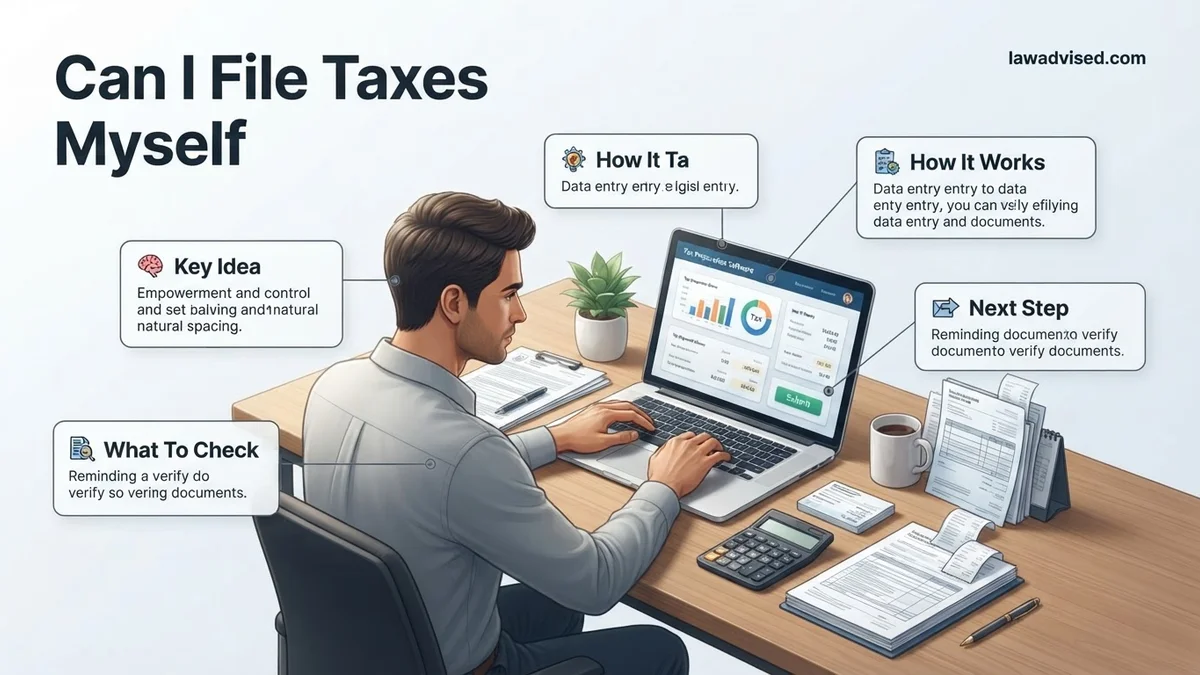
Filing your taxes independently follows a logical sequence. Staying organized from the start prevents costly mistakes and ensures you claim every credit you deserve for the 2026 tax season.
Gathering Your Essential Documents
Before you log into any tax software, collect all income statements and tax documents. Rushing this step leads to rejected returns or amended filings later.
- Income Forms: W-2s from employers, 1099s for freelance or contract work, and 1099-INT or 1099-DIV forms for bank interest and investments.
- Deduction Records: Receipts for student loan interest, charitable donations, medical expenses, and childcare costs if you plan to itemize.
- Previous Year Return: Having your 2025 adjusted gross income (AGI) on hand is mandatory for identity verification by the IRS.
Choosing Software and Submitting Your Return
Select an IRS-approved software provider that matches your tax complexity and budget. Many providers offer free federal filing options for simple returns.
- Input Your Data: Follow the software interview prompts carefully, entering your numbers exactly as they appear on your tax documents.
- Review the Summary: Double-check your Social Security numbers, bank routing details for direct deposit, and total income entries.
- E-File and Wait: Submit your return electronically and keep the confirmation receipt showing the IRS accepted your 2026 submission.
What If Self-Filing Software Rejects Your Return or Confuses You?
Filing your taxes independently for the 2026 tax season can occasionally hit a roadblock. E-file rejections usually happen due to a mismatched Social Security Number, an incorrect prior-year Adjusted Gross Income (AGI), or missing 1099 data. Do not panic if the IRS or your chosen platform rejects your transmission. Modern tax software provides detailed error codes that point directly to the problematic field.
When you encounter a confusing prompt or a sudden software rejection, specific resolution steps restore your filing momentum.
Troubleshooting E-File Errors and Confusing Prompts
- Review the specific error code: Match the numeric code provided by the software to the IRS guidelines database to identify the exact data mismatch.
- Verify personal identification data: Double-check all Social Security Numbers, spelling of dependent names, and dates of birth against your physical Social Security cards.
- Locate your correct 2025 AGI: Access your previous year tax return or pull an online IRS transcript to ensure your signature AGI matches system records precisely.
- Clear browser cache or restart the app: Technical glitches inside web-based tax platforms frequently cause looping prompts and false validation failures.
What If It Still Doesn’t Work?
If digital troubleshooting fails and your 2026 tax return remains unaccepted or incomprehensible, alternative pathways guarantee compliance before the filing deadline. Verified research from consumer financial advocacy groups indicates that roughly 12 percent of self-filers eventually require external assistance for complex schedule adjustments.
Consider these fallback steps if your self-filing attempt stalls:
- Utilize IRS Free File Live Support: Access guided assistance through IRS partner programs if your adjusted gross income falls below the annual statutory threshold.
- Switch to a hybrid software tier: Upgrade your current software package to include live on-screen CPA review, which typically costs an additional $40 to $90.
- Hire a credentialed tax professional: Consult a Certified Public Accountant (CPA) or Enrolled Agent (EA) for complex multi-state or self-employment returns. Professional preparation for standard itemized returns ranges from $220 to $500 according to national industry averages.
- File an extension: Submit Form 4868 electronically before the April deadline to secure an automatic six-month extension, granting adequate time to resolve data discrepancies without incurring late-filing penalties.
Conclusion
Filing your taxes independently in 2026 remains entirely achievable when utilizing structured software, accurate financial documents, and methodical verification steps. While rejections and complex prompts can disrupt the process, utilizing systematic troubleshooting or hybrid CPA support ensures a compliant submission. According to verified research and tax administration data, taking time to double-check personal data entries eliminates the vast majority of processing delays. Your immediate actionable next step is to gather your Form W-2s, 1099s, and your 2025 AGI to begin your secure e-file process today.
❓ Frequently Asked Questions
Can I legally file my own taxes without an accountant?
Yes, every individual taxpayer has the legal right to prepare and file their own federal and state tax returns without professional assistance. The IRS provides free forms and instructions, though most taxpayers choose user-friendly digital software to simplify the process.
When should I avoid filing my taxes myself?
You should consider hiring a CPA if you own a complex business, deal with complicated multi-state real estate transactions, or have intricate stock options and cryptocurrency trades. If your financial situation causes significant confusion or high audit risk, professional help is safer.
What are the best software options for self-filing?
Popular choices include FreeTaxUSA, TurboTax, H&R Block, and TaxSlayer. Your choice should depend on your budget, whether you need state filing, and the complexity of your income sources.
How do I know if I qualify for IRS Free File?
The IRS Free File program is typically available to taxpayers whose Adjusted Gross Income (AGI) falls below a specific threshold set annually. Brand-name software options offer free federal and state filing options for qualifying income levels.
What happens if I make a mistake on my self-filed tax return?
If you catch a mistake after submitting, you can easily file an amended return (Form 1040-X) to correct errors regarding income, deductions, or filing status.
How long does it take to get a refund when filing myself?
When you e-file and select direct deposit, the IRS typically issues refunds within 21 days. Paper returns take significantly longer, often six to eight weeks or more to process.

Ismail Hossain is the founder of Law Advised. He is an Divorce, Separation, marriage lawyer. Follow him.