State Income Tax Explained Expert Guide to 2026
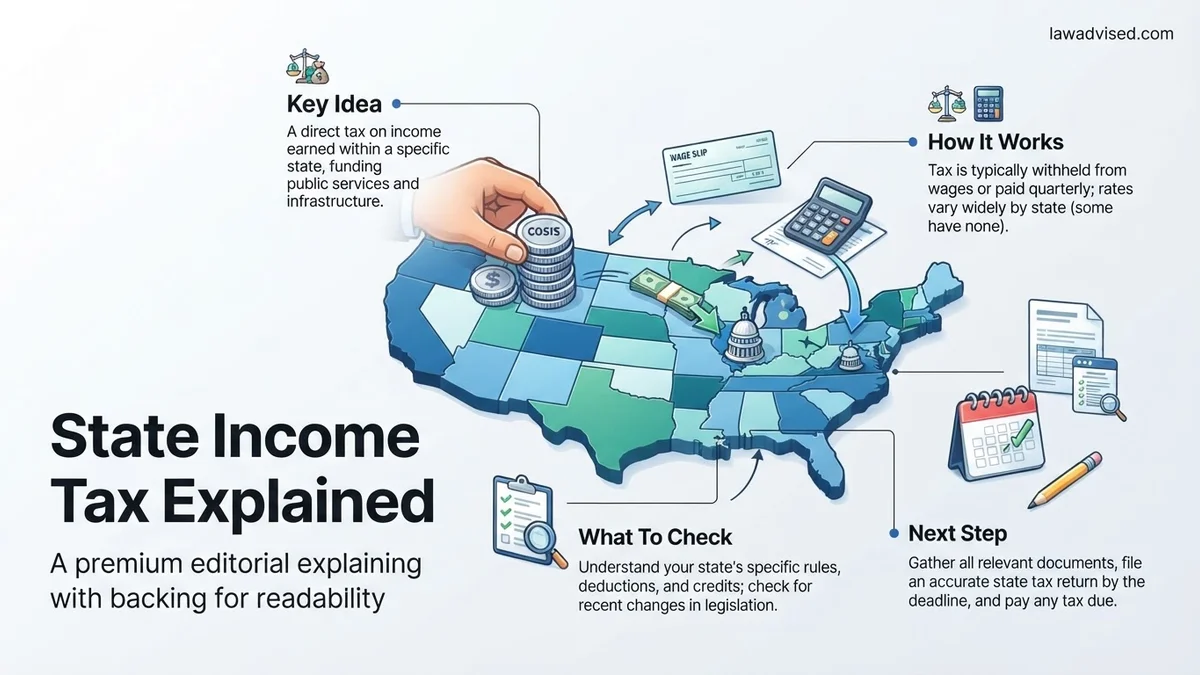
State income tax is a levy imposed by 41 states and Washington, D.C. on the earned income of their residents and workers. Unlike federal taxes, these rates vary drastically across the country, directly shrinking your take-home pay depending on where you live and work.
State income tax is a mandatory percentage of your earnings paid directly to the state government where you live or earn income, functioning entirely separate from your federal tax obligations. While federal taxes fund national programs, your state income tax finances local infrastructure, public education, state parks, and emergency services.
As you navigate your personal finances in 2026, understanding this dual tax system is crucial for accurate budgeting and avoiding unexpected bills. Because your state and federal taxes operate on separate rules, brackets, and filing deadlines, managing your take-home pay requires looking closely at both systems simultaneously.
Key Takeaways
- Forty-one states and Washington, D.C., levy a standard state income tax on earnings.
- States use three distinct tax structures:progressive brackets, flat rates, and zero tax.
- State taxes are filed and calculated entirely separate from your federal tax return.
- Nine U.S. states currently levy no traditional income tax on wages.
- Moving across state lines mid-year triggers dual-status tax filing requirements.
What Causes State Income Tax Obligations — Mechanics and Residency Rules
Understanding Your Tax Home and Domicile
Your legal residence, or domicile, dictates which state has the right to tax your worldwide income. If you live in a state for more than 183 days a year, you are generally classified as a statutory resident. Your tax home is where you permanently reside and intend to return.
Handling Multi-State Income and Remote Work
Remote work complicates state tax obligations significantly. If you live in New Jersey but work for a company based in New York, you may trigger tax liabilities in both states. Most states offer tax credits for taxes paid to another jurisdiction to prevent double taxation, but filing multi-state returns requires careful tracking of your work days.
- Resident State: Taxes 100 percent of your income, regardless of where you earned it.
- Non-Resident State: Taxes only the income earned physically within its borders.
- Reciprocity Agreements: Special pacts between neighboring states allow you to pay tax only to your home state.
How to Fix Your Withholdings — Step-by-Step State Tax Management
Submitting Form W-4 and State Equivalents
Your employer withholds state income tax from each paycheck based on the forms you fill out when starting a job. Unlike the federal W-4, most states require their own specific state withholding certificate to calculate local deductions accurately. If you skip this step, your employer might default to the highest withholding rate.
Adjusting Your Paycheck to Avoid Surprises
Life changes like moving, getting a raise, or switching to remote work mean your current withholdings are likely out of date. Review your pay stubs quarterly to ensure your state deductions match your expected 2026 liability.
- Pull a recent pay stub: Check the year-to-date state tax withheld versus your total gross income.
- Calculate your projected liability: Estimate your annual state taxable income using your current salary.
- Submit a revised state form: Give your HR department an updated withholding certificate to increase or decrease deductions immediately.
What If You Move or Work Across State Lines — Dual-State Fallbacks and Solutions
Working in one state while living in another complicates tax obligations significantly. Taxpayers frequently face the risk of double taxation without proper navigation of state reciprocity agreements.
Understanding Reciprocity Agreements
Neighboring states often establish reciprocity agreements to ease the burden on cross-border commuters. Under these pacts, workers pay income tax only to their state of residence, not their state of employment. For example, a resident of New Jersey working in Pennsylvania can submit Form REV-419 to exempt their wages from Pennsylvania withholding. According to data from the Federation of Tax Administrators, roughly 16 states currently maintain these reciprocal arrangements.
Handling Non-Reciprocal States
When states lack a reciprocity agreement, employees must file non-resident tax returns in the state where they earned the income. The resident state typically offers a tax credit for taxes paid to the non-resident state to prevent dual taxation. Tax experts emphasize calculating both returns carefully to ensure the credit matches the out-of-state liability accurately.
What If It Still Doesn’t Work?
Navigating complex multi-state tax situations or unexpected state audits requires structured escalation steps. If standard filing methods or payroll adjustments fail to resolve state tax discrepancies, follow these fallback procedures:
- Review payroll withholding adjustments: Submit a revised Form W-4 or state-specific equivalent to your employer’s human resources department immediately to correct ongoing withholding errors for 2026.
- Contact the state department of revenue: Call or use the secure online portal of the specific state tax agency to request a formal account transcript and clarify disputed liabilities.
- File an amended state return: If you discovered an error after filing, submit the appropriate state amendment form, such as federal Form 1040-X paired with its state counterpart, usually within the mandatory 3-year statute of limitations.
- Consult a certified tax professional: Engage a Certified Public Accountant (CPA) or enrolled agent specializing in multi-state taxation if state notices escalate to garnishments or liens. Professional consultation fees for complex multi-state resolutions typically range from $300 to $1,500 depending on the severity of the discrepancies.
Conclusion
Mastering state income tax rules protects earners from unexpected liabilities and dual taxation penalties, especially when managing interstate employment. According to verified research and expert sources from the Tax Foundation, proactive tax planning and accurate residency tracking remain the most effective defenses against compliance errors. Take your next actionable step today by reviewing your current paystub withholdings and state tax registration status for 2026.
❓ Frequently Asked Questions
What is state income tax and how does it differ from federal tax?
State income tax is a mandatory percentage of earnings collected by state governments to fund local infrastructure, education, and public services. It operates independently from the federal income tax system, meaning it uses separate tax brackets, deductions, and filing forms.
Which states currently have no income tax?
Alaska, Florida, Nevada, South Dakota, Tennessee, Texas, Washington, and Wyoming levy no income tax on earned wages. New Hampshire does not tax earned wages either, though it taxes certain interest and dividend income until its full phase-out.
How do progressive state income tax brackets work?
In a progressive system, your income is divided into brackets, and each bracket is taxed at a progressively higher rate. Only the income falling within a specific bracket is taxed at that rate, rather than your entire income being taxed at the highest tier.
What is a flat state income tax and which states use it?
A flat tax applies a single, unchanging tax rate to all taxable income regardless of how much you earn. States like Illinois, Pennsylvania, and Indiana utilize a flat tax structure for simplicity.
How do remote workers handle state income taxes when living in one state and working in another?
Remote workers generally owe income tax to their state of physical residence. However, some states enforce ‘convenience of the employer’ rules, which can tax remote workers based on where their employer’s physical office is located.
What happens if I fail to file my state income tax return?
Failing to file your state tax return can result in financial penalties, compounding interest on unpaid balances, and state-level tax liens or wage garnishments. State tax agencies regularly cross-reference federal returns to catch missing state filings.

Ismail Hossain is the founder of Law Advised. He is an Divorce, Separation, marriage lawyer. Follow him.