Can Married Person File Head of Household 2026 Expert Guide
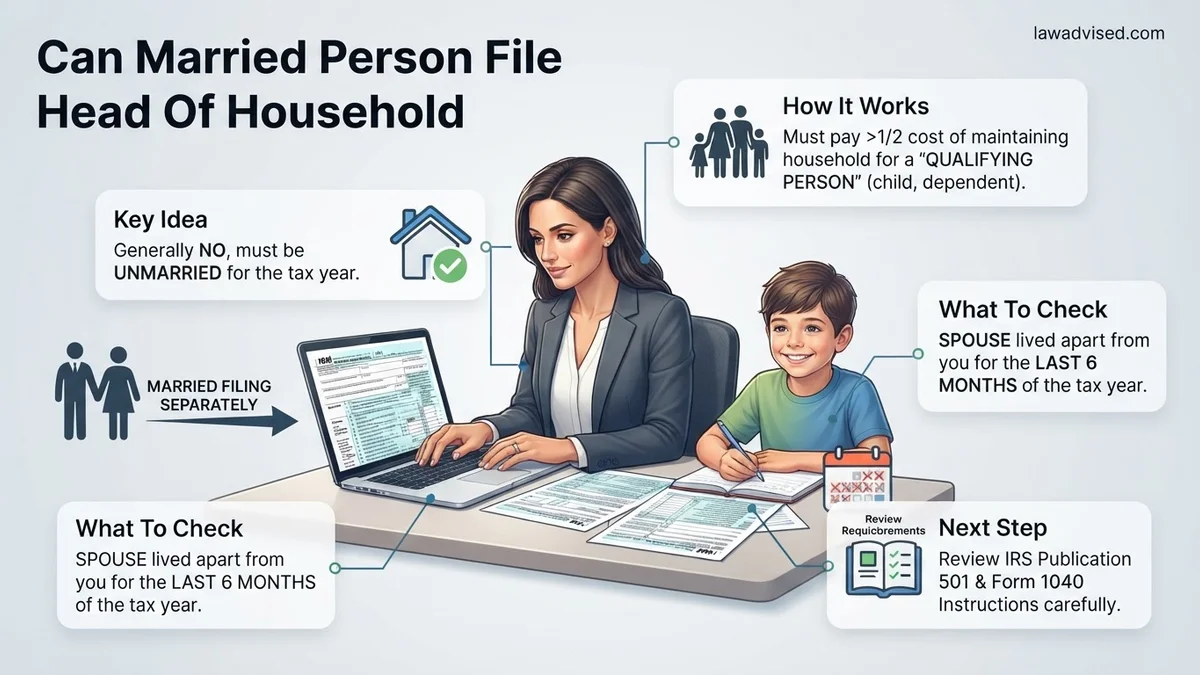
Yes, a legally married person can file as head of household, but only if they meet extremely strict IRS criteria. Most married couples do not qualify unless they lived apart for the final six months of the tax year and paid over half the cost of maintaining a home for a qualifying dependent.
Yes, a legally married person can file as Head of Household, but only if you meet a very strict set of IRS criteria known as being considered unmarried. Most married couples must file as either married filing jointly or married filing separately, but the Head of Household status offers a higher standard deduction and more favorable tax brackets for those who qualify.
Navigating this status correctly for the 2026 tax year protects you from costly IRS audits and incorrect withholding penalties. If you are separated from your spouse and maintaining a home for a dependent child, understanding these exact rules determines whether you can legally claim this beneficial filing status.
Key Takeaways
- You must not have lived with your spouse at any time during the last six months of the tax year.
- You must pay more than half the cost of keeping up your home.
- A qualifying dependent, such as a child, must live in your home for more than half the year.
- Filing as head of household offers a higher standard deduction than married filing separately.
- Failing any single IRS test means you must choose a different filing status.
What Causes Married Taxpayers to Misunderstand Head of Household Status
The Legal Marriage Trap
The biggest point of confusion for taxpayers is the difference between marital status under state law and marital status under federal tax law. Even if you have been living apart from your spouse for several years, you are still legally married in the eyes of the IRS until a court finalizes a divorce. Many people assume that physical separation automatically grants them single or head of household status. However, the IRS requires you to meet specific statutory tests to bypass the joint filing requirement while a marriage is still legally intact.
Misinterpreting the Half-Year Rule
Another common mistake involves miscalculating the timeline of physical separation. Taxpayers often look at a rolling twelve-month period rather than the specific calendar year. If you reconciled briefly during the tax year, or if your spouse moved out in November, you likely violate the strict timeline mandated by the federal government.
- Assuming a legal separation agreement equals being considered unmarried for taxes.
- Confusing child custody agreements with IRS dependency and household support tests.
- Failing to realize that living in the same apartment building or duplex with your spouse can disqualify you.
How to Qualify as Unmarried Under IRS Rules for 2026
The Six-Month Separation Timeline
To file as Head of Household while legally married for the 2026 tax year, you must pass the time test regarding your living arrangements. You cannot have lived with your spouse at any time during the last six months of 2026. This means your spouse must have moved out permanently on or before July 1, 2026. If your spouse stayed with you for even a single night in July or later, you immediately lose eligibility for this status for the 2026 tax year, regardless of your other circumstances.
Financial Support and Dependent Requirements
Beyond the separation timeline, your household finances must meet two additional statutory thresholds for the 2026 tax year.
- You must pay more than half the cost of keeping up your home for the entire year.
- Your home must be the main home of a qualifying dependent, such as your child, stepchild, or foster child, for more than half of 2026.
- Qualifying costs include rent, mortgage interest, real estate taxes, insurance, repairs, utilities, and groceries eaten in the home.
Step-by-Step Guide to Filing as Head of Household While Married
Filing under the Head of Household status while legally married requires careful documentation to satisfy IRS guidelines for the 2026 tax year. Taxpayers must navigate specific procedural safeguards to ensure compliance with the Internal Revenue Code.
Step 1: Verify the Separate Maintenance Requirement
- Review the calendar to confirm your spouse did not live in your home during the last six months of 2026.
- Gather proof of separate residences, such as a formal lease agreement, utility bills in your spouse’s name at a different address, or a legal separation decree.
Step 2: Establish Financial Independence
- Calculate your household expenses to prove you paid more than 50 percent of the total costs of keeping up your home for the entire year.
- Compile receipts, mortgage statements, grocery bills, and property tax records for verification.
Step 3: Confirm Qualifying Dependents
- Identify a qualifying dependent, such as a biological child, stepchild, or adopted child, who lived with you for more than half of 2026.
- Ensure you can claim the dependent as an exemption, or that you could claim them except for the custodial parent release rules under IRC Section 152(e).
What If Your Spouse Lived With You and You Do Not Qualify
If your spouse resided in your home for any part of the final six months of 2026, you cannot legally utilize the Head of Household filing status. Attempting to do so triggers automated IRS mismatch notices and potential audits. Taxpayers failing this test must pivot to alternative filing methods to maintain tax compliance.
When the Head of Household criteria cannot be met, taxpayers should evaluate these structural alternatives:
- File as Married Filing Jointly: This remains the most financially advantageous status for most couples, offering significantly higher standard deductions and tax brackets.
- File as Married Filing Separately: Choose this route if financial separation, liability protection, or pending divorce proceedings make joint filing impossible, keeping in mind that this status forfeits many tax credits.
- Consult a Certified Public Accountant (CPA): Engage a licensed tax professional to review complex separation timelines or state-specific community property laws. Professional consultation fees for married filing status reviews typically range from $250 to $600 depending on complexity.
- Utilize IRS Interactive Tax Assistant: Run your exact household and residency details through the official 2026 IRS online tool to confirm your absolute baseline eligibility before software submission.
Conclusion
Filing as Head of Household while legally married in 2026 is strictly reserved for individuals who maintained a separate household, paid the majority of living expenses, and provided a home for a qualifying dependent for over half the year. According to verified research and tax expert sources from the IRS and National Association of Tax Professionals, misinterpreting the final six-month residency rule is a primary trigger for federal tax audits and delayed refunds. The most effective next step is to pull your complete financial and residential records for 2026 to verify that your separate maintenance timeline withstands IRS scrutiny before submitting your return.
❓ Frequently Asked Questions
What exact timeline must a married person follow to be considered unmarried by the IRS?
To be considered unmarried for head of household purposes, your spouse must not have lived in your home for the final six consecutive months of the tax year. Temporary absences for business, medical care, or school do not reset this separation period.
What expenses count toward paying more than half the cost of maintaining a home?
Qualifying expenses include rent, mortgage interest, real estate taxes, property insurance, utilities, repairs, maintenance, and food eaten in the home. Expenses do not include the cost of clothing, education, medical treatment, vacations, or life insurance.
Can I use head of household if I lived apart from my spouse for only five months of the year?
No. The IRS rule strictly requires that you live apart from your spouse for the last six months of the calendar year. Falling short by even a few days will disqualify you from this filing status.
What happens if I mistakenly file as head of household when I am married and living with my spouse?
Filing incorrectly can trigger an IRS audit, leading to the recalculation of your taxes, back taxes owed, potential penalties, and interest charges. The IRS matches tax returns against W-2 and 1099 data, making household status discrepancies easy for them to flag.
Does having a signed separation agreement change the head of household rules?
A separation agreement is useful for legal purposes, but the IRS relies strictly on physical living arrangements and financial support tests. Even with a signed agreement, you still must not have lived together during the final six months of the year.
If I do not qualify for head of household, what is my best alternative filing status?
If you do not meet the strict separation requirements, your choices are typically Married Filing Jointly or Married Filing Separately. Most taxpayers choose Married Filing Jointly unless there are specific legal or financial reasons to separate their tax liabilities.

Ismail Hossain is the founder of Law Advised. He is an Divorce, Separation, marriage lawyer. Follow him.