How Filing Status Affects Taxes Expert 2026 Guide
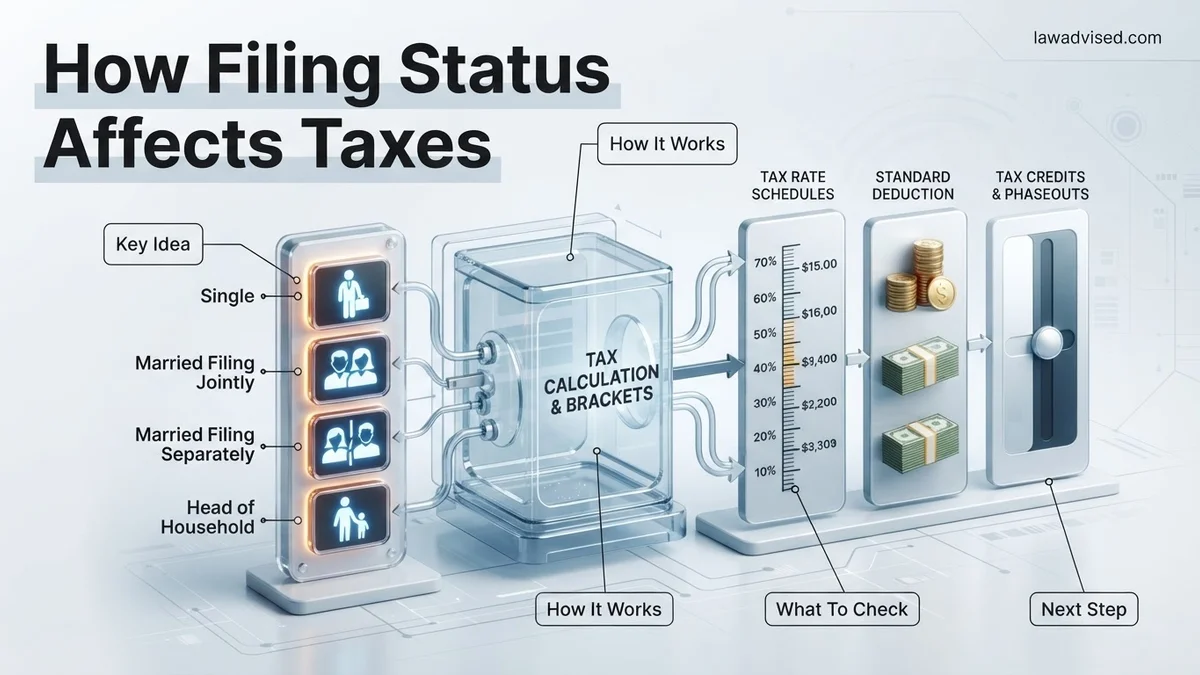
Your choice of IRS filing status directly dictates your standard deduction, tax bracket thresholds, and overall tax liability. Selecting the incorrect category can trigger costly penalties or cause you to miss out on valuable credits.
Your IRS filing status directly dictates your standard deduction, tax bracket thresholds, and eligibility for specific tax credits, fundamentally determining your overall tax liability for 2026. Choosing the wrong status can lead to underpaid taxes, costly IRS audits, or missed refunds.
Navigating these categories requires precision because standard deductions vary significantly. For instance, the 2026 standard deduction for single filers is projected at $15,000, while married couples filing jointly receive double that amount at $30,000. Matching your actual household and marital situation on December 31, 2026, to the exact IRS definition ensures you neither overpay nor trigger compliance flags.
Key Takeaways
- Filing status determines your exact standard deduction amount for the tax year.
- Tax bracket income thresholds shift significantly depending on whether you file jointly or separately.
- Head of Household offers much lower tax rates than Single status for eligible parents.
- Married Filing Separately often disqualifies you from major tax credits like the EITC.
- Your marital status on the final day of the tax year controls your filing status.
What Causes Filing Status Errors and Tax Penalties
Filing status errors usually stem from misinterpreting legal marital status, misunderstanding dependent support rules, or using outdated household definitions. The IRS cross-references Social Security numbers, making mismatched statuses between divorced or separated spouses immediately visible.
Common Married Filing Mistakes
Couples often stumble when their life changes occur late in the year. Your marital status for the entire 2026 tax year is determined by your legal status on December 31, 2026. If you separate in December without a final decree of divorce, the IRS still considers you married for that tax year. Attempting to file as Single while legally married triggers automated IRS mismatch notices, interest, and accuracy-related penalties.
Head of Household Misclassification
The Head of Household status offers a higher standard deduction and wider tax brackets than Single status, making it a frequent source of aggressive auditing. Common errors include claiming this status without a qualifying dependent, failing to pay more than half the household upkeep costs, or using a dependent who does not meet the strict IRS relationship and residency tests for the entire year.
How to Choose the Correct Filing Status Step-by-Step
Selecting the right status prevents costly amended returns and keeps your tax liability strictly minimized. Follow a logical sequence to isolate the single category that matches your exact 2026 circumstances.
Step 1: Evaluate Your Legal Marital Status
Start by confirming your legal standing on the last day of the tax year.
- If you are unmarried, divorced, or legally separated under state law by December 31, 2026, you must choose between Single or Head of Household.
- If you are legally married, you must choose between Married Filing Jointly or Married Filing Separately.
- If your spouse passed away recently, you may qualify for Qualifying Surviving Spouse if you have a dependent child.
Step 2: Test for Head of Household Qualifications
If you are unmarried, do not automatically default to the Single filing status. Check if you qualify for Head of Household, which provides a significantly higher standard deduction for 2026. You must meet three strict criteria:
- You were unmarried or considered unmarried on the last day of 2026.
- You paid more than half the cost of keeping up a home for the year.
- A qualifying dependent lived with you in that home for more than half of 2026, barring temporary absences for school or medical care.
How to Fix Incorrect Tax Filings and Amend Returns
Filing under the wrong status happens more often than taxpayers realize. According to IRS compliance data, millions of returns are adjusted annually due to incorrect status selections. Catching this mistake requires prompt action to avoid underpayment penalties and delayed refunds.
Steps to Correct Your Status
- Wait for your original return to be fully processed by the IRS before taking any action.
- Obtain Form 1040-X, Amended U.S. Individual Income Tax Return, for the 2026 tax year.
- Recalculate your income, deductions, and tax liability using the correct filing status.
- Attach any new or revised schedules, such as Schedule A or Schedule E, that are impacted by the status change.
- Mail the completed paper form to the appropriate IRS processing center, or submit it electronically if your tax software supports 2026 e-filing for amended returns.
The IRS typically processes amended returns within 16 to 20 weeks. If the correction results in an additional tax owed, paying immediately minimizes accrued interest.
What If Your Marital Status Changed Mid-Year
Life events like marriage, divorce, or the death of a spouse drastically impact your tax obligations. IRS regulations dictate that your legal status on the final day of the tax year determines your status for the entire 12-month period.
Navigating Life Changes
- For marriages, couples legally married by December 31, 2026, must file either Married Filing Jointly or Married Filing Separately for the entire year.
- For divorces, individuals whose divorce decree is finalized by December 31 are considered unmarried for the entire tax year.
- For widowed taxpayers, surviving spouses who have a dependent child may qualify for the Qualifying Widow(er) status for up to two years following the loss.
Tax experts emphasize reviewing withholding adjustments whenever a major life event occurs. Submitting a new Form W-4 to your employer prevents unexpected tax bills.
What If It Still Doesn’t Work?
If your attempts to amend a return or resolve a filing status dispute stall with the IRS, you need escalating fallback measures. Follow these steps to secure a resolution:
- Check the status of your amended return online using the IRS “Where’s My Amended Return?” tool, available 3 weeks after submission.
- Contact the IRS dedicated taxpayer assistance line directly at 1-800-829-1040 to speak with a representative regarding complex status discrepancies.
- Engage a certified public accountant (CPA) or an Enrolled Agent (EA) to intercede on your behalf. Professional representation for IRS correspondence typically costs between $300 and $1,000 depending on complexity.
- Request assistance from the Taxpayer Advocate Service (TAS), an independent organization within the IRS, if you are experiencing severe financial hardship due to a delayed refund or status dispute.
Conclusion
Choosing the correct filing status is the single most critical decision on your tax return, directly dictating your standard deduction and tax brackets. When errors occur or life circumstances shift, utilizing Form 1040-X promptly safeguards your financial standing. According to verified research and expert tax sources, proactive compliance prevents costly audits and maximizes legitimate deductions. Take action today by reviewing your 2026 tax documents against current IRS guidelines to ensure absolute accuracy.
❓ Frequently Asked Questions
How do standard deductions vary across the five filing statuses?
Each filing status has a unique standard deduction amount set by the IRS, with Married Filing Jointly receiving the highest baseline deduction, followed by Head of Household, and Single and Married Filing Separately receiving lower amounts.
What are the main financial risks of filing as Married Filing Separately?
Choosing to file separately strips away eligibility for numerous lucrative tax breaks, including the Earned Income Tax Credit, the Child and Dependent Care Credit, and certain education credits.
Can I use Head of Household if I am legally married?
Yes, if you meet the ‘abandoned spouse’ rules, meaning you lived apart from your spouse for the last six months of the tax year and paid more than half the cost of maintaining a home for a qualifying child.
How do tax brackets change between Single and Married Filing Jointly statuses?
While joint brackets do not always precisely double the single thresholds, they generally provide significantly wider income bands before pushing joint filers into higher marginal tax rates.
Does my filing status depend on my status on January 1st or December 31st?
The IRS determines your marital status and corresponding filing options based entirely on your legal status on the final day of the tax year, December 31st.
What qualifies a taxpayer as a Qualifying Surviving Spouse?
This status is available for two years following the death of a spouse, provided the surviving taxpayer has a dependent child and maintains a home that serves as the primary residence for that child.

Ismail Hossain is the founder of Law Advised. He is an Divorce, Separation, marriage lawyer. Follow him.