How Filing Status Affects Tax Refund Expert 2026 Guide
Your choice of filing status directly determines your standard deduction and tax bracket thresholds, which heavily dictates whether you owe money or get a refund. Selecting the incorrect status can cost you thousands of dollars in missed tax savings. This guide breaks down the math behind each category to maximize your refund.
Your filing status directly dictates your standard deduction amount and tax bracket thresholds, creating the foundational math that either inflates or shrinks your tax refund. When you choose a status like Head of Household instead of Single, the IRS nearly doubles your standard deduction and widens your lower tax brackets, meaning significantly more of your hard-earned income is shielded from federal taxes.
For your 2026 tax return, picking the mathematically optimal filing status is the single most powerful move you can make to lower your tax liability and maximize your refund. Filing under the wrong status doesn’t just trigger IRS processing delays or audits—it can leave thousands of dollars on the table by applying smaller deductions and harsher tax rates to your income.
Key Takeaways
- Filing status dictates your standard deduction and tax brackets.
- Head of Household provides larger deductions than Single status.
- Married Filing Jointly usually yields the lowest overall tax liability.
- Choosing Married Filing Separately often forfeits valuable tax credits.
- Your marital status on the last day of the tax year is legally binding.
What Causes Filing Status to Alter Your Tax Refund
The Standard Deduction Math
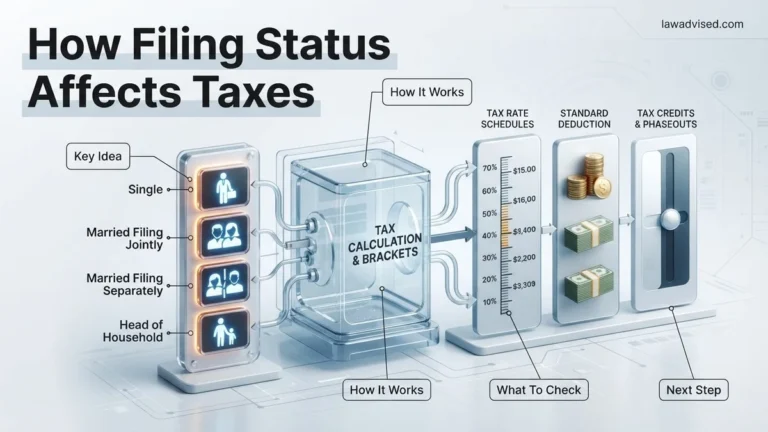
The standard deduction is a flat, no-questions-asked amount that reduces the income you are taxed on. Because the IRS scales this deduction based on your filing status, your choice here immediately shifts your taxable income baseline.
- Single and Married Filing Separately: Feature the lowest baseline standard deduction amounts for 2026.
- Married Filing Jointly: Roughly doubles the Single deduction, designed to account for combined household expenses.
- Head of Household: Provides a middle-ground deduction that is significantly higher than Single, rewarding unmarried taxpayers who pay more than half the cost of keeping up a home for a qualifying dependent.
Tax Bracket Thresholds and Margins
Tax brackets dictate the percentage of tax you pay on incremental blocks of income. Filing status changes where those bracket lines are drawn.
- Bracket Stretching: A Married Filing Jointly status stretches the 10 percent and 12 percent tax brackets much further than a Single status.
- The Marriage Penalty Risk: For very high-earning dual-income couples, combining incomes can push them into higher marginal brackets faster under Married Filing Jointly compared to filing separately.
- Refund Impact: Wider brackets mean a larger portion of your income is taxed at lower rates, lowering your overall tax liability and driving up your potential refund.
How to Fix and Choose the Best Filing Status for Your 2026 Taxes
Evaluating Marital and Household Reality
Your legal marital status on the last day of 2026 legally locks in your baseline choices, but your living arrangements dictate your specific sub-category. You must weigh the actual financial outcomes of your status options rather than just defaulting to what is easiest.
- Married Filing Jointly vs. Separately: Joint filing almost always yields a larger refund due to access to more credits and better tax brackets. Separate filing is typically only used to isolate liability from a spouse’s tax debts or in specific legal separation scenarios.
- Qualifying Surviving Spouse: If your spouse passed away in 2024 or 2025 and you have a dependent child, you may qualify for this status, which grants you the same generous tax brackets and standard deduction as Married Filing Jointly for 2026.
Correcting a Mistaken Filing Status
If you realize you selected the wrong filing status after submitting your return, the fix requires prompt action to protect your refund or correct a balance due.
- Wait for Processing: Do not file an amended return immediately. Let the IRS process your original 2026 tax return first.
- File Form 1040-X: Submit an amended return to switch your status. If the change increases your standard deduction, expect a supplementary refund check or direct deposit.
- Avoid Common Traps: Claiming Head of Household while failing to meet the strict dependent support rules is a top trigger for IRS audits. Ensure your household financial records match IRS definitions before filing.
Step-by-Step Guide to Evaluating Head of Household vs Single Status
Filing as Head of Household instead of Single offers a significantly higher standard deduction and a more advantageous tax bracket structure, which typically maximizes your tax refund. According to IRS compliance data, millions of taxpayers mistakenly file as Single when they qualify for the superior Head of Household status.
Evaluating Your Eligibility
- Verify your marital status on the last day of the tax year. You must be considered unmarried or legally separated under state law by December 31, 2026.
- Confirm that you paid more than half the cost of keeping up a home for the year. This includes rent, mortgage interest, utilities, property taxes, and groceries.
- Identify a qualifying dependent. This is usually a child who lived with you for more than half the year and meets specific age and relationship criteria.
- Review temporary absence rules if your dependent was away at school or receiving medical care, as they may still count toward your household maintenance.
Calculating the Financial Impact
- Run a mock tax calculation using your W-2 data and 2026 inflation-adjusted thresholds for both Single and Head of Household categories.
- Compare the projected standard deduction amounts to see the immediate taxable income reduction.
- Assess the Child Tax Credit and Earned Income Tax Credit limits, which expand favorably under Head of Household filing.
What If Your Filing Status Was Entered Incorrectly on Prior Returns?
Discovering an error on a submitted tax return can cause anxiety, but the IRS provides a formal amendment process to reclaim missed refund money. Tax regulations permit you to correct your filing status and claim an additional refund up to three years from the original filing deadline.
Correcting Past Returns
- Obtain Form 1040-X, Amended U.S. Individual Income Tax Return, for the specific tax year requiring correction.
- Gather all original documents, including W-2s, 1099s, and records proving your household maintenance costs for that year.
- Recalculate your tax liability using the correct filing status, clearly noting the net difference in your expected refund.
- Submit the completed amendment either electronically through modern tax software or by mailing a paper form to the appropriate IRS service center.
What If It Still Doesn’t Work?
Navigating complex dependency rules and multi-status scenarios can sometimes result in rejected returns or unexpected tax liabilities. If standard adjustment methods fail to secure your expected tax refund, consider these structured troubleshooting steps:
- Double-check all Social Security numbers and dependent birth dates against official government documents for data entry typos.
- Review IRS notice letters carefully to identify the specific code or discrepancy holding up your return processing.
- Consult a Certified Public Accountant (CPA) or an Enrolled Agent (EA) who specializes in individual tax compliance. Professional consultation fees typically range from $250 to $600 depending on the complexity of your amended or unfiled returns.
- Utilize the IRS Volunteer Income Tax Assistance (VITA) program if you meet their income thresholds for free, expert-guided return reviews.
Conclusion
Filing status serves as the foundational multiplier for your standard deduction, tax brackets, and ultimate tax refund amount. Selecting the correct status requires careful adherence to IRS guidelines regarding household maintenance and dependent care. According to verified research and tax authority data, utilizing professional software or certified assistance prevents costly classification errors. Your actionable next step is to review your current withholding documents and projected 2026 filing criteria to ensure optimal refund results.
❓ Frequently Asked Questions
How does the standard deduction change across different filing statuses?
Each filing status has a unique standard deduction amount set by the IRS. Married Filing Jointly receives the largest deduction, followed by Head of Household, with Single and Married Filing Separately receiving the lowest amounts.
Why does Married Filing Separately often result in a smaller refund?
Choosing to file separately disqualifies you from many lucrative tax credits and deductions, such as the Child and Dependent Care Credit, and splits tax bracket thresholds in half.
What specific criteria make a single parent eligible for Head of Household?
To qualify, you must be unmarried on the last day of the year, pay more than half the cost of keeping up a home, and have a qualifying dependent live with you for more than half the year.
Can I amend my tax return if I chose the wrong filing status?
Yes, you can file an amended return using Form 1040-X to change your filing status, which may result in a larger refund if you overlooked a better category.
How do tax brackets shift based on whether I file alone or jointly?
Tax bracket income thresholds widen significantly for joint filers, allowing married couples to earn more money before moving into higher percentage tax brackets.
What if my spouse and I are going through a divorce during tax season?
If you are not legally divorced or legally separated by December 31, the IRS still considers you married for that entire tax year, requiring you to file jointly or separately.

Ismail Hossain is the founder of Law Advised. He is an Divorce, Separation, marriage lawyer. Follow him.