Standard Deduction for Seniors 2026 Expert Guide to Amounts
Taxpayers aged 65 or older qualify for an additional standard deduction that increases their overall tax-free income limit. This guide provides the exact 2026 senior standard deduction amounts categorized by every filing status to maximize your tax savings.
For the 2026 tax year, taxpayers aged 65 and older receive a significantly higher standard deduction by combining the base standard deduction with an additional senior standard deduction amount. If you are filing as single and at least 65 years old by the end of 2026, your base standard deduction is projected to be $15,000, plus an additional $2,000 for being a senior, bringing your total standard deduction to $17,000. Married couples filing jointly where both spouses are 65 or older receive a combined base deduction plus a $1,600 additional senior increment for each qualifying spouse.
Navigating these precise dollar amounts is critical for reducing your taxable income accurately and avoiding overpayment. Because tax thresholds adjust annually for inflation, knowing the exact figures for 2026 ensures you claim every dollar you are entitled to keep. This guide breaks down the exact amounts by filing status and walks you through how to calculate your total deduction.
Key Takeaways
- Taxpayers must turn 65 by January 1, 2027, to claim the 2026 senior deduction.
- The additional standard deduction for seniors depends strictly on your filing status.
- Blind taxpayers receive an extra standard deduction amount in addition to the senior boost.
- Filing jointly where both spouses are 65 or older doubles the extra senior deduction.
- Always review the latest IRS inflation adjustments before filing your tax return.
What Causes Confusion About the Standard Deduction for Seniors
Base Deduction Versus the Additional Senior Amount
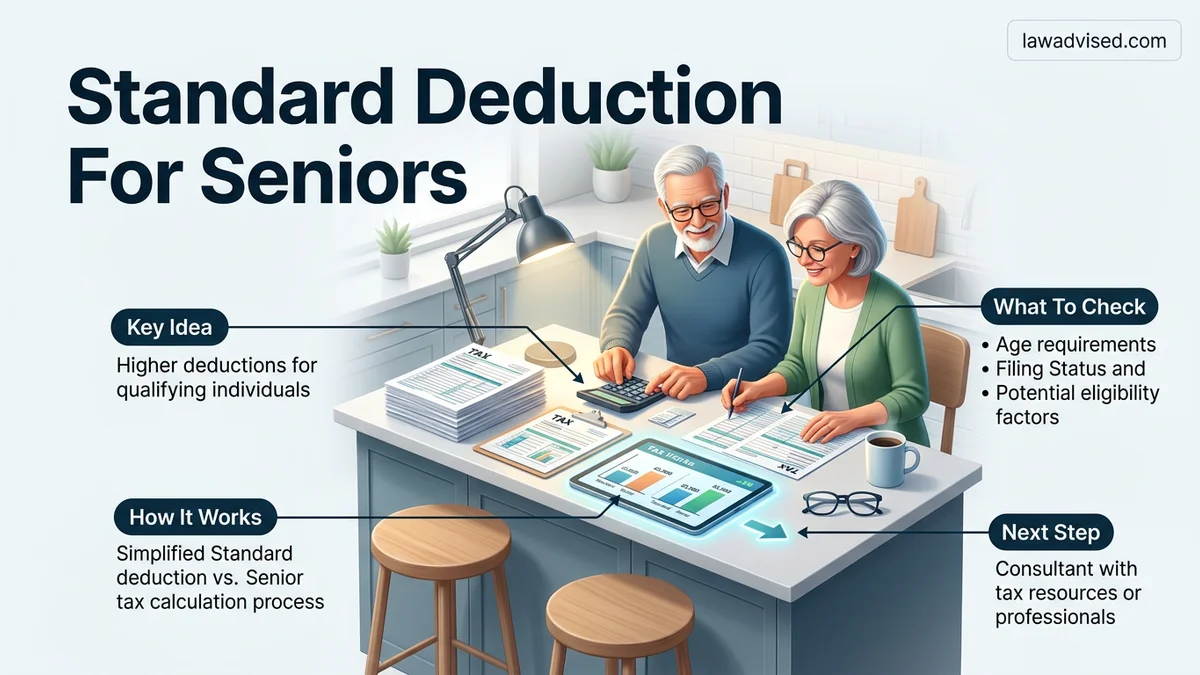
Many taxpayers mistakenly assume the standard deduction for seniors is a single, flat rate that applies to everyone. In reality, the IRS calculates your senior tax break by adding two separate components together: the standard deduction for your specific filing status and the additional standard deduction granted for age. For 2026, keeping these two numbers distinct prevents errors on your tax return. If you only claim the base amount and forget the extra senior increment, you leave money on the table.
Filing Status Complications
Confusion often spikes when determining how the senior addition applies to married couples. You cannot simply double the single senior bonus automatically for every filing category. The extra standard deduction amount varies depending on whether one spouse or both spouses have reached age 65. Blindness also triggers an additional standard deduction amount that stacks on top of the senior bonus, which frequently leads to math errors on Form 1040.
- Single filers age 65 or older get one additional standard deduction amount.
- Married filing jointly couples calculate the additional amount per qualifying spouse who is 65 or older.
- Qualifying surviving spouses use the married filing jointly rules for the additional senior amount.
How to Calculate Your Total 2026 Senior Standard Deduction Step-by-Step
Step 1: Identify Your Base 2026 Standard Deduction
To find your total 2026 deduction, you must start with the correct base amount for your filing status. For single filers, the base is $15,000. For married couples filing jointly, the base is $30,000. Heads of household receive a base of $22,500, and married individuals filing separately use $15,000. Confirm your official filing status for the 2026 tax year before moving to the next step, as choosing the wrong baseline guarantees an inaccurate final calculation.
Step 2: Add the Additional Senior and Blindness Amounts
Once you have your base number, add the extra increments for age and vision. For 2026, the additional standard deduction for being 65 or older is $2,000 for single or head of household filers, and $1,600 per qualifying person for married filing status (joint or separate) and qualifying surviving spouses. If you are also legally blind, you can add another $2,000 (if single) or $1,600 (if married) to your total. For example, a single senior who is 65 and blind will combine $15,000 plus $2,000 plus $2,000 for a total 2026 standard deduction of $19,000.
- Locate your base standard deduction based on your 2026 filing status.
- Check the box on your tax return indicating you were born before January 2, 1962 (making you 65 or older by the end of 2026).
- Add the appropriate $1,600 or $2,000 additional amount for each applicable qualification (age 65+ and/or blindness).
How to Fix Common Tax Filing Errors Involving Age 65 Qualifications
Tax filing errors regarding the senior standard deduction usually stem from misunderstanding the exact birthdate cutoff or miscalculating taxable income streams. According to IRS guidelines, you must turn 65 by January 1, 2027, to claim the additional standard deduction on your 2026 tax return. Failing to update software settings or manually checking the correct box on Form 1040 remains a frequent pitfall.
Correcting Birthdate and Box-Checking Mistakes
If you discover an omission after submitting your return, do not panic. Follow these steps to correct the record:
- Wait until the IRS processes your original 2026 tax return before taking action.
- Obtain IRS Form 1040-X, Amended U.S. Individual Income Tax Return.
- Recalculate your standard deduction using the correct senior age-additional amount.
- Attach any supporting documentation if income or withholding figures changed alongside the deduction update.
- Mail the completed Form 1040-X to the designated IRS processing center for your region, or submit it through your e-file provider if they support electronic amendments.
What If Your Income Exceeds the Standard Deduction Threshold
Exceeding the standard deduction threshold simply means your gross income surpasses the limit required for tax-free filing. This scenario requires you to evaluate whether itemizing deductions yields a larger tax break than the enhanced standard deduction for seniors. Financial experts recommend running both calculations before finalizing your 2026 return.
Evaluating Alternative Tax Strategies
When your income pushes past the standard deduction threshold, consider these strategic shifts:
- Aggregate medical and dental expenses that exceed 7.5 percent of your adjusted gross income to see if itemizing on Schedule A surpasses the senior standard deduction.
- Review charitable contribution limits, including Qualified Charitable Distributions from traditional IRAs, which directly lower your adjusted gross income.
- Consult tax preparation software comparison tools to analyze itemized versus standard deduction outcomes automatically.
- Assess state-specific tax laws, as many states decouple from federal rules regarding senior standard deductions.
What If It Still Doesn’t Work?
If automated software rejections persist or IRS discrepancy notices arrive regarding your age 65 qualifications, manual intervention is required. Try these fallback steps to resolve the issue:
- Double-check your Social Security Administration records to ensure your birthdate is registered accurately on federal databases.
- Print a paper copy of Form 1040, manually enter the senior standard deduction amount on line 12, and mail the return directly.
- Contact a Certified Public Accountant (CPA) or Enrolled Agent (EA) who specializes in senior tax planning. Professional service fees typically range from $250 to $600 depending on complexity.
- Utilize the IRS Volunteer Income Tax Assistance (VITA) program for free tax help if your household income falls below program limits.
Conclusion
Navigating the standard deduction for seniors in 2026 requires strict attention to birthdate rules and accurate form preparation. By securing your correct additional standard deduction, you significantly lower your taxable liability. According to verified research and expert sources from the IRS and major accounting associations, double-checking your initial calculations prevents costly processing delays. Take the actionable next step today by reviewing your tax software settings or consulting a qualified professional to ensure your 2026 filing captures every authorized senior tax break.
❓ Frequently Asked Questions
How is the extra standard deduction calculated for taxpayers age 65 or older?
The IRS adds a specific incremental dollar amount to the standard base deduction depending on your filing status, such as single or married filing jointly.
What exact date determines if I turn 65 for the 2026 tax year?
For the 2026 tax year, you are considered age 65 on the day before your 65th birthday, meaning your birthday must fall on or before January 1, 2027.
Are senior standard deduction amounts adjusted for inflation every year?
Yes, the IRS reviews and adjusts both the base standard deduction and the additional senior standard deduction annually to account for inflation.
What happens if I turn 65 in January of the following year?
If your 65th birthday falls in January, the IRS treats you as not having reached age 65 by the end of the prior tax year, delaying the additional deduction.
Do dependents filing their own taxes qualify for the senior standard deduction?
Taxpayers who can be claimed as a dependent on someone else’s return have a limited standard deduction and are subject to special calculation rules.
Where do I report the standard deduction for seniors on my tax return?
You report your total standard deduction directly on Form 1040 or Form 1040-SR, which is specifically designed for senior taxpayers.

Ismail Hossain is the founder of Law Advised. He is an Divorce, Separation, marriage lawyer. Follow him.