Should I Take Standard Deduction or Itemize? 2026 Guide
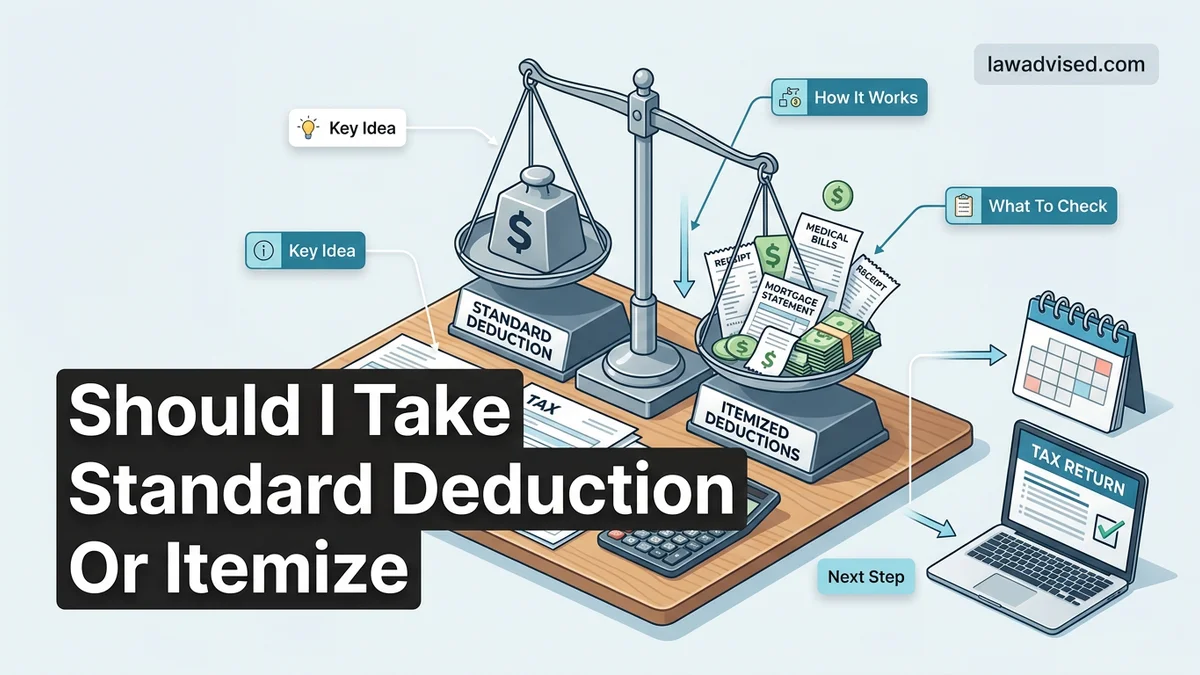
Deciding whether to take the standard deduction or itemize depends entirely on whether your total deductible expenses exceed the 2026 threshold for your filing status. If your itemized expenses are higher than the standard deduction amount, you should itemize. Otherwise, taking the standard deduction is the faster and more financially advantageous choice.
You should take the standard deduction instead of itemizing if your total allowable itemized expenses fall below the IRS threshold for your filing status. For the 2026 tax year, the standard deduction provides a guaranteed, flat-rate reduction of your taxable income that almost 90 percent of American taxpayers choose because it requires zero receipt tracking or complex calculation.
Deciding between the standard deduction and itemizing directly impacts how much money stays in your pocket or comes back to you as a tax refund. If your combined deductible expenses—such as mortgage interest, state and local taxes, and charitable donations—beat the standard deduction limits, itemizing saves you money. If they do not, taking the standard deduction ensures you get the maximum possible tax break with minimal effort.
Key Takeaways
- Compare your total eligible itemized expenses against the specific 2026 standard deduction for your filing status.
- Homeowners with high mortgage interest and property taxes are the most likely to benefit from itemizing.
- Charitable donations, medical expenses exceeding 7.5% of AGI, and state taxes count toward itemizing.
- Take the standard deduction if your itemized expenses fall below the IRS threshold.
- Married couples filing separately must coordinate their deduction choices to match each other.
The Core Dilemma: What Causes Confusion Between Standard and Itemized Deductions
The Tug-of-War Between Simplicity and Savings
Taxpayers often struggle with this choice because they assume itemizing always yields a bigger tax break. In reality, the tax code forces you to pick one path exclusively. You cannot mix and match by taking the standard deduction and adding a few itemized expenses on top. This all-or-nothing rule creates anxiety about leaving money on the table.
Common Misconceptions About Write-Offs
Many people believe that every time they spend money on a good cause or pay a medical bill, it directly lowers their tax bill. However, you only benefit from itemizing if the sum of your eligible expenses beats your baseline standard deduction. If you itemize and your total expenses equal less than the standard deduction, you have unnecessarily increased your tax liability.
- The standard deduction is a flat amount adjusted annually for inflation.
- Itemized deductions require you to track, calculate, and prove every single expense.
- You only cross the finish line if your itemized total beats the statutory threshold.
Step-by-Step Guide to Calculating Your 2026 Deduction Threshold
The Golden Rule of Tax Math
The decision-making formula is straightforward. Look up the 2026 standard deduction for your specific filing status. Next, add up your potential itemized deductions for the year. If your itemized total exceeds the standard deduction amount by even one dollar, you should itemize. Otherwise, take the standard deduction.
Evaluating the 2026 Numbers
To run this math accurately, you need to know the baseline targets you are trying to beat for the 2026 tax year. Compare your estimated expenses against these IRS figures:
- Single: Standard deduction projected near $15,000.
- Married Filing Jointly: Standard deduction projected near $30,000.
- Head of Household: Standard deduction projected near $22,500.
Suppose you are filing as single in 2026 and your mortgage interest plus charitable giving totals $13,500. Because that number sits below the $15,000 standard threshold, you should take the standard deduction and skip itemizing entirely.
How to Fix Low Itemized Totals Using Bunching Strategies
Many taxpayers fall just short of the standard deduction threshold because their deductible expenses are spread evenly across multiple tax years. When expenses hover below the limit annually, you lose valuable tax savings. Financial experts recommend strategic bunching to overcome this hurdle.
The Mechanics of Deduction Bunching
Bunching involves doubling up or accelerating deductible expenses into a single calendar year to force your total well above the standard deduction threshold. In alternating years, you take the standard deduction when your expenses naturally drop. This tactical swing maximizes your lifetime tax savings without increasing your total spending over a two-year window.
Step-by-Step Implementation
- Calculate your baseline deductible expenses for a standard 12-month period to identify your current gap.
- Identify flexible deductions that you can control, such as charitable donations, elective medical procedures, and property tax payments.
- Schedule elective medical and dental procedures late in the current calendar year or early in January to stack them together.
- Contribute multiple years of planned charitable giving into a single calendar year using a Donor-Advised Fund (DAF).
- Pay state estimated taxes or property taxes early if timing rules allow you to squeeze three payments into a single tax year.
What If Your Itemized Expenses Are Right on the Border?
Hovering within a few hundred dollars of the standard deduction creates a unique dilemma for 2026 filers. When your calculated itemized deductions nearly match the threshold, minor mathematical errors or forgotten receipts can alter your optimal filing method. Precision is critical when you are close to the margin.
Evaluating Borderline Scenarios
Tax software often handles borderline calculations automatically by running both scenarios simultaneously. However, you must account for state-level tax interactions as well. According to state tax policy data, many states require you to itemize on your state return if you itemize federally, even if the standard deduction would otherwise be more advantageous locally.
Steps to Resolve Close Calls
When you find yourself on the border of itemizing and taking the standard deduction, use this systematic checklist:
- Audit every potential deduction category to ensure no minor medical mileage, out-of-pocket charitable items, or educator expenses were missed.
- Run a dual calculation using certified tax preparation software to compare federal and state tax liabilities combined.
- Check your specific state tax code to see if decoupling from federal itemization rules is permitted.
- Consult the latest IRS inflation adjustments for 2026 to verify you are using the exact figures updated for the current tax year.
What If It Still Doesn’t Work?
If your calculations consistently show that itemizing yields no financial benefit and bunching strategies fail to close the gap, you must pivot to optimizing the standard deduction. When complex financial situations persist, consider the following fallback steps:
- Maximize above-the-line deductions—such as contributions to traditional IRAs, health savings accounts (HSAs), and student loan interest—which reduce your adjusted gross income independently of itemizing.
- Consult a certified public accountant (CPA) or Enrolled Agent (EA) to review multi-year tax planning strategies tailored to your income bracket. Professional consultation fees typically range from $300 to $800 depending on complexity.
- Utilize IRS Free File or commercial tax software equipped with optimization algorithms to prevent manual calculation errors.
- Revisit your employer withholding using IRS Form W-4 to ensure your take-home pay matches your final tax liability accurately.
Conclusion
Deciding between the standard deduction and itemizing comes down to matching your total qualified expenses against the statutory threshold for 2026. When expenses fall short, tactical bunching can push your totals over the limit to secure maximum tax savings. According to verified research and expert financial sources, proactive multi-year tax planning remains the most effective method for lowering overall lifetime liability. Your actionable next step is to run a preliminary expense tally using current tax software to see how your numbers compare against the established threshold.
❓ Frequently Asked Questions
What is the primary difference between taking the standard deduction and itemizing?
The standard deduction provides a flat, fixed dollar amount reduction of your taxable income based on your filing status with zero documentation required. Itemizing requires you to list and prove every individual eligible expense throughout the year to calculate a custom deduction amount.
Who benefits the most from itemizing deductions on their tax return?
Homeowners carrying large mortgages, individuals with significant medical debt relative to their income, and heavy charitable contributors are the most likely to benefit from itemizing instead of taking the standard deduction.
What is the SALT cap limit for itemized deductions?
The State and Local Tax (SALT) deduction—which includes state income or sales taxes plus property taxes—is capped at a maximum of $10,000 total for most filing statuses.
Are medical expenses easy to qualify for when itemizing?
Medical expenses are notoriously difficult to clear the threshold for because only the portion of your unreimbursed medical expenses that exceeds 7.5% of your adjusted gross income (AGI) can be itemized.
How does ‘bunching’ charitable donations help me itemize?
Bunching involves grouping multiple years’ worth of charitable donations or property tax payments into a single calendar year to push your total itemized expenses well above the standard deduction threshold for that specific year.
What special rules apply to married couples filing separately?
If you are married filing separately, both spouses must use the same method. If one spouse itemizes deductions, the other spouse is forced to itemize as well and cannot take the standard deduction.

Ismail Hossain is the founder of Law Advised. He is an Divorce, Separation, marriage lawyer. Follow him.