Standard Deduction Rules for Nonresidents 2026 Expert Guide
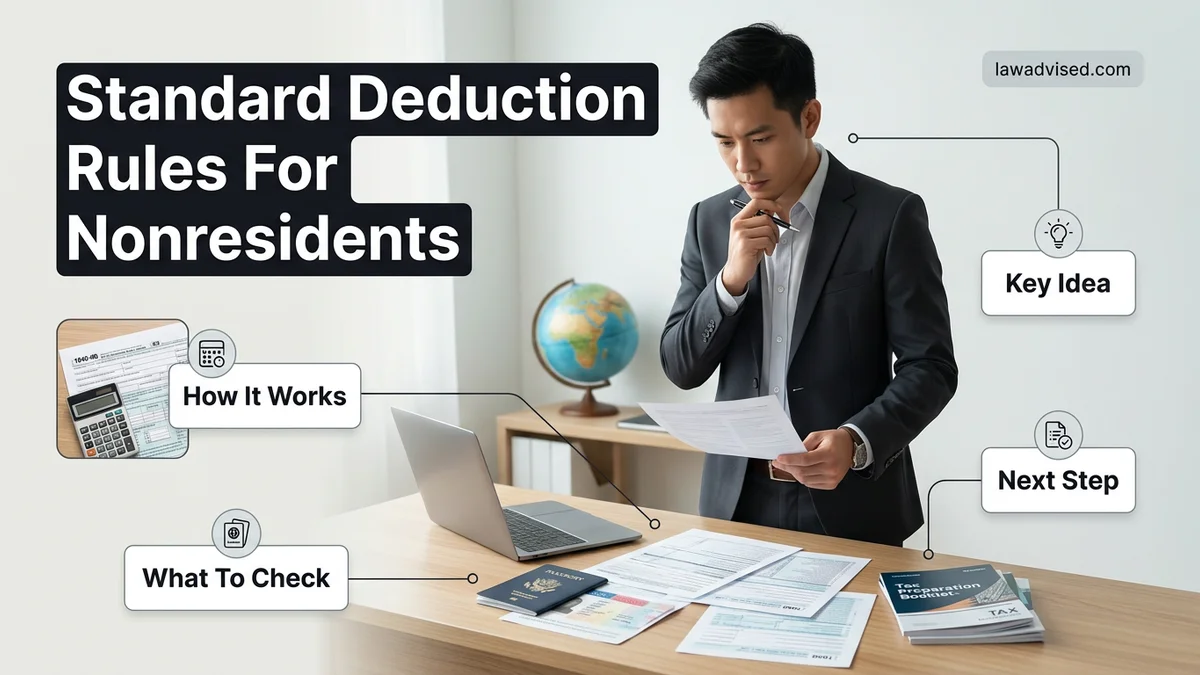
As a nonresident alien, you generally cannot claim the standard deduction on your US federal income tax return and must instead itemize your allowable deductions. The primary exception applies to certain students and business apprentices from India who qualify under specific tax treaty provisions. Understanding your tax residency status is essential to filing Form 1040-NR correctly and avoiding costly IRS penalties.
As a nonresident alien filing a US tax return for 2026, you cannot take the standard deduction. The IRS strictly mandates that nonresident aliens must use the itemized deduction method if they want to reduce their taxable US-source income, with very few exceptions.
This rule catches many international students, temporary workers, and foreign investors off guard. Filing incorrectly by claiming the standard deduction can trigger automatic IRS audits, delays in your tax refund, and severe penalties. Understanding how to handle your deductions properly ensures your 2026 return remains fully compliant.
Key Takeaways
- Nonresident aliens generally cannot take the standard deduction on US tax returns.
- You must file Form 1040-NR and itemize your allowable deductions instead.
- Residents of India may qualify for the standard deduction under specific tax treaty rules.
- Filing status restrictions prevent nonresidents from using the Married Filing Jointly status.
- Dual-status aliens have unique rules regarding standard deductions during transition years.
What Causes Denial of the Standard Deduction for Nonresident Aliens
The Statutory Baseline Under IRS Code Section 63
The Internal Revenue Code draws a hard line between residents and nonresidents regarding tax perks. Under Section 63(c)(6), nonresident aliens are explicitly excluded from claiming the basic standard deduction. Even if you earned all your income inside the United States during 2026, your residency status on Form 1040-NR dictates this restriction. The IRS automated processing systems immediately flag and reject returns where a nonresident alien attempts to claim this amount.
Residency Status Determines Your Eligibility
Your tax status depends on the Green Card Test or the Substantial Presence Test, not your immigration visa category. If you fail both tests for the 2026 tax year, you are classified as a nonresident alien for tax purposes. Key factors that trigger denial include:
- Holding an F-1 or J-1 student visa while being in the US for fewer than five calendar years.
- Holding a J-1 non-student visa (such as a researcher or trainee) while being in the US for fewer than two calendar years.
- Working in the US temporarily on an H-1B or L-1 visa without meeting the substantial presence day count.
How to Fix Your Filing Strategy by Itemizing Allowable Deductions
Shifting Your Focus to Schedule A
Because you cannot claim the standard deduction on your 2026 Form 1040-NR, you must pivot to itemizing your deductions using Schedule A. While US citizens often find itemizing tedious, it is your only statutory route to lowering your taxable income. You can deduct specific expenses directly tied to your US employment or income generation, provided you have the proper receipts and documentation to back them up.
What You Can Actually Deduct
Nonresident aliens cannot deduct personal expenses, but certain connected costs are fully allowable. To build a valid itemized deduction profile for 2026, focus on these categories:
- State and local income taxes: Taxes withheld from your paycheck by your state or city of residence.
- Charitable contributions: Cash or property donations made to qualified US tax-exempt organizations.
- Job-related expenses: Unreimbursed employee business expenses that exceed two percent of your adjusted gross income, if applicable.
- Casualty losses: Losses from federally declared disasters affecting your US-located property.
Step-by-Step Guide to Claiming India Tax Treaty Exceptions
Nonresident aliens are generally barred from taking the standard deduction, but a specific exception exists for residents of India under Article 21(2) of the US-India Income Tax Treaty. According to verified IRS technical publications, Indian students and business apprentices can claim the standard deduction if they meet strict criteria.
Eligibility and Filing Requirements
To successfully claim this treaty-based exception on your 2026 federal tax return, you must navigate a precise procedural pathway. Tax experts emphasize that missing a single form will trigger automated IRS rejections.
- Verify that you qualify as a nonresident alien from India under the primary residency rules and the Closer Connection Exception test.
- Complete Form 1040-NR (Nonresident Alien Income Tax Return) for the 2026 tax year, ensuring you report all worldwide US-connected income accurately.
- Attach IRS Form 8833 (Treaty-Based Return Position Disclosure Under Section 6114 or 7701(b)) to formally disclose your reliance on the US-India tax treaty provisions.
- Calculate your allowable standard deduction using the specific worksheet provided in the official IRS instructions for Form 1040-NR, rather than standard resident amounts.
- Mail your complete tax package to the designated IRS processing center, as treaty-based claims often require paper filing rather than standard electronic submission.
What If It Still Doesn’t Work and You Need Dual-Status Filing Solutions
If your standard deduction claim is rejected or your residency status shifts mid-year, standard nonresident rules may no longer apply. Dual-status filing situations often occur when a nonresident alien transitions to resident alien status, or vice versa, during the 2026 calendar year.
When automated tax software fails to handle complex dual-status transitions or treaty exceptions, consider these four fallback steps:
- Review your Form 8833 attachments and W-2 forms to ensure income codes and treaty articles match current IRS reporting standards for 2026.
- Transition from basic consumer tax software to specialized international tax preparation platforms capable of managing Form 1040-NR and dual-status statements.
- Consult a certified public accountant (CPA) or Enrolled Agent (EA) who specializes in nonresident tax law and cross-border compliance. Professional fees for dual-status returns generally range from $400 to $1,200 depending on complexity.
- File an amended return using Form 1040-X if the IRS issues an adjustment notice regarding your standard deduction eligibility.
Conclusion
Navigating the standard deduction rules as a nonresident in 2026 requires strict adherence to IRS guidelines and careful attention to rare treaty exceptions, such as those available to Indian students. Misapplying these rules leads to costly processing delays and potential audits. According to verified research and expert sources, utilizing specialized international tax software or consulting a qualified professional ensures full compliance. Your actionable next step is to review your exact residency start dates and verify your eligibility for Form 8833 before submitting your final tax documents.
❓ Frequently Asked Questions
Why does the IRS prohibit nonresident aliens from taking the standard deduction?
The US tax code treats nonresidents differently because they are only taxed on US-source income, meaning personal living expenses and standard deductions associated with resident filing are largely excluded.
How do I know if I qualify as a resident of India for the tax treaty exception?
Under Article 21(2) of the US-India Income Tax Treaty, students and business apprentices from India may claim the standard deduction if they meet specific residency and scholarship requirements.
What expenses can I itemize as a nonresident alien?
Nonresident aliens can itemize deductions such as state and local income taxes, contributions to US charities, casualty losses from a federally declared disaster, and unreimbursed employee business expenses.
How does dual-status affect my standard deduction eligibility?
If you are a dual-status alien during the year, you generally cannot take the standard deduction if you are a nonresident alien at the end of the year, but specific rules apply based on your exact transition timeline.
Can I claim dependents as a nonresident alien to lower my tax burden?
Dependents can generally only be claimed if you are a resident of Canada, Mexico, South Korea, or if you are a US national, subject to specific student and scholarship conditions.
What are the consequences of incorrectly claiming the standard deduction on Form 1040-NR?
Claiming the standard deduction when ineligible will trigger an IRS notice, resulting in recalculated taxes, interest charges, and potential penalties for underpayment.

Ismail Hossain is the founder of Law Advised. He is an Divorce, Separation, marriage lawyer. Follow him.