
Mortgage Interest Deduction Explained Step-by-Step 2026
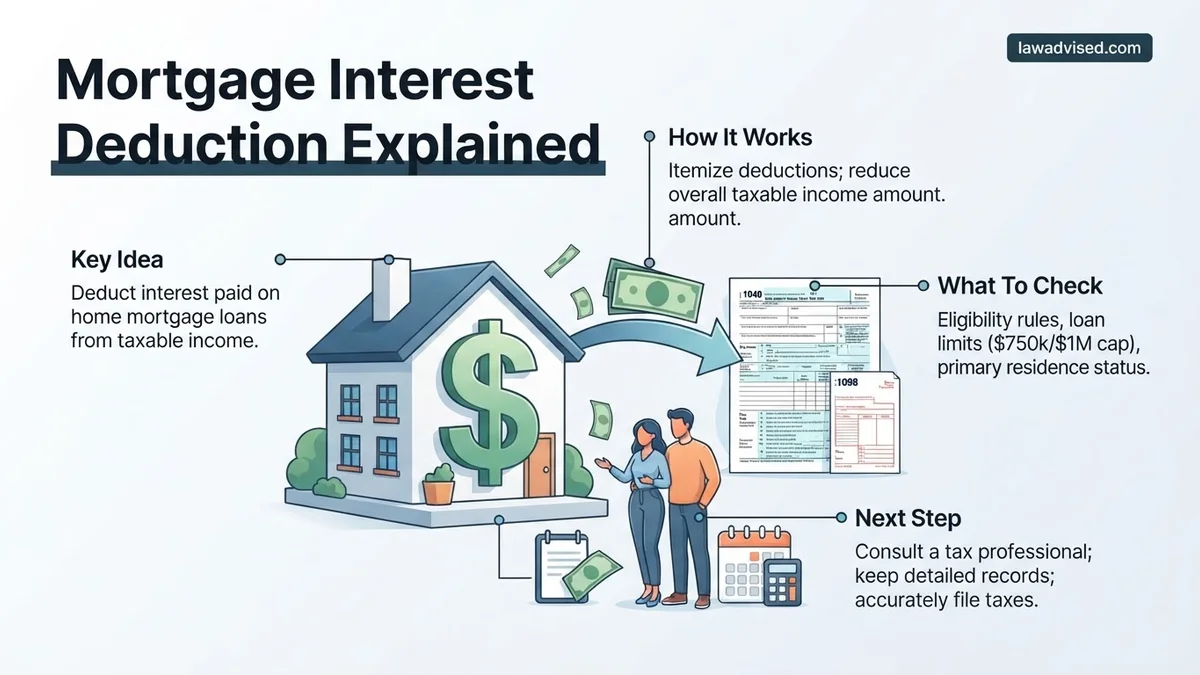
The mortgage interest deduction allows eligible homeowners to reduce their taxable income by deducting the interest paid on a qualified loan. To benefit from this tax break, you must itemize your deductions on your federal tax return rather than taking the standard deduction. Understanding current IRS limits and qualifying debt rules is essential to maximizing your actual tax savings.
The mortgage interest deduction is a federal tax incentive that allows homeowners to reduce their taxable income by the amount of interest they paid on a qualified loan during the year. For the 2026 tax year, this deduction remains one of the most powerful tools available to lower your overall tax burden, provided your total itemized deductions exceed the standard deduction threshold.
Maximizing this tax break requires understanding strict IRS limits, including the current loan caps and the crucial choice between itemizing and taking the standard deduction. If you want to keep more of your hard-earned money, you need to know exactly how to leverage your home loan for maximum savings.
Key Takeaways
- You must itemize deductions on Schedule A to claim the mortgage interest deduction.
- The current IRS loan limit is $750,000 for married couples filing jointly.
- Home equity debt interest is only deductible if used to buy, build, or substantially improve the home.
- Lenders issue Form 1098 early in the year detailing your exact annual interest paid.
- Compare your total itemized deductions against the standard deduction before filing.
What Causes High Tax Bills Without the Mortgage Interest Deduction
Many homeowners assume that simply buying a house automatically lowers their annual tax bill. Unfortunately, the tax code does not work that way. Without a strategic approach to claiming your housing expenses, you could easily miss out on thousands of dollars in potential savings and face an unexpectedly high tax bill in 2026.
The Standard Deduction Trap
The biggest reason homeowners pay more tax than necessary is the high standard deduction. Under current 2026 tax rules, the standard deduction takes up a massive amount of your financial baseline. If your total deductible expenses do not cross this finish line, your mortgage interest provides zero extra tax benefit.
- Standard deductions consume the first chunk of your potential housing write-offs.
- State and local tax (SALT) caps limit your other itemized deductions to 10,000 dollars.
- Newer homeowners with smaller loan balances often fail to clear the itemizing hurdle.
Misunderstanding Eligible Debt Limits
Another costly mistake is assuming all home-related debt qualifies for the deduction. The IRS enforces strict limits on what money you can write off. If you treat a personal home equity loan like a blank check for vacations or car purchases, you will trigger an IRS audit and face a steep tax bill.
- Acquisition debt must be used directly to buy, build, or substantially improve your home.
- Loan amounts are capped at 750,000 dollars for married couples filing jointly.
- Home equity debt used for everyday living expenses is no longer tax-deductible.
How to Fix Your Tax Strategy by Itemizing Mortgage Interest
To capture the financial benefits of your home loan, you must abandon the standard deduction and itemize your expenses on IRS Schedule A. This strategy requires tracking your deductible costs meticulously throughout the year. When your total itemized write-offs exceed the standard threshold, every extra dollar of mortgage interest directly reduces your taxable income.
The Math Behind Itemizing Versus Standard Deductions
Deciding whether to itemize comes down to a simple math equation. You must compare your total itemized expenses against the 2026 standard deduction for your filing status. If your mortgage interest, combined with allowable state taxes and charitable donations, beats that standard amount, itemizing is your clear path to savings.
- Add up your annual mortgage interest statement (Form 1098) from your lender.
- Add your capped SALT payments and qualifying charitable contributions.
- If this combined sum is higher than your standard deduction, you should itemize.
A Practical Calculation Example for 2026
Imagine you are filing jointly in 2026 with a mortgage balance that generates 22,000 dollars in annual interest. You also pay 10,000 dollars in state and local taxes, and give 3,000 dollars to charity. Your total itemized deductions equal 35,000 dollars.
- Your total itemized deductions: 35,000 dollars.
- Assume the married filing jointly standard deduction is roughly 30,000 dollars.
- Your net gain by itemizing: 5,000 dollars in additional deductions removed from your taxable income.
- At a 24 percent marginal tax bracket, that extra deduction saves you 1,200 dollars in cash.
Step-by-Step Guide to Claiming Your Deduction Using Form 1098
Claiming the mortgage interest deduction requires accurate reporting on your federal tax return. You must itemize your deductions rather than taking the standard deduction. Here is how to complete the process correctly for the 2026 tax year.
Step 1: Gather Your Form 1098
By late January 2026, your mortgage lender will issue Form 1098 (Mortgage Interest Statement). This document reports the exact amount of interest you paid throughout the previous year. Verify that the figures match your own year-end mortgage statements.
Step 2: Calculate Your Total Itemized Deductions
Add your mortgage interest to other qualifying itemized expenses. These typically include state and local taxes (subject to the current $10,000 SALT cap), charitable donations, and out-of-pocket medical expenses exceeding 7.5 percent of your adjusted gross income.
Step 3: Complete Schedule A
Transfer the figures from Form 1098 onto IRS Schedule A (Form 1040), specifically on lines 8a through 8e. Line 8a is designated for home mortgage interest and points reported to you on Form 1098. If you paid points not reported on your form, enter them on line 8b.
Step 4: File with Form 1040
Attach completed Schedule A to your Form 1040 when filing your federal tax return. Ensure that your total itemized deductions exceed the standard deduction threshold for your specific filing status in 2026. Keep your Form 1098 in your tax records for at least three years in case of an audit.
What If Your Itemized Total Still Falls Below the Standard Deduction
Many homeowners find that their itemized deductions still do not surpass the standard deduction threshold. According to recent IRS data and housing market studies, only a small percentage of taxpayers benefit from itemizing under current tax laws. If your combined deductions fall short, consider these strategic fallback options:
- Bunch Charitable Contributions: Combine multiple years of charitable giving into a single tax year using a donor-advised fund. This pushes your itemized total well above the standard deduction threshold in alternating years.
- Time Your Medical Procedures: Schedule elective medical procedures and pay major out-of-pocket healthcare expenses within the same calendar year to clear the 7.5 percent adjusted gross income hurdle.
- Maximize Property Tax Strategies: Prepay local property taxes if permitted by your municipality, keeping in mind the strict $10,000 aggregate limit on state and local taxes.
- Consult a Certified Public Accountant: Hire a qualified tax professional to review complex multi-property scenarios or business-use home deductions. Professional CPA fees typically range from $300 to $800 depending on return complexity.
- Take the Standard Deduction: Accept that taking the standard deduction is mathematically optimal for your financial situation, providing a guaranteed, hassle-free tax reduction without itemization.
Conclusion
Navigating the mortgage interest deduction requires careful calculation of your itemized expenses against the elevated standard deduction thresholds. When your combined deductions exceed the standard limit, filing Form 1098 via Schedule A maximizes your annual tax savings. According to verified research and expert sources from leading financial institutions, evaluating your deduction strategy annually ensures you never miss a legitimate tax advantage. Your immediate next step is to log into your mortgage portal and download your Form 1098 statement for the upcoming filing deadline.
❓ Frequently Asked Questions
How do I know if I should itemize or take the standard deduction?
You should itemize if the sum of your mortgage interest, state and local taxes (SALT), charitable donations, and medical expenses exceeds the standard deduction threshold for your filing status. For many taxpayers, the higher standard deduction means itemizing no longer lowers their tax burden.
Are home equity loans still deductible under current tax rules?
Under current rules, home equity loan or HELOC interest is only tax-deductible if the borrowed funds are used directly to buy, build, or substantially improve the taxpayer’s primary or secondary home that secures the loan.
What happens if my mortgage exceeds the $750,000 limit?
If your mortgage principal exceeds $750,000, you cannot deduct all of the interest you pay. The IRS requires you to calculate a proportional ratio, allowing you to deduct only the percentage of interest that corresponds to the allowable $750,000 limit.
Does the mortgage interest deduction apply to investment or rental properties?
No, the traditional personal mortgage interest deduction does not apply to investment or rental properties. Instead, landlords deduct mortgage interest as a standard business operating expense on Schedule E.
Can I deduct mortgage points paid when buying my home?
Yes, mortgage points (or discount points) paid to lower your interest rate are generally deductible. They can either be deducted fully in the year paid if they meet strict IRS criteria, or amortized over the life of the loan.
What records do I need to keep in case of an IRS audit?
You should retain your Form 1098, closing disclosure statements showing the loan amount and use of funds, and any receipts or invoices for home improvements if you utilized home equity debt for renovations.

Ismail Hossain is the founder of Law Advised. He is an Divorce, Separation, marriage lawyer. Follow him.
