1099 MISC Explained Step-by-Step Guide for 2026 Tax Filers
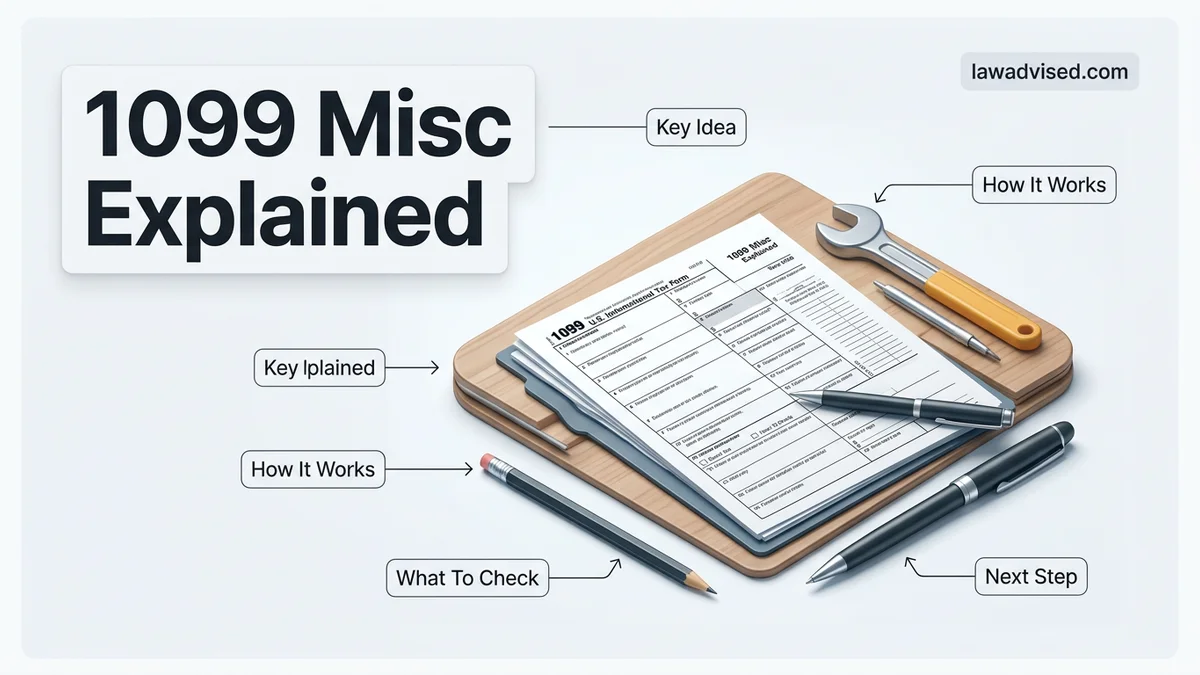
Form 1099-MISC is an IRS tax document used to report miscellaneous payments like rent, prizes, and healthcare benefits made in the course of a trade or business. Businesses must issue this form when payments to a single recipient reach specific dollar thresholds, typically $600 within a calendar year.
Form 1099-MISC is an IRS information return used to report miscellaneous types of income—such as rent, prizes, or medical payments—paid to someone who is not your employee during the tax year. If you operate a trade or business in 2026, understanding this form prevents costly penalties and compliance headaches.
The primary confusion for most filers stems from how the 1099-MISC interacts with other tax documents, particularly the 1099-NEC. Getting these forms mixed up leads to immediate IRS matching notices, forcing you to scramble for corrections.
Key Takeaways
- Form 1099-MISC reports miscellaneous income, excluding standard independent contractor labor.
- The standard reporting threshold for most income types is $600.
- Royalties require reporting if payments total $10 or more.
- Distinguish 1099-MISC from 1099-NEC, which specifically tracks nonemployee compensation.
- Issuers must provide copies to recipients and the IRS by strict annual deadlines.
What Causes 1099-MISC Reporting Confusion and Errors
The 1099-MISC vs. 1099-NEC Boundary Line
The biggest compliance trap is reporting nonemployee compensation on the wrong form. Since 2020, payments for freelance work, independent contractors, and general service providers belong exclusively on Form 1099-NEC. Form 1099-MISC is strictly for other types of miscellaneous payments.
- Form 1099-NEC: Use this for standard contractor fees, commissions, and independent service provider payments totaling $600 or more.
- Form 1099-MISC: Use this for rent, royalties, legal settlements, and prize winnings.
- The Trap: Putting contractor service fees on a 1099-MISC will trigger an immediate rejection or audit flag from the IRS in 2026.
Misunderstanding Payment Thresholds and Exemptions
Another major error involves failing to track specific payment types that have unique reporting limits. While the standard baseline threshold for most 1099-MISC boxes is $600, certain payments have different rules.
- Rents and Prizes: The threshold remains $600 for rental payments and prize winnings.
- Royalties: You must file if royalties hit $10 or more.
- Corporate Exemptions: Most payments made to corporations (C-corps or S-corps) are exempt, but payments for legal services are a notable exception. You must report legal fees paid to a corporate law firm on a 1099-MISC.
How to Fix 1099-MISC Filing Mistakes and Misclassifications
Correcting Submissions Already Sent to the IRS
If you realize you filed the wrong form or reported an incorrect dollar amount after submitting your documents for the 2026 tax season, you need to act quickly. Do not simply file a second matching form without checking the correction box.
- Check the Correct Box: When filing a corrected paper or electronic form, you must check the “CORRECTED” checkbox at the top of the document.
- Issue Copies Promptly: Send a corrected Copy B to the recipient so they can update their own tax records before filing their individual returns.
- File Form 1096: If you are filing corrections on paper, accompany them with a newly calculated transmittal Form 1096.
Establishing Internal Audits to Prevent Future Errors
The best way to fix a mistake is to prevent it from happening during your initial intake process. Review your vendor onboarding workflow to ensure proper classification before any money changes hands.
- Collect Form W-9 Upfront: Never disburse a payment without a signed Form W-9 on file. This document tells you the payee’s tax classification and whether they operate as an individual, LLC, or corporation.
- Separate Accounting Categories: Configure your accounting software to tag vendor disbursements by income type (rent versus services) to automate the correct 1099 generation at year-end.
Step-by-Step Guide to Distinguishing 1099-MISC from 1099-NEC
Navigating independent contractor forms requires precision, especially with shifting IRS enforcement priorities in 2026. Misclassifying payments between the 1099-MISC and 1099-NEC can trigger costly IRS notices and compliance audits. Follow this procedural framework to determine the exact form your business must file.
Step 1: Identify the Nature of the Payment
To choose the correct form, evaluate the primary service or good rendered. According to IRS compliance guidelines, if the payment compensates a worker for services performed as a non-employee, it belongs on the 1099-NEC. If the payment falls under miscellaneous categories like rent, prizes, or medical payments, it belongs on the 1099-MISC.
Step 2: Apply the 2026 Threshold Rules
Review the dollar amount paid to the recipient during the 2026 tax year. The reporting threshold for the 1099-NEC remains strictly at $600 for non-employee compensation. Meanwhile, the 1099-MISC features varying thresholds, requiring a minimum of $600 for rents or services, but $10 for gross royalties or broker payments in lieu of dividends.
- Review all vendor ledger accounts for total annual disbursements exceeding $600.
- Separate service-based labor payments from property rentals, legal settlements, and award winnings.
- Cross-reference the payment classification against current 2026 IRS instructions for Form 1099-MISC and 1099-NEC.
- Generate the corresponding form type within your accounting software to ensure correct electronic filing compliance.
What If It Still Doesn’t Work and You Receive an IRS Penalty Notice
Receiving an IRS penalty notice for incorrect or late 1099 filing requires immediate, methodical correction. When standard software fixes fail or automated mismatch notices arrive from the IRS, implement these fallback steps to minimize financial penalties.
- Inspect the IRS notice carefully to identify the specific error code, mismatched Taxpayer Identification Number, or disputed filing amount.
- Submit a corrected return immediately using Form 1099-MISC or 1099-NEC marked with the “Corrected” checkbox at the top.
- File Form 8821 or Form 2848 if you need to authorize a certified public accountant or enrolled agent to communicate directly with the IRS on your behalf.
- Consult a licensed tax professional or tax attorney if the proposed penalty exceeds $1,000 or involves complex worker classification disputes. Professional resolution services typically range from $300 to $1,500 depending on audit complexity.
Conclusion
Mastering the 1099-MISC ensures your business stays fully compliant with evolving 2026 tax regulations while avoiding severe IRS misclassification penalties. By systematically separating non-employee compensation from miscellaneous rents and royalties, you protect your enterprise from costly audits. According to verified research and tax administration experts, proactive filing and precise categorization remain the most effective defenses against compliance errors. Take your next actionable step today by auditing your vendor payment ledgers and confirming all contractor W-9 forms are up to date.
❓ Frequently Asked Questions
What specific types of payments belong on Form 1099-MISC?
Common payments include rent for office space or equipment, prizes and awards, medical and healthcare payments, gross proceeds paid to an attorney, and royalty payments of $10 or more. Each category has a dedicated box on the official IRS form.
How has the separation of 1099-MISC and 1099-NEC changed tax reporting?
Prior to 2020, nonemployee compensation was included on the 1099-MISC. The IRS separated these forms to create distinct filing deadlines, requiring businesses to report contractor labor exclusively on Form 1099-NEC.
What happens if a business fails to file Form 1099-MISC on time?
The IRS assesses tiered financial penalties for late or incorrect filings. The penalty amount increases depending on how late the form is submitted after the official deadline.
Are corporations exempt from receiving a 1099-MISC?
In most cases, payments made to corporations do not require a 1099-MISC. However, exceptions apply, such as payments made to attorneys or corporations providing medical and healthcare services.
What information do I need from a vendor to fill out a 1099-MISC?
You need the recipient’s legal name, address, and Taxpayer Identification Number (TIN), which is typically collected using IRS Form W-9 before issuing any payments.
What should a recipient do if they find an error on their received 1099-MISC?
The recipient should contact the payer immediately to request a corrected form. The payer must then file a corrected 1099-MISC with the IRS and provide an updated copy to the recipient.

Ismail Hossain is the founder of Law Advised. He is an Divorce, Separation, marriage lawyer. Follow him.