Social Security Tax for Self Employed Step-by-Step 2026
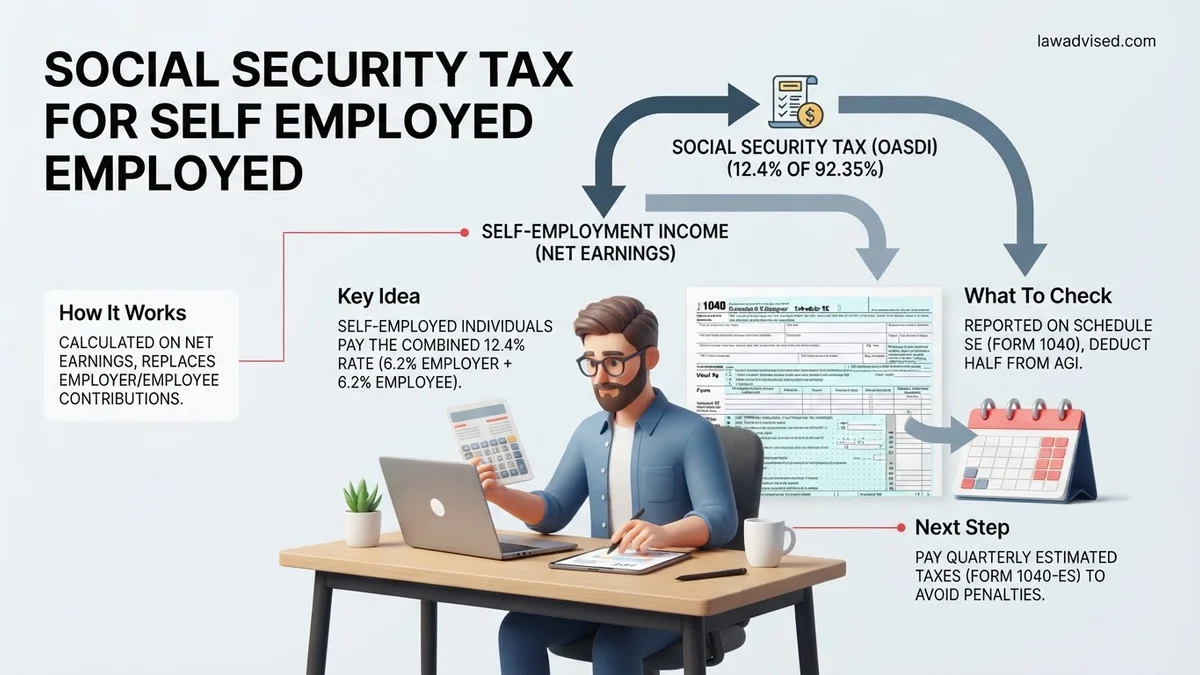
As a self-employed individual, you are responsible for paying both the employer and employee portions of your payroll taxes, resulting in a 12.4% Social Security tax rate on your net earnings up to the annual wage cap. Calculating this obligation requires applying the 92.35% net earnings rule and properly reporting the total using IRS Schedule SE.
As a self-employed earner in 2026, you owe a total self-employment tax rate of 15.3% on your net earnings. Exactly 12.4% of that rate goes directly toward the Social Security trust fund, while the remaining 2.9% funds Medicare. Unlike traditional W-2 employees whose employers pay half of these FICA taxes, you are entirely responsible for both the employee and employer halves of the equation.
Calculating and paying this liability accurately prevents unexpected IRS penalties and helps you manage your quarterly cash flow effectively. Let us break down the exact mechanics of how the 2026 Social Security tax applies to your freelance or business income, how the wage cap works, and how to compute what you owe step-by-step.
Key Takeaways
- The self-employed Social Security tax rate is 12.4% up to the annual maximum wage cap.
- Calculate net self-employment earnings by multiplying your net profit by 92.35%.
- Deduct half of your total self-employment tax on your Form 1040 adjusted gross income.
- Pay your taxes quarterly using IRS Form 1040-ES to avoid underpayment penalties.
- File Schedule SE with your annual tax return to report and calculate your exact liability.
What Causes High Social Security Tax Liabilities for Self-Employed Earners
Managing your tax burden starts with understanding why self-employment bills often catch freelancers off guard. The culprit is the combination of the 12.4% Social Security rate and the way net earnings are assessed before the tax is even applied.
The 12.4% Social Security Rate Breakdown
When you work a regular job, your employer pays a 6.2% match for Social Security, and 6.2% is withheld from your paycheck. When you work for yourself, you must cover the full 12.4% yourself. This applies to every dollar of net self-employment income you generate up to the annual government limit.
The 2026 Wage Cap and Maximum Earnings Limit
Social Security tax does not apply to infinite earnings. The IRS enforces an annual wage cap—known as the maximum taxable earnings limit—which adjusts each year for inflation. For the 2026 tax year, you only pay the 12.4% Social Security tax on your net self-employment earnings up to this specific threshold.
- Earnings at or below the 2026 cap are subject to the full 12.4% rate.
- Any net earnings you generate above the 2026 wage cap are entirely exempt from the 12.4% Social Security tax.
- You still continue to pay the 2.9% Medicare tax, as Medicare does not have an upper wage cap.
Master Social Security Tax for Self-Employed in 6 Simple Steps
Navigating self-employment taxes can feel overwhelming, especially when it comes to funding your future retirement and disability benefits through the Self-Employment Contributions Act (SECA). Unlike traditional W-2 employees whose employers split their payroll taxes, independent contractors and freelancers must shoulder both the employer and employee portions. This comprehensive walkthrough demystifies the mechanics of self-employment tax, showing you exactly how to calculate, file, and manage your obligations so you can avoid surprise penalties and keep your business finances running smoothly.
Step 1: Understand the Self-Employment Tax Rate and Components
What you need: Access to your gross business income records and basic knowledge of current federal tax brackets.
Instructions: Before you can pay your taxes, you must understand what makes up the self-employment tax. The total self-employment tax rate is 15.3%. This combined rate is split into two distinct parts: 12.4% for Social Security (old-age, survivors, and disability insurance) and 2.9% for Medicare (hospital insurance). The Social Security portion only applies up to a specific annual wage base limit set by the Social Security Administration, which adjusts periodically for inflation. For instance, if you earn net earnings below this threshold, you pay the full 12.4% Social Security tax. The Medicare portion, however, applies to all of your net earnings without a cap, and high earners may even face an additional 0.9% Medicare surtax.
Pro Tip: Remember that this 15.3% is strictly for FICA equivalents (Social Security and Medicare) and does not include your federal, state, or local income taxes.
Step 2: Calculate Your Net Earnings From Self-Employment
What you need: Completed profit and loss statements, Schedule C forms, and receipts for all legitimate business expenses.
Instructions: You do not pay self-employment tax on your gross revenue; you pay it on your net earnings. To find this figure, tally up all your gross self-employment income for the calendar year. Next, subtract all ordinary and necessary business expenses—such as software subscriptions, home office deductions, travel, and professional fees—to arrive at your net profit. Once you have your net profit, multiply that amount by 92.35% (or 0.9235). The IRS allows you to exclude 7.65% of your net earnings from the tax calculation, which mirrors the employer-equivalent deduction that traditional businesses receive. This adjusted figure is officially known as your net earnings from self-employment.
Pro Tip: Keep meticulous digital records of every receipt. Maximizing your legal write-downs directly lowers your net earnings, which in turn reduces your overall tax burden.
Step 3: Complete IRS Schedule SE
What you need: Your final net earnings calculation from Step 2 and IRS Form 1040 along with Schedule SE.
Instructions: Schedule SE is the specific tax form used to calculate the tax due on your net earnings from self-employment. If your net earnings are $400 or more, you are legally required to file this form with your annual federal income tax return. Section A of Schedule SE is generally used for short calculations, while Section B is for more complex situations involving church employee income or optional methods. You will transfer your net earnings figure from Schedule C onto Schedule SE, run through the step-by-step mathematical formulas provided on the form, and determine your total self-employment tax liability. The final output from Schedule SE will then be transferred directly to your Form 1040.
Pro Tip: Most modern tax software automates Schedule SE by pulling data directly from your Schedule C, but it is always wise to review the final numbers line by line.
Step 4: Claim the Deductible Part of Self-Employment Tax
What you need: Your completed Schedule SE and Form 1040 (specifically Schedule 1).
Instructions: Because self-employed individuals pay both halves of the Social Security and Medicare taxes, the IRS allows you to deduct one-half of your total self-employment tax liability as an adjustment to income. This is commonly referred to as an “above-the-line” deduction, meaning you can claim it even if you take the standard deduction rather than itemizing. To execute this, take the final self-employment tax amount calculated on your Schedule SE, divide it by two, and enter that result on Schedule 1 of Form 1040. This deduction reduces your adjusted gross income (AGI), which ultimately lowers your overall federal income tax liability, providing a much-needed financial cushion for independent workers.
Pro Tip: Do not confuse this deduction with a business expense. It is a personal tax deduction taken on your individual income tax return, but it directly offsets the sting of the 15.3% tax.
Step 5: Make Accurate Quarterly Estimated Tax Payments
What you need: Form 1040-ES (Estimated Tax for Individuals), estimated annual income projections, and a calendar for IRS payment deadlines.
Instructions: The United States tax system operates on a pay-as-you-go basis. As a self-employed worker, taxes are not automatically withheld from your paychecks, meaning you cannot wait until April to pay what you owe. If you expect to owe $1,000 or more in taxes when your return is filed, you must make quarterly estimated tax payments throughout the year using IRS Form 1040-ES. The year is split into four payment periods with distinct deadlines: April 15, June 15, September 15, and January 15 of the following year. Calculate your expected annual self-employment and income taxes, divide by four, and submit equal installments to the IRS on or before each deadline to stay compliant.
Pro Tip: Set aside 25% to 30% of every client payment into a separate, dedicated business savings account the moment you receive it so you never touch your tax money.
Step 6: Leverage Technology and Track Social Security Credits
What you need: An online Social Security Administration (SSA) account and bookkeeping software (such as QuickBooks, FreshBooks, or Wave).
Instructions: To ensure your self-employment taxes are translating into future retirement benefits, you must monitor your earnings record with the government. Create a secure “my Social Security” account on the official ssa.gov website to review your annual earnings history and verify that your reported self-employment income is accurately credited each year. On the business operations side, integrate automated accounting software to track income and expenses in real-time. This prevents scrambling during tax season and ensures your quarterly estimated calculations remain accurate even as your freelance revenue fluctuates throughout the year.
Pro Tip: You need a total of 40 credits (earned at a rate of up to 4 per year) to qualify for Social Security retirement benefits, making consistent reporting critical.
✅ Final Checklist
- Verified that net self-employment earnings exceed the $400 filing threshold
- Multiplied net profit by the 92.35% adjustment factor
- Accurately completed IRS Schedule SE and attached it to Form 1040
- Claimed the 50% deduction for self-employment tax on Schedule 1
- Scheduled and paid all four quarterly estimated tax installments (Form 1040-ES) on time
Important Notes:
- Failure to pay estimated taxes on time can result in underpayment penalties and daily compounding interest charges from the IRS.
- Consider hiring a Certified Public Accountant (CPA) or Enrolled Agent (EA) if your business structure changes (such as electing S-Corp status) or if your income fluctuates wildly.
- Estimated preparation time is 2 to 4 hours per quarter for record-keeping and payments; financial cost varies based on income level and software subscriptions used.
How to Calculate Your Net Earnings and Social Security Tax Step-by-Step
You do not pay Social Security tax on your gross revenue. The IRS allows you to deduct ordinary and necessary business expenses first, but you also must apply a specific calculation rule before determining your final tax liability.
The 92.35% Net Earnings Rule
Before applying the 12.4% Social Security rate, you must adjust your net schedule C profit. Because employers get to deduct their half of employment taxes, the IRS grants self-employed individuals an equivalent adjustment. You multiply your net business profit by 92.35% (or subtract 7.65% effectively) to find your net earnings subject to self-employment tax.
Step-by-Step Calculation Example for 2026
Imagine your freelance business generates $100,000 in gross revenue for 2026, and you have $20,000 in legitimate business write-offs. Your net profit is $80,000.
- Find net business profit: $100,000 minus $20,000 equals $80,000.
- Apply the 92.35% multiplier: $80,000 multiplied by 0.9235 equals $73,880. This is your net earnings subject to self-employment tax.
- Calculate Social Security tax: Multiply $73,880 by 12.4%, which equals $9,161.12.
- Calculate Medicare tax: Multiply $73,880 by 2.9%, which equals $2,142.52.
- Total self-employment tax: Combine $9,161.12 and $2,142.52 for a total liability of $11,303.64.
How to Fix Quarterly Underpayments and Pay IRS Schedule SE Correctly
If you realize you missed a quarterly estimated tax payment or miscalculated your liability, ignoring the issue will only compound IRS penalties. Fixing underpayments requires a methodical approach to reconcile your records and submit the correct amounts using Schedule SE for the 2026 tax year.
Step 1: Calculate Your True Self-Employment Liability
Re-evaluate your net earnings from self-employment for the year-to-date using verified accounting software or bank records. Remember that only 92.35 percent of your net self-employment earnings are subject to the 15.3 percent tax rate. Document all eligible business deductions to lower your net baseline before calculating the final tax amount.
Step 2: File and Pay via IRS Direct Pay
Once you determine the exact shortfall, navigate to the official IRS Direct Pay portal to settle the balance immediately. Select “Estimated Tax” as the reason for the payment and apply it to the appropriate 2026 tax quarter. According to tax compliance guidelines, paying immediately stops the accrual of further failure-to-pay penalties and interest.
Step 3: Complete IRS Schedule SE
When tax season arrives, transfer your calculated figures onto IRS Schedule SE (Form 1040).
- Multiply your total net self-employment earnings by 0.9235 to find your taxable base.
- Apply the 12.4 percent Social Security tax rate up to the current 2026 wage base limit.
- Add the 2.9 percent Medicare tax portion to complete your total self-employment tax calculation.
- Enter the final deductible half of your self-employment tax directly onto Schedule 1 of Form 1040.
What If Your Income Exceeds the Wage Cap or Still Doesn’t Match Projections
Fluctuating self-employment income can derail even the most carefully planned tax strategies. If your earnings shift dramatically mid-year, or if you hit the statutory maximum wage cap for Social Security, you must adjust your calculations to avoid overpaying the IRS.
Handling Income Surges Beyond the Wage Cap
The Social Security Administration imposes a maximum wage base limit for the 2026 tax year. Once your combined net earnings and any W-2 wages cross this statutory threshold, you stop paying the 12.4 percent Social Security tax portion. However, you must continue paying the 2.9 percent Medicare tax on all earnings without limitation.
Managing Sudden Income Drops
If your business revenue drops significantly mid-year, maintaining your original quarterly payments will tie up valuable cash flow. Recalculate your projected annual net earnings for 2026 using annualized income installment methods. Adjust your remaining quarterly payments downward to match your new, realistic liability projection.
What If It Still Doesn’t Work?
Tax regulations surrounding self-employment and Social Security contributions are notoriously complex. If your calculations continue to produce discrepancies or the IRS issues an unexpected notice, utilize these fallback steps to resolve the issue:
- Request an official IRS tax transcript online to verify which quarterly payments have successfully posted to your account.
- Utilize the IRS Interactive Tax Assistant tool on their official website to model complex self-employment scenarios.
- Consult a Certified Public Accountant (CPA) or Enrolled Agent (EA) specializing in freelance taxation. Professional fees for self-employment tax reviews typically range from $300 to $600.
- File for a formal penalty abatement if reasonable cause, such as a major disaster or severe illness, caused your underpayment.
Conclusion
Managing Social Security tax as a self-employed professional demands vigilance, accurate quarterly calculations, and correct usage of IRS Schedule SE. Failing to account for both the 12.4 percent Social Security and 2.9 percent Medicare components leads directly to statutory penalties and interest charges. According to verified research and expert financial sources, proactive mid-year tax adjustments prevent cash flow crises and eliminate end-of-year filing surprises. Your actionable next step is to review your year-to-date accounting records today, calculate your precise net earnings for 2026, and schedule any necessary estimated payments through the IRS Direct Pay portal.
❓ Frequently Asked Questions
How does the self-employed Social Security tax differ from regular W-2 withholding?
W-2 employees split their 12.4% Social Security tax obligation with an employer, each paying 6.2%. Self-employed individuals operate as both employer and employee, meaning they must pay the full 12.4% rate themselves.
What happens if my net self-employment earnings are very low?
You generally do not owe self-employment tax if your net earnings from self-employment are less than $400 for the tax year. However, you may still need to file a return and pay income tax depending on your total gross income.
Is the Medicare tax included alongside the Social Security tax?
Yes, self-employment tax covers both Social Security (12.4%) and Medicare (2.9%), combining for a total SECA tax rate of 15.3% on net earnings up to the wage cap.
How do quarterly estimated tax payments work for self-employed workers?
Estimated taxes are paid four times a year using IRS Form 1040-ES to cover both your income taxes and self-employment taxes. Missing these deadlines can result in IRS underpayment penalties and interest charges.
Can I claim the deduction for half of my self-employment tax if I take the standard deduction?
Yes, the deduction for half of your self-employment tax is an ‘above-the-line’ adjustment to income, meaning you can claim it even if you choose to take the standard deduction instead of itemizing.
Where do I report my self-employment tax on my tax return?
You calculate your self-employment tax on IRS Schedule SE and carry that final figure over to Schedule 1 of Form 1040, as well as your main Form 1040 tax calculation.

Ismail Hossain is the founder of Law Advised. He is an Divorce, Separation, marriage lawyer. Follow him.