Self Employment Tax Deduction Explained Step-by-Step 2026
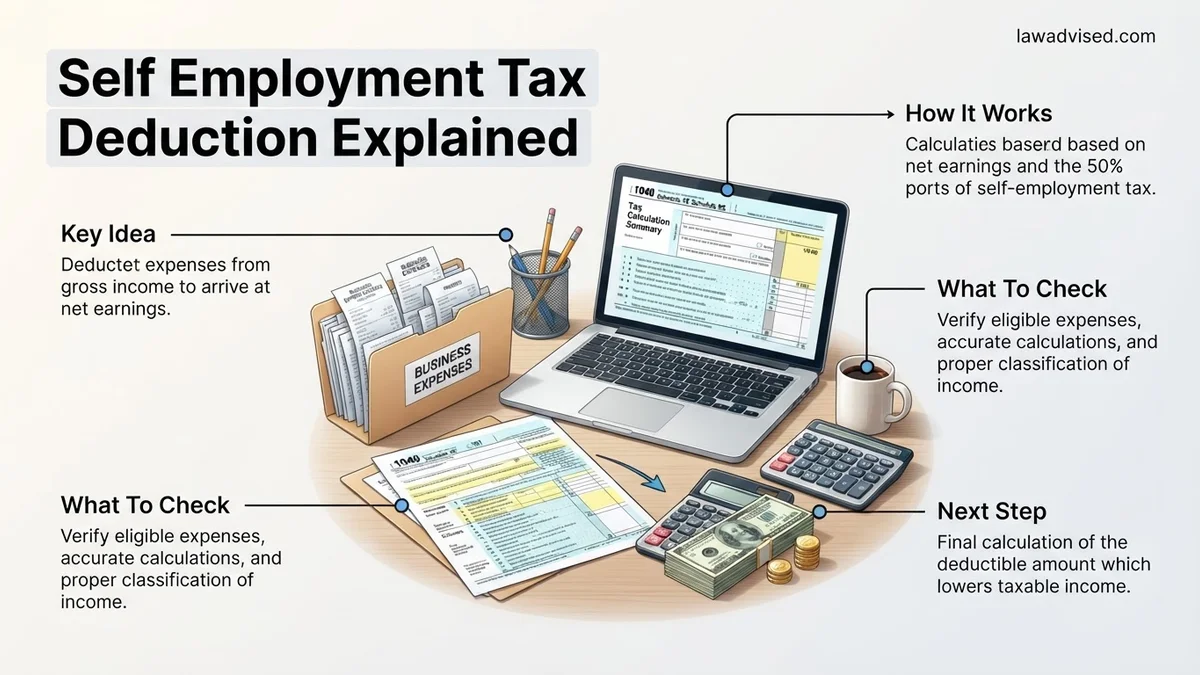
The self-employment tax deduction allows freelancers and business owners to deduct half of their self-employment tax from their gross income. This above-the-line deduction effectively levels the playing field with traditional W-2 employees by mirroring the employer’s share of FICA taxes. Understanding how to calculate this write-off directly reduces your adjusted gross income and overall tax liability.
The self-employment tax deduction allows you to deduct half of your total self-employment tax liability directly from your gross income on your 2026 tax return. This reduction lowers your adjusted gross income, which ultimately saves you money on federal income taxes.
When you work as a traditional employee, your employer pays half of your FICA taxes—covering Social Security and Medicare. As a freelancer, independent contractor, or sole proprietor in 2026, you must pay both the employer and employee portions, totaling 15.3% on your net earnings. The self-employment tax deduction exists specifically to offset this burden and keep your tax math fair compared to W-2 earners.
Key Takeaways
- Deduct exactly 50% of your total calculated self-employment tax.
- Take this write-off as an above-the-line deduction on Schedule 1.
- Net earnings from self-employment must exceed $400 to trigger SE tax.
- Calculate total SE tax using Schedule SE before finding your deduction.
- Lower your adjusted gross income directly without needing to itemize deductions.
What Causes High Self-Employment Taxes and Why the Deduction Exists
The 15.3% Burden Explained
Your self-employment tax rate is 15.3% on your net earnings up to the Social Security wage base limit for 2026. This combined rate consists of 12.4% for Social Security and 2.9% for Medicare. Because you act as both the employer and the employee, your business technically owes both halves. This dual responsibility creates a massive tax bill for many new freelancers.
Leveling the Playing Field With W-2 Employees
W-2 employees never see the 7.65% employer-paid portion of their FICA taxes on their paystubs. To keep the tax code equitable, the IRS lets self-employed individuals treat the employer-equivalent portion as an ordinary business expense. This relief valve ensures you are not paying income tax on money that legally went toward your mandatory Social Security and Medicare obligations.
- W-2 employees split FICA taxes 50/50 with employers.
- Self-employed workers pay the full 15.3% upfront.
- The above-the-line deduction refunds the employer-equivalent half from your income tax calculations.
Self Employment Tax Deduction Made Easy: Your Essential Action Plan
Navigating self-employment taxes can often feel overwhelming for freelancers, independent contractors, and small business owners. However, understanding the self-employment tax deduction can save you thousands of dollars at tax time. This comprehensive guide breaks down the complex world of Schedule SE, net earnings, and deductions into manageable actions, ensuring you keep more of your hard-earned money while staying fully compliant with the IRS.
Step 1: Determine Your Self-Employment Status and Filing Requirement
What you need: Form 1040, Schedule C from your previous or current tax year, and your total gross business income records.
Instructions: Before calculating any deductions, you must confirm that you actually owe self-employment tax. The IRS requires you to pay self-employment tax (Social Security and Medicare) if your net earnings from self-employment were $400 or more during the tax year. This applies whether your freelance work is a full-time career or a side hustle. Calculate your gross receipts and subtract your ordinary and necessary business expenses to find your net profit. If this number exceeds $400, you are legally required to file Schedule SE along with your individual tax return.
Pro Tip: Don’t forget that self-employment tax is separate from your standard income tax, though both are calculated on your annual Form 1040.
Step 2: Calculate Your Total Net Earnings From Business Operations
What you need: Profit and loss statements, bank statements, receipts, and IRS Schedule C (Profit or Loss From Business).
Instructions: To find the base amount for your self-employment tax, fill out Schedule C to determine your net profit or loss. Tally all your business income streams, including 1099-NEC forms, cash payments, and client deposits. Next, deduct all legitimate business expenses such as software subscriptions, home office use, marketing, and professional fees. The resulting figure on line 31 of Schedule C is your net earnings from self-employment. This is the exact number you will transfer to Schedule SE to begin computing your tax obligations.
Pro Tip: Keep meticulous digital or physical records of every business expense. If you get audited, the burden of proof rests entirely on you to substantiate every deduction.
Step 3: Master the Multiplier on IRS Schedule SE
What you need: Completed Schedule C, IRS Schedule SE form, and a basic calculator.
Instructions: Once you have your net earnings, it is time to use Schedule SE (Self-Employment Tax). Generally, the total self-employment tax rate is 15.3%. This is broken down into 12.4% for Social Security (up to the annual wage base limit set by the IRS) and 2.9% for Medicare. On Schedule SE, you will multiply your net earnings by 92.35% (0.9235) because the IRS allows you to deduct an amount equal to one-half of your self-employment tax when figuring your adjusted gross income. Multiply that adjusted net amount by the 15.3% total tax rate to arrive at your final self-employment tax liability.
Pro Tip: If your net earnings exceed the Social Security wage base limit for the year, you stop paying the 12.4% Social Security portion on income above that threshold, but you continue paying the 2.9% Medicare tax.
Step 4: Claim the Above-the-Line Self-Employment Tax Deduction
What you need: Completed Schedule SE, Form 1040 (Schedule 1).
Instructions: One of the greatest perks of being self-employed is the ability to offset the sting of the 15.3% tax. The IRS allows you to deduct 50% of your total self-employment tax liability as an “above-the-line” deduction on your Form 1040 (Schedule 1, Part II). This means you do not need to itemize your deductions to claim this tax break; it directly reduces your overall Adjusted Gross Income (AGI). For example, if your total self-employment tax calculated on Schedule SE is $6,000, you can deduct $3,000 right off the top of your personal income taxes, lowering your federal income tax bracket.
Pro Tip: Ensure you transfer the exact half-tax figure from Schedule SE to Form 1040, Schedule 1. Failing to claim this deduction means you are paying significantly more income tax than legally required.
Step 5: Implement Quarterly Estimated Tax Payments
What you need: IRS Form 1040-ES (Estimated Tax for Individuals), estimated income projections, and a calendar.
Instructions: Unlike W-2 employees who have taxes automatically withheld from every paycheck, self-employed individuals operate on a pay-as-you-go system. If you expect to owe $1,000 or more in taxes when you file your return, you are required to make quarterly estimated tax payments to the IRS and your state agency. These payments cover both your income tax and your self-employment tax. The standard quarterly deadlines generally fall on April 15, June 15, September 15, and January 15 of the following year. Use Form 1040-ES to calculate these payments based on the previous year’s liability or projected current-year income.
Pro Tip: Setting aside 25% to 30% of every client payment into a separate, dedicated business savings account prevents year-end panic and ensures you always have cash ready for quarterly payments.
Step 6: Integrate Ordinary Business Deductions to Lower the Baseline
What you need: Mileage tracker apps, utility bills, inventory logs, and expense categorization software.
Instructions: The lower your net business profit, the lower your self-employment tax will be. Therefore, maximizing your ordinary and necessary business deductions is critical. Review your operations for deductible expenses such as the home office deduction (calculated by square footage or simplified method), business vehicle mileage, advertising, travel, continuing education, and health insurance premiums. Every legitimate dollar you expense reduces the net profit figure that flows into Schedule SE, directly shrinking your overall tax burden.
Pro Tip: Never mix personal and business finances. Open a dedicated business checking account and credit card to automatically track deductible expenses and simplify your tax preparation.
✅ Final Checklist
- Verified that net self-employment earnings equal or exceed $400 for the tax year.
- Accurately filled out Schedule C to capture all valid business income and deductions.
- Completed IRS Schedule SE and correctly applied the 92.35% multiplier and 15.3% tax rate.
- Transferred exactly 50% of your calculated self-employment tax to Form 1040, Schedule 1 as an above-the-line deduction.
- Calculated and scheduled your four annual estimated tax payments using Form 1040-ES to avoid underpayment penalties.
Important Notes:
- Tax laws change frequently; always cross-reference your calculations with current IRS publication guidelines or up-to-date tax software.
- When dealing with complex corporate structures (like electing S-Corporation status) or multi-state self-employment income, seek the guidance of a certified public accountant (CPA).
- Estimated time: 2 to 4 hours of compilation and calculation; potential cost range: $0 (DIY using IRS free file or tax software) to $300+ (for professional CPA preparation).
How to Calculate Your Self-Employment Tax Deduction Step-by-Step
Step 1: Determine Your Net Self-Employment Earnings
Before you calculate any taxes, you must calculate your net profit for the 2026 tax year. Subtract your ordinary and necessary business expenses from your total gross business income. Note that you only pay self-employment tax if your net earnings reach 400 dollars or more. For calculation purposes, the IRS requires you to multiply your net earnings by 92.35% before applying the 15.3% tax rate.
Step 2: Calculate the Total Tax and the 50% Deduction
Once you have your taxable net earnings, multiply that figure by 15.3% to find your total self-employment tax. You then divide that final tax number by two. That exact 50% amount is your self-employment tax deduction, which you claim on Schedule 1 of your Form 1040.
- Net Profit: Assume your freelance business nets 100,000 dollars in 2026.
- Adjusted Net Earnings: Multiply 100,000 dollars by 92.35% to get 92,350 dollars.
- Total SE Tax: Multiply 92,350 dollars by 15.3% to get 14,129.55 dollars.
- Your Deduction: Divide 14,129.55 dollars by 2 to get 7,064.78 dollars.
How to Report Your Self-Employment Tax Deduction on IRS Tax Forms
Claiming your self employment tax deduction requires accurate navigation of standard IRS paperwork. Failing to report this adjustment correctly can trigger automated mismatch notices from the federal agency. Tax experts recommend handling this process carefully during your 2026 filing cycle.
Step-by-Step Reporting Procedure
- Complete Schedule C (Profit or Loss From Business) first to calculate your net earnings from self-employment for 2026.
- Transfer your net earnings total to Schedule SE (Self-Employment Tax) to compute the total social security and medicare taxes owed.
- Multiply your total self-employment tax by 50 percent to find the exact allowable deduction amount.
- Enter this calculated deduction amount directly onto Schedule 1 (Additional Income and Adjustments to Income) attached to Form 1040.
- Subtract this adjustment on your main Form 1040 to lower your adjusted gross income before applying standard or itemized deductions.
What If It Still Doesn’t Work?
If your deductions fail to lower your overall tax burden significantly, or if calculating Schedule SE manually becomes overwhelming, you need alternative fallback strategies. According to verified research from the National Association of Tax Professionals, self-filers face higher error rates on complex adjustments. Consider these troubleshooting steps for 2026:
- Upgrade to certified tax preparation software that automatically imports Schedule C data directly into Schedule SE and Schedule 1.
- Review your business expense logs to ensure you did not accidentally miss ordinary and necessary write-offs that lower your baseline net profit.
- Schedule a consultation with a certified public accountant (CPA) or Enrolled Agent to audit your prior calculations before submitting your return to the IRS.
- Prepare for professional service costs, which typically range from $300 to $700 for comprehensive small business tax preparation.
Conclusion
Mastering the self employment tax deduction ensures you never pay double the Federal Insurance Contributions Act taxes paid by traditional W-2 employees. By properly calculating your net earnings and accurately transferring half of your self-employment tax to Schedule 1, you instantly lower your adjusted gross income for 2026. According to verified research and expert financial sources, proactive adjustment tracking remains the single most effective way to optimize cash flow for independent contractors. Your actionable next step is to log into your accounting software today, finalize your Schedule C totals, and verify your deduction figures before filing your taxes.
❓ Frequently Asked Questions
How does the self-employment tax deduction lower my income taxes?
Because it is an above-the-line deduction, it directly reduces your Adjusted Gross Income (AGI). A lower AGI decreases the total amount of income subject to federal income tax, giving you double the tax savings alongside your standard deduction.
Can I claim the self-employment tax deduction if I also have a W-2 job?
Yes, you can claim the deduction for your freelance or side-business earnings as long as your net earnings hit the $400 threshold. However, your W-2 wages still count toward the annual Social Security wage base limit when calculating total tax.
What is the difference between business expense deductions and the self-employment tax deduction?
Business expense deductions (like software or office supplies) lower your net business profit. The self-employment tax deduction is calculated after you find that net profit, specifically targeting the FICA-equivalent taxes you owe as your own employer.
Does the self-employment tax deduction reduce my state income taxes?
In most states, yes. Because state income tax calculations typically start with your federal Adjusted Gross Income (AGI), an above-the-line deduction like the self-employment tax deduction naturally lowers your state tax liability as well.
What happens if I forget to claim the self-employment tax deduction on my tax return?
If you realize you missed the deduction after filing, you can file an amended tax return using Form 1040-X for the respective tax year to claim your missed write-off and receive a refund.
Are LLC owners and sole proprietors eligible for the same deduction?
Yes, sole proprietors, single-member LLCs, independent contractors, and partners in a partnership all calculate and claim the self-employment tax deduction using the exact same IRS formulas and schedules.

Ismail Hossain is the founder of Law Advised. He is an Divorce, Separation, marriage lawyer. Follow him.