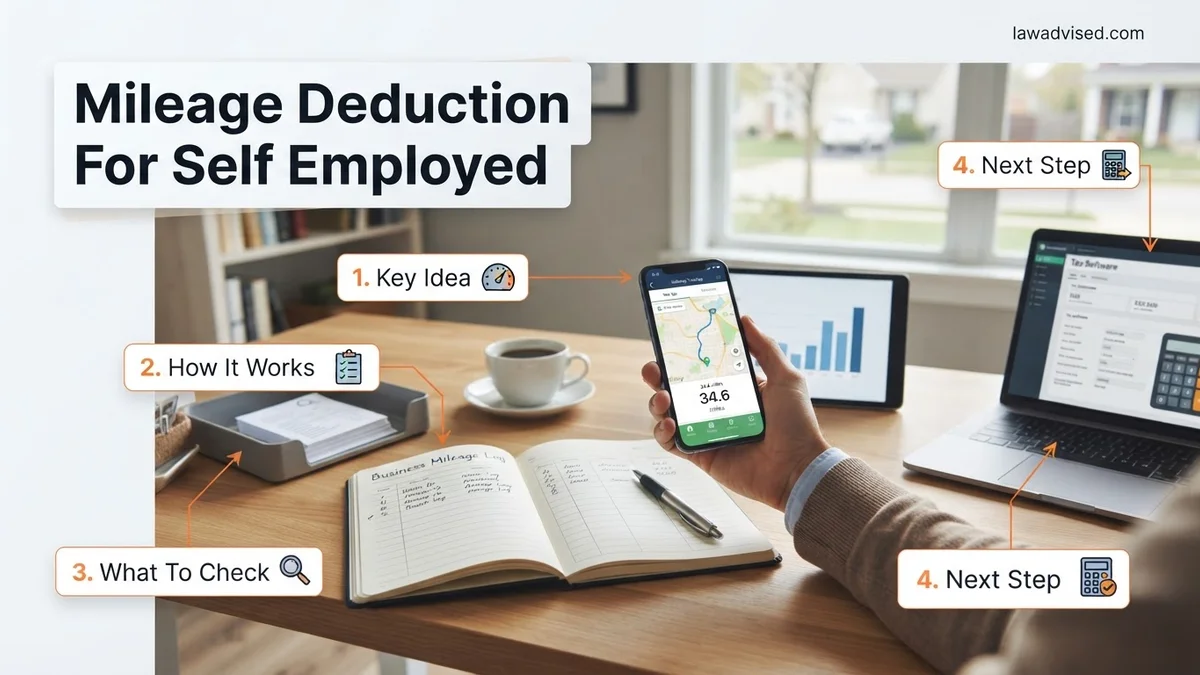
Mileage Deduction for Self Employed Step-by-Step Guide 2026
Navigating the mileage deduction for self employed professionals requires tracking every business mile to maximize tax savings. You can choose between the standard mileage rate or actual expenses, provided you maintain strict IRS-compliant records.
For the 2026 tax year, self-employed individuals can deduct business-related driving expenses using the IRS standard mileage rate. This deduction allows you to subtract a set amount for every mile driven for business purposes, drastically lowering your taxable self-employment income without the headache of tracking every single gas station receipt or oil change.
Mastering this deduction is one of the most effective ways to lower your tax liability as a freelancer, independent contractor, or sole proprietor. Missing out on these deductions means leaving hundreds or even thousands of dollars on the table simply because you failed to log your daily trips accurately.
Key Takeaways
- Multiply total qualified business miles by the IRS standard mileage rate.
- Maintain a daily log of dates, destinations, business purposes, and odometer readings.
- Exclude regular personal commuting miles from your deductible business mileage total.
- Compare standard mileage against actual vehicle expenses to find the highest deduction.
- Save all parking fees and bridge tolls, which are deductible separately.
What Causes Under-Deducting on Business Mileage
Many self-employed professionals fail to claim the full mileage deduction they deserve. This usually stems from poor tracking habits, confusion over what qualifies as business travel, and a lack of understanding regarding strict IRS documentation standards for 2026.
Common Tracking Pitfalls
The biggest driver of under-deducting is the reliance on memory. Trying to reconstruct your driving history at the end of the year always results in missed trips. You forget about quick trips to the post office, supply runs, and detours to meet clients. Furthermore, failing to distinguish between commuting miles and actual business miles creates unnecessary auditing risks.
Qualifying vs. Non-Qualifying Miles
To maximize your deduction legally, you must understand what counts:
- Qualifying: Driving from your home office to a client’s location, trips between multiple work sites, and driving to temporary work locations outside your regular metropolitan area.
- Non-Qualifying: Your daily commute from your home to your primary regular place of business is never deductible. Personal errands run during a work trip must also be excluded.
Mileage Deduction Made Easy: Your Essential Action Plan
Maximizing your tax savings as a freelancer or independent contractor requires careful tracking of your vehicle expenses. This guide walks you through the exact process of claiming the self-employed mileage deduction accurately, helping you keep more of your hard-earned money while staying completely compliant with tax laws.
Step 1: Understand IRS Rules for Business Mileage
What you need: Access to current IRS tax guidelines (Publication 463) and a basic understanding of what qualifies as deductible business travel.
Instructions: Before tracking a single mile, you must understand what the IRS considers deductible. Regular commuting from your home to your primary office or workplace is never deductible. However, if you work from a qualified home office, trips from your home to client meetings, networking events, the post office, or supply stores are entirely deductible. If you have an external office, trips from that office to client sites also qualify. Review your typical weekly travel patterns to separate personal driving from legitimate business ventures.
Pro Tip: Never try to deduct your regular daily commute. Mixing personal commuting miles with business miles is one of the fastest ways to trigger an IRS audit.
Step 2: Choose Your Deduction Method
What you need: Your vehicle’s purchase price, lease terms (if applicable), gas receipts, maintenance records, and an estimate of your annual business versus personal driving percentages.
Instructions: You must choose between two IRS methods: the Standard Mileage Rate and the Actual Expenses Method. For the standard rate, you simply multiply your business miles by the IRS-approved annual rate (typically around 67 cents per mile). For the actual expenses method, you track every dollar spent on gas, oil, repairs, insurance, registration fees, and vehicle depreciation, then deduct the business-use percentage of that total. Calculate your estimated deduction using both methods during your first year to see which yields a higher payout.
Pro Tip: Whichever method you choose in the first year of driving a particular car for business sets the tone. You can switch to actual expenses later if you use the standard rate first, but you can never switch back to standard if you started with actual expenses.
Step 3: Set Up a Reliable Mileage Tracking System
What you need: A smartphone with a GPS-enabled mileage tracking app (like MileIQ, Everlance, or Hurdlr) or a physical mileage logbook kept in your glove compartment.
Instructions: Manual paper logs are notoriously easy to forget, leading to missed deductions and lost revenue. Download a dedicated mileage tracking application that automatically records your drives via GPS. If you prefer a manual approach, keep a dedicated notebook in your car center console. Regardless of the method you choose, you must record five crucial data points for every single business trip: the exact date, total mileage driven, starting and ending destinations, and the specific business purpose of the trip.
Pro Tip: Set a weekly smartphone calendar reminder to review and categorize your tracked miles so unassigned trips do not pile up at the end of the month.
Step 4: Record Every Business Trip Diligently
What you need: Your tracking app or logbook, and clear notes regarding the professional nature of your outings.
Instructions: Cultivate the habit of logging your trips immediately or swiping right/left on your tracking app at the end of every drive. Vague descriptions like “Client meeting” will not suffice if the IRS questions your return. Instead, write descriptive entries such as “Meeting with ABC Corp marketing team regarding Q3 project” or “Pickup inventory supplies at Office Depot.” Consistency is your best defense, as contemporaneous logs—those recorded at or near the time of the travel—carry much more weight during an audit than reconstructed lists.
Step 5: Track Vehicle Acquisition and Depreciation Data
What you need: Vehicle purchase invoice, loan financing documents, or lease agreements, alongside the vehicle’s odometer reading on January 1st.
Instructions: At the very beginning of the calendar year (or on the exact date you start using your car for business), write down your exact odometer reading. If you chose the Actual Expenses Method, you will also need to track the total cost of the vehicle for depreciation calculations, or keep track of every monthly lease payment. Even if you use the Standard Mileage Rate, recording your January 1st and December 31st odometer readings is mandatory, as the IRS requires total annual vehicle mileage on Schedule C to determine your overall business-use percentage.
Pro Tip: Take a clear photo of your car dashboard showing the odometer reading on January 1st and December 31st to serve as foolproof digital proof.
Step 6: Calculate Your Total Deduction at Tax Time
What you need: Your finalized mileage log summaries, total annual business miles, and your completed Schedule C tax form.
Instructions: When tax season arrives, compile your data. If using the Standard Mileage Rate, multiply your total verified business miles by the IRS mileage rate for that tax year. If using the Actual Expenses Method, calculate your business use percentage by dividing your annual business miles by your total annual miles, then multiply that percentage by your total vehicle operating costs. Transfer your final calculated deduction amount directly to Part II (Car and Truck Expenses) of your IRS Form Schedule C (Profit or Loss From Business).
Step 7: Archive and Store Your Records Securely
What you need: Cloud storage (Google Drive, Dropbox, or a dedicated tax software portal) or a secure physical filing cabinet.
Instructions: Do not throw away your mileage logs and expense receipts once you file your taxes. The IRS expects you to retain all supporting financial documentation for a minimum of three years from the date you filed your return (and sometimes up to six years if substantial underreporting is suspected). Export your digital mileage logs to a PDF or CSV file and store them in a dedicated folder along with your gas and maintenance receipts if you used the actual expense method.
Pro Tip: Back up all digital logs to a secure cloud drive so a broken smartphone or lost notebook will not destroy years of vital tax records.
✅ Final Checklist
- Verified that all logged trips exclude regular home-to-office commuting miles
- Recorded the five mandatory data points (date, miles, start, end, purpose) for every trip
- Captured odometer readings on January 1st and December 31st
- Selected and properly calculated the deduction using either the Standard Rate or Actual Expenses method
- Transferred the correct final deduction amount to Schedule C of your tax return
Important Notes:
- Never estimate your miles from memory at the end of the year; the IRS strictly requires contemporaneous logs and will reject unverified claims during an audit.
- Consult a certified public accountant (CPA) or tax professional if you drive multiple vehicles for business or switch from a personal vehicle to a business-owned vehicle mid-year.
- Estimated time investment: 2-3 minutes per day for logging, plus 1 hour at year-end for calculations. No financial cost required if using manual logs; $5 to $15 per month if using premium automated tracking software.
How to Calculate and Claim Your Mileage Deduction Step-by-Step
Calculating your deduction is straightforward once you have your total annual business mileage. The process requires multiplying your verified business miles by the IRS-mandated standard mileage rate for 2026, then reporting that final figure on your Schedule C.
Step 1: Gather Your Mileage Logs
You need to compile your total business miles for the entire 2026 tax year. The IRS requires strict, contemporaneous records. Every single entry must include:
- The exact date of the trip.
- Your starting and ending destinations.
- The specific business purpose of the trip or the client name.
- Your starting and ending odometer readings for the year (and ideally for individual trips).
Step 2: Apply the Standard Mileage Rate
Take your total verified business miles and multiply them by the official 2026 IRS standard mileage rate. For example, if you drove 10,000 qualifying business miles throughout the year, you simply multiply that number by the per-mile rate to determine your total deduction. Keep in mind that you must choose the standard mileage method in the first year your car is available for business use if you want to use it in future years.
Step 3: File on Schedule C
Report your calculated mileage deduction directly on Part IV of your IRS Schedule C (Profit or Loss From Business). You will also need to answer a few basic administrative questions about your vehicle, such as the date you placed it in service, total personal versus business miles driven, and whether you have written evidence to support your deduction.
How to Fix Common Mileage Tracking and Compliance Mistakes
Audits by the IRS frequently target self-employed business owners who deduct vehicle expenses without maintaining compliant records. Preventing costly penalties requires addressing standard tracking errors before filing your 2026 tax return.
Mixing Personal and Business Miles
Commuting between your primary residence and a regular office location is never tax-deductible under federal guidelines. Self-employed professionals often mistakenly log daily commutes as business travel, which triggers compliance flags during random audits.
- Reclassify any standard home-to-office journeys as personal non-deductible mileage immediately.
- Verify that business trips originate from your qualified home office or a secondary work location.
- Ensure your tracking app or physical log distinguishes between commuting and client-visit travel.
Failing to Record Supporting Details
An entry consisting solely of total miles driven is insufficient for tax compliance standards. The IRS demands a contemporaneous record for every single trip claimed on your schedule.
- Update your logging habit to record the exact date of the business trip.
- Include the specific business purpose and the names of clients or locations visited.
- Document the starting and ending odometer readings alongside total mileage calculated.
What If Your Mileage Log Is Incomplete or Rejected
Discovering gaps in your mileage records during tax season creates significant stress for self-employed filers. According to tax compliance experts, reconstructing data legally is possible when primary logs fall short of IRS standards.
Reconstruction and Fallback Steps
If your mileage log is incomplete, missing, or questioned by a tax professional, execute these corrective steps immediately to protect your deduction for the 2026 tax year:
- Reconstruct your missing logs using digital breadcrumbs such as calendar appointments, digital receipts, credit card statements, and phone location history.
- Calculate a reliable estimation baseline by reviewing a representative sample month of verified travel and applying that average to the rest of the year.
- Consult a Certified Public Accountant or Enrolled Agent if your total claimed deduction exceeds ten thousand dollars or faces direct agency inquiry. Professional tax representation services typically cost between three hundred and twelve hundred dollars depending on complexity.
- Switch to an automated, GPS-enabled mileage tracking application to eliminate manual entry errors for all future tax periods.
- Amend previous filings immediately if you discover systemic tracking errors that could invalidate historical vehicle deductions.
Conclusion
Maximizing your vehicle deduction as a self-employed professional requires disciplined record-keeping and strict adherence to IRS compliance rules for 2026. According to verified research and expert financial sources, maintaining contemporaneous digital logs prevents costly audit adjustments and protects your bottom line. Take your next actionable step today by downloading an IRS-compliant tracking application and auditing your current travel logs for missing data.
❓ Frequently Asked Questions
How do I prove my business mileage if I forgot to log a trip?
Reconstructing a mileage log relies on calendar appointments, receipts, and map histories. However, contemporaneous logs created at the time of travel provide the strongest defense during an IRS audit.
Can I switch between standard mileage and actual expenses every year?
For vehicles you own, you must choose the standard mileage rate in the first year the car is available for business to use standard mileage in future years. For leased vehicles, you must use the standard rate for the entire lease period if you choose it initially.
Do I need a physical mileage book or can I use an app?
Digital mileage tracking apps are fully accepted by the IRS as long as they automatically record dates, GPS routes, start and end locations, and prompt you to log the business purpose.
What qualifies as a deductible business trip for freelancers?
Trips from your home office to a client’s location, temporary work sites, business meetings, or supply runs all qualify as deductible business travel.
Are rideshare drivers subject to different mileage rules?
Rideshare and delivery drivers can deduct all miles driven from the moment they log into the app and search for a fare until their shift ends, provided they track the mileage accurately.
What happens if I use my personal vehicle for both business and personal use?
You must strictly separate personal miles from business miles and only calculate your deduction using the percentage or total count of verified business miles driven.

Ismail Hossain is the founder of Law Advised. He is an Divorce, Separation, marriage lawyer. Follow him.