How Capital Gains Tax Works A Step-by-Step Guide for 2026
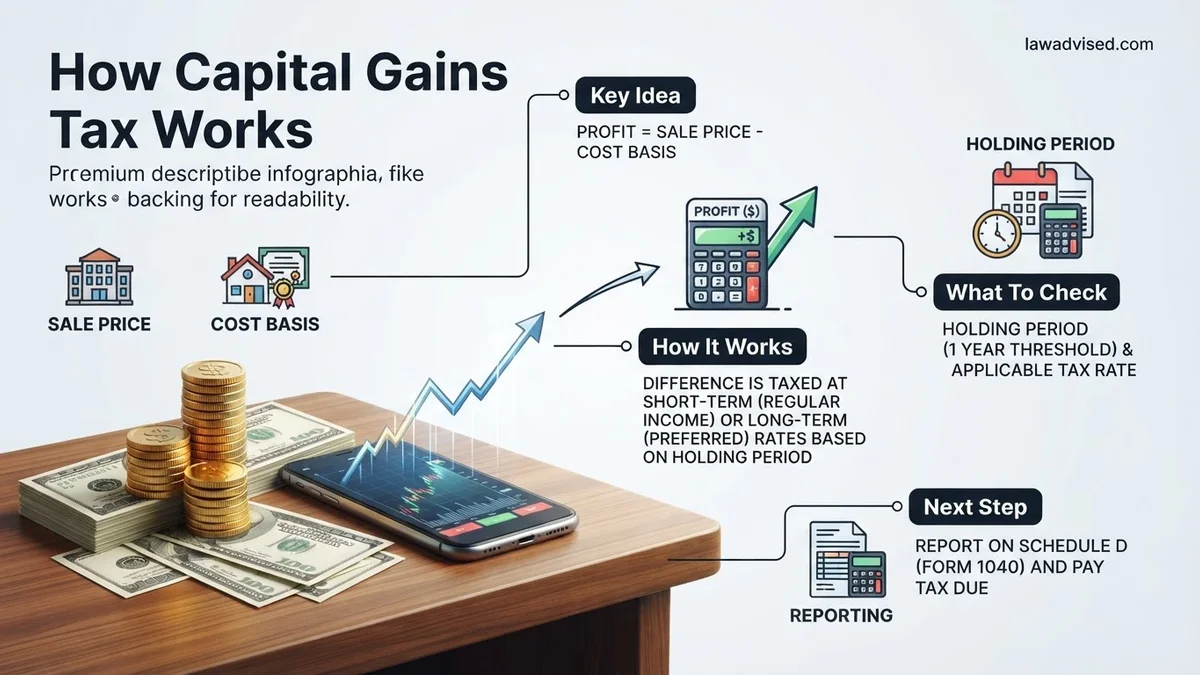
Capital gains tax is a levy on the profit you make when selling an asset like stocks, real estate, or crypto. Your tax rate depends entirely on your cost basis, your total income, and whether you held the asset for more or less than one year.
Capital gains tax is a levy on the profit you make when you sell an asset for more than you originally paid for it. The exact amount you owe depends on two main factors: how long you held the asset before selling, and your overall taxable income level for 2026.
Understanding these mechanics protects your investment returns from unexpected tax bills. Whether you are selling stocks, real estate, or cryptocurrency, knowing how the government calculates your profit allows you to time your sales strategically and keep more money in your pocket.
Key Takeaways
- Capital gain is calculated by subtracting your cost basis from the final sale price.
- Short-term capital gains are taxed at ordinary income tax brackets.
- Long-term capital gains benefit from lower preferential rates of 0%, 15%, or 20%.
- Holding an asset for over 365 days triggers the long-term tax rate qualification.
- Strategies like tax-loss harvesting and the primary residence exclusion can lower liabilities.
What Causes Capital Gains Tax and How Assets Are Triggered
The Trigger Event: Selling for a Profit
Simply watching your investments grow in value does not trigger a capital gains tax. You only owe tax when a taxable event occurs. This means you must actually sell, exchange, or dispose of the asset for cash or other property. Unrealized gains—often called paper profits—remain completely tax-free until you liquidate the position.
Qualifying Assets
Capital gains apply to most forms of property and investments you own for personal or investment purposes. Common assets that trigger capital gains tax when sold include:
- Stocks, bonds, and mutual funds held in taxable brokerage accounts
- Cryptocurrency and digital tokens
- Real estate, including your primary residence, vacation homes, and rental properties (subject to specific exclusion rules)
- Valuable collectibles like art, antiques, and gold
How to Calculate Your Capital Gain Step-by-Step
The Core Formula: Sale Price Minus Cost Basis
Calculating your baseline capital gain is straightforward. You take the total amount you received from the sale and subtract your cost basis. Your cost basis is generally what you originally paid for the asset, plus any purchase commissions, fees, and major improvements made to the property.
Adjusting for Expenses and Improvements
To lower your taxable profit, make sure you calculate your cost basis accurately. If you bought a stock for $5,000 and paid a $10 broker fee, your cost basis is $5,010. If you sell that stock later for $8,000, your capital gain is $2,990, not $3,000. For real estate investors in 2026, allowable capital improvements like a new roof or HVAC system directly increase your cost basis, reducing your eventual tax burden.
How to Fix High Tax Bills Using Proven Exemptions and Harvesting
Minimizing your tax liability legally requires leveraging statutory exemptions and tactical portfolio adjustments. According to recent Internal Revenue Service guidelines, proactive planning significantly reduces the impact of capital gains taxes in 2026.
Tax-Loss Harvesting Strategies
Offsetting gains with losses is a cornerstone of advanced portfolio management. Follow these procedural steps to execute tax-loss harvesting effectively:
- Review your brokerage account to identify underperforming assets currently held at a loss.
- Sell the losing investments to realize capital losses that can offset your realized capital gains dollar-for-dollar.
- Reinvest the proceeds into a similar, but not substantially identical, asset to maintain your market exposure.
- Apply up to $3,000 of remaining net losses against ordinary income if your losses exceed your gains.
- Track your transactions carefully to ensure you do not violate the strict 30-day wash-sale rule.
Primary Residence Exclusions
Homeowners can shield substantial profits from taxation under Section 121 of the Internal Revenue Code. Verify your eligibility using these criteria:
- Confirm you owned the property for at least two out of the five years preceding the sale date.
- Verify that you used the property as your primary residence for that same two-year aggregate timeframe.
- Exclude up to $250,000 of capital gains from your taxable income if you file as a single taxpayer.
- Exclude up to $500,000 of capital gains if you are married and filing a joint return.
What If It Still Doesn’t Work?
If standard exemptions and basic loss harvesting fail to reduce your 2026 capital gains tax burden to an acceptable level, more complex measures are required. Financial analysts and certified public accountants recommend exploring these advanced fallback options:
- Establish a charitable remainder trust (CRT) to defer capital gains taxes while generating an income stream.
- Invest your capital gains into a designated Qualified Opportunity Zone fund to temporarily defer and potentially reduce your tax liability.
- Consult with a Certified Financial Planner or a Certified Public Accountant specializing in tax minimization strategies. Professional consultation fees typically range from $200 to $500 per hour depending on complexity.
- File for an installment sale agreement with the IRS if you sold property, allowing you to spread your tax payments across multiple tax years.
Conclusion
Navigating capital gains tax rules in 2026 demands a clear understanding of holding periods, tax brackets, and available exemptions. Failing to plan for these taxes can severely diminish your investment returns and real estate profits. According to verified research and expert sources from leading financial institutions, proactive tax-loss harvesting and strategic timing remain the most reliable methods for preserving wealth. Your next actionable step is to review your current portfolio performance and schedule a consultation with a certified tax professional to map out your 2026 filing strategy.
❓ Frequently Asked Questions
How does the IRS define the cost basis of an asset?
Cost basis is the original purchase price of an asset plus any capitalized expenses such as commissions, legal fees, and improvement costs. This figure is crucial because your capital gain is simply the sale price minus this cost basis.
Are cryptocurrency transactions subject to capital gains tax?
Yes, the IRS classifies cryptocurrency as property, meaning selling crypto for fiat, trading one crypto for another, or using it to buy goods triggers a taxable capital gain or loss.
What is the Section 121 exclusion for primary residences?
The Section 121 exclusion allows eligible homeowners to exclude up to $250,000 (or $500,000 for married couples filing jointly) of profit from the sale of their primary home, provided they lived in it for two out of the five years prior to the sale.
Does the 3.8% Net Investment Income Tax apply to everyone?
No, the Net Investment Income Tax (NIIT) only applies to high-income earners whose modified adjusted gross income exceeds certain thresholds, such as $200,000 for single filers and $250,000 for married couples filing jointly.
How are capital gains reported to the tax authorities?
When you sell assets, brokerages typically issue a Form 1099-B detailing your proceeds. You must report these transactions and calculate your final tax liability using Form 8949 and Schedule D of your federal tax return.
What happens if my capital losses exceed my capital gains in a single year?
If your total losses outweigh your gains, you can use up to $3,000 of those excess losses to offset your ordinary income. Any remaining unused losses can be carried forward indefinitely into future tax years.

Ismail Hossain is the founder of Law Advised. He is an Divorce, Separation, marriage lawyer. Follow him.