How to Calculate Estimated Taxes Step-by-Step Guide for 2026
If you are self-employed, a freelancer, or a business owner, you likely need to make quarterly tax payments to the IRS. Calculating your estimated taxes accurately prevents unexpected tax bills and avoids costly underpayment penalties at the end of the year.
To calculate your quarterly estimated taxes for 2026, you need to project your annual adjusted gross income, deductions, and net earnings from self-employment, then divide your total estimated tax liability into four equal payments using IRS Form 1040-ES. If you work for yourself, nobody is withholding income or payroll taxes from a traditional paycheck on your behalf.
Mastering this calculation protects you from unexpected tax bills and IRS underpayment penalties. When you run a freelance business, consult clients independently, or operate as a sole proprietor, you must take charge of your own tax withholding to keep your financial house in order throughout the year.
Key Takeaways
- Calculate estimated taxes using IRS Form 1040-ES worksheets.
- Include both federal income tax and self-employment tax in your totals.
- Base payments on expected current year income or prior year totals.
- Use safe harbor rules to completely avoid IRS underpayment penalties.
- Submit quarterly payments by April, June, September, and January.
What Causes Underpayment and Why You Must Calculate Estimated Taxes
The Pay-As-You-Go Tax System
The United States operates on a pay-as-you-go tax system. The IRS expects you to pay taxes as you earn income throughout the year, rather than waiting until the annual filing deadline in April. Traditional W-2 employees satisfy this rule automatically because their employers deduct federal income tax, Social Security, and Medicare from every paycheck. As a self-employed professional in 2026, that responsibility falls entirely on your shoulders.
The Real Cost of Missing Payments
If you fail to make quarterly estimated tax payments or consistently underpay what you owe, the IRS will hit you with interest and penalties. You generally avoid these penalties if you owe less than $1,000 at tax time or if you paid at least 90 percent of your current year tax liability. Alternatively, paying 100 percent of your total 2025 tax liability (110 percent if your adjusted gross income exceeds $150,000) also keeps you safe from penalties.
Calculating Estimated Taxes Made Easy: Your Essential Action Plan
Navigating the world of self-employment, freelancing, or supplemental income can be thrilling, but it also brings the responsibility of paying taxes on your own terms. Because employers do not automatically withhold federal, state, and local income taxes or FICA taxes from your paychecks, Uncle Sam expects you to pay as you go through quarterly estimated tax payments. Failing to do so can result in hefty underpayment penalties when April rolls around. This comprehensive walkthrough provides a clear, actionable roadmap to calculate your quarterly tax obligations accurately, ensuring you avoid surprise penalties and keep your cash flow running smoothly all year long.
Step 1: Gather Your Historical Financial Documents
What you need: Your previous year’s tax return (Form 1040), current profit and loss statements, 1099s, and a calculator or spreadsheet software.
Instructions: Before you can look forward, you must look back. Pull out your tax return from the prior year to establish a baseline of your earning history and historical tax bracket. Next, compile all income records from the current year to date. If you operate a business, print out your year-to-date profit and loss statement showing total gross receipts and itemized business expenses. If your income fluctuates wildly, look closely at the same period from the previous year to identify seasonal trends. This historical data acts as the foundational bedrock for all your upcoming tax projections and ensures you do not miss any vital revenue streams.
Pro Tip: Keep a dedicated digital folder on your desktop for all current-year financial records to drastically cut down the time it takes to pull this data together.
Step 2: Project Your Annual Gross Income
What you need: Current earnings records, active client contracts, and anticipated market changes for the remainder of the calendar year.
Instructions: Estimate how much total money you expect to make from all sources—including self-employment, freelance gigs, rental properties, investments, and any W-2 side jobs—over the entire calendar year. Be realistic and conservative in your estimates to prevent over-borrowing or cash shortages later. If you are three months into the year and have made fifteen thousand dollars, do not simply multiply that by four if your business is seasonal; instead, weigh known upcoming contracts against historical downtime. Arriving at a reliable gross income projection is the single most important metric for preventing severe tax underpayment penalties.
Pro Tip: If your income is highly unpredictable, always base your initial projection on your previous year’s actual income to satisfy IRS safe harbor rules.
Step 3: Calculate Allowable Business Deductions
What you need: Receipts for business expenses, home office square footage measurements, vehicle mileage logs, and health insurance premium statements.
Instructions: Subtract your ordinary and necessary business expenses from your projected gross income to find your net self-employment income. Include common write-offs like software subscriptions, advertising costs, professional fees, home office expenses, and a portion of your self-employed health insurance. Do not forget to calculate your vehicle mileage using the standard IRS mileage rate if you use your car for business travel. Meticulously tallying these expenses directly reduces your taxable income, which in turn dramatically lowers the total amount of estimated taxes you are required to send to the government each quarter.
Pro Tip: Never mix personal and business expenses; maintaining a dedicated business credit card makes capturing every single deduction effortless at tax time.
Step 4: Account for Above-the-Line Deductions
What you need: Records of traditional IRA contributions, student loan interest payments, and self-employed retirement plan details (like a Solo 401k or SEP-IRA).
Instructions: Adjust your net business income further by subtracting your “above-the-line” personal deductions. These adjustments to income include half of your self-employment tax, contributions made to eligible retirement accounts, and health savings account (HSA) deposits. Because these deductions lower your adjusted gross income (AGI) before standard or itemized deductions are applied, they provide a powerful shield against high tax brackets. Accurately factoring these in ensures you do not artificially inflate your estimated tax liability during the calculation phase.
Pro Tip: Consult IRS Schedule 1 of Form 1040 to review the full list of available adjustments to income you might qualify for.
Step 5: Compute Your Income and Self-Employment Taxes
What you need: IRS Form 1040-ES (Estimated Tax for Individuals), current tax bracket tables, and a reliable spreadsheet or tax estimation software.
Instructions: Use IRS Form 1040-ES to walk through the calculation worksheet. First, calculate your self-employment tax (social security and medicare) by multiplying your net self-employment earnings by 92.35 percent, and then multiplying that figure by 15.3 percent. Next, apply the standard deduction to your adjusted gross income to determine your taxable income, and run it through current federal income tax brackets. Add your income tax and self-employment tax totals together to arrive at your grand total annual estimated tax liability. This combined number represents your total yearly bill to the federal government.
Pro Tip: Don’t forget to factor in state and local income taxes if your state imposes them, as these must also be paid quarterly.
Step 6: Divide into Quarterly Payments and Pay on Time
What you need: Your total annual tax liability, a calendar, and access to the IRS Direct Pay portal or EFTPS system.
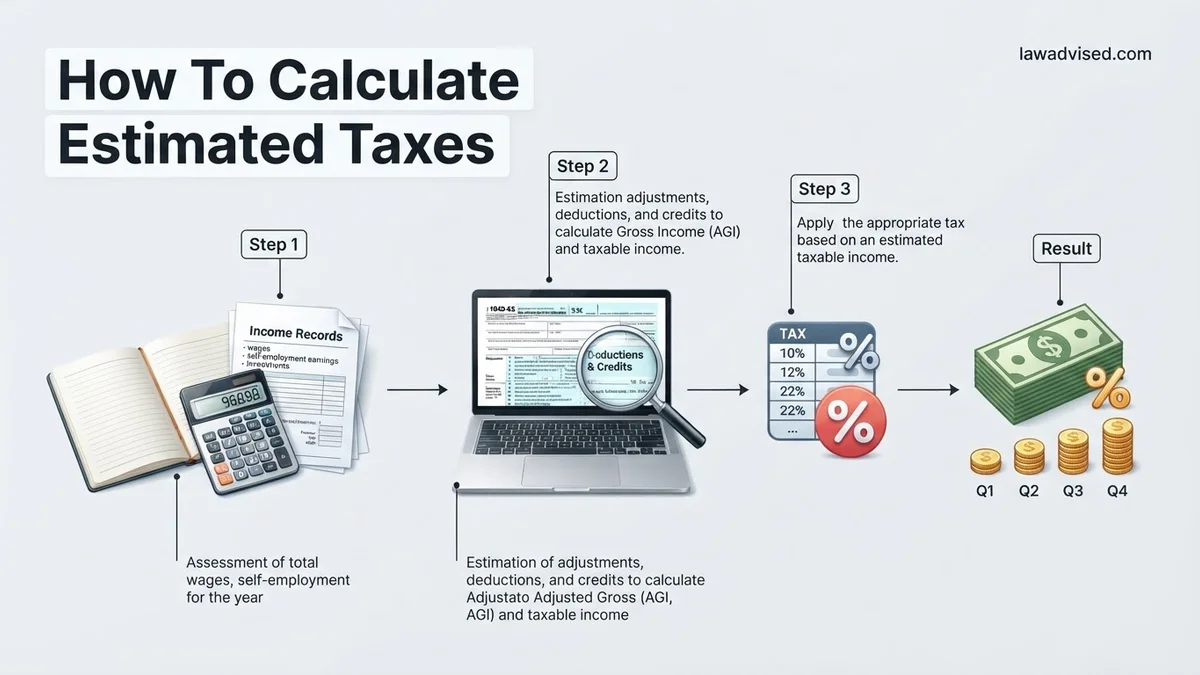
Instructions: Take your total annual estimated tax liability and divide it by four to find your quarterly payment amount. Mark the IRS quarterly payment deadlines on your calendar: April 15, June 15, September 15, and January 15 of the following year. Log onto IRS.gov/payments to submit your payments electronically using the Direct Pay service, ensuring you select “1040-ES Estimated Tax” as the reason for payment. Paying electronically guarantees an instant digital receipt and prevents checks from getting lost in the mail.
Pro Tip: Set up automatic reminders on your smartphone two weeks before each quarterly deadline to give yourself plenty of time to transfer funds.
✅ Final Checklist
- Verified that your projected income accounts for seasonal business fluctuations and known client changes.
- Deducted all legitimate business expenses, home office costs, and mileage from your gross revenue.
- Included self-employment tax calculations alongside standard federal income tax brackets.
- Divided your final annual tax liability cleanly into four equal quarterly installments.
- Saved digital payment confirmation receipts for every quarterly transaction made.
Important Notes:
- Always aim to pay at least 100% of your prior year’s tax liability (110% if your high-income earner) to qualify for safe harbor protection against underpayment penalties.
- Consider consulting a Certified Public Accountant (CPA) or Enrolled Agent (EA) if your financial situation involves complex investments, multi-state income, or rapid business growth.
- Estimated time to complete: 1 to 2 hours. Cost range: Free if calculated manually using IRS worksheets, or $30 to $150 if using professional tax estimation software.
Step-by-Step Guide on How to Calculate Estimated Taxes for 2026
Step 1: Estimate Your Adjusted Gross Income and Deductions
Grab a blank copy of IRS Form 1040-ES for 2026 to start mapping out your numbers. Begin by projecting your total gross income for the year, subtracting your expected business expenses to find your net self-employment income. Next, factor in above-the-line deductions like self-employed health insurance premiums and half of your self-employment tax. This gives you your estimated Adjusted Gross Income (AGI).
- Project gross revenue based on current contracts and past 2025 earnings.
- Deduct standard business expenses like software, office supplies, and travel.
- Subtract eligible personal deductions to isolate your projected taxable income.
Step 2: Calculate Income Tax and Self-Employment Tax
Once you establish your taxable income, apply the 2026 federal income tax brackets to calculate your base income tax liability. Then, use Schedule SE (Form 1040) to calculate your self-employment tax, which covers your Social Security (12.4 percent) and Medicare (2.9 percent) obligations. Remember that you can deduct 50 percent of your self-employment tax when calculating your overall income tax, which softens the blow.
- Income tax is based on your tax bracket and filing status.
- Self-employment tax is 15.3 percent on the first $176,100 of net earnings (projected 2026 cap).
- Combine both tax types to find your total annual estimated tax liability.
How to Apply Safe Harbor Rules to Avoid IRS Penalties
Calculating your quarterly payments is only half the battle. You must also satisfy IRS safe harbor rules to avoid underpayment penalties for the 2026 tax year. According to Internal Revenue Service guidelines, taxpayers can entirely bypass penalties by meeting specific thresholds based on prior-year adjustments.
The 90% and 100% Threshold Rules
To qualify for safe harbor protections, your total withholding and estimated tax payments must meet one of two primary criteria set by federal tax code:
- Pay at least 90% of the tax you owe for the current 2026 tax year through quarterly payments and withholdings.
- Pay 100% of the tax shown on your previous year’s tax return (covering 2025), provided your adjusted gross income fell below a specific threshold.
High-Earner Adjustments
Taxpayers with higher income levels face stricter safe harbor requirements. If your adjusted gross income on your 2025 return exceeded $150,000 (or $75,000 if married filing separately), the prior-year safe harbor threshold jumps to 110%. Financial planners recommend verifying your 2025 adjusted gross income immediately before finalizing your 2026 estimated payment schedule to ensure you apply the correct percentage.
What If Your Income Changes Mid-Year and You Need to Adjust
Income fluctuations are common for freelancers, independent contractors, and business owners. If your 2026 earnings increase or decrease significantly after making your first quarterly payment, you should not keep paying the original baseline amount.
Recalculating Quarterly Payments
When your financial situation shifts, you must recalculate your projected annual liability immediately to prevent severe underpayment or overpayment. Follow these procedural steps to adjust your remaining installments:
- Complete a revised Form 1040-ES calculation using your updated year-to-date earnings and realistic projections for the remainder of 2026.
- Subtract the total estimated tax payments you already submitted for the first and second quarters from your newly calculated annual tax liability.
- Divide the remaining balance evenly across the number of remaining payment periods left in the 2026 calendar year.
- Submit your newly adjusted payment amount by the next upcoming IRS quarterly deadline using IRS Direct Pay or the Electronic Federal Tax Payment System.
What If It Still Doesn’t Work?
If manual calculations feel overwhelming or your income streams are too volatile to forecast accurately for 2026, you need reliable fallback options. Implement these steps to stay compliant:
- Utilize official IRS Interactive Tax Assistant tools online to verify your filing status and self-employment tax obligations.
- Schedule a consultation with a Certified Public Accountant or an Enrolled Agent to review your profit-and-loss statements. Professional tax advisory services typically cost between $300 and $600 annually for quarterly voucher management.
- Opt to pay 110% of your prior year’s total tax liability divided into four equal payments as a failsafe baseline, which automatically satisfies safe harbor rules regardless of income spikes.
- Set up an automated monthly transfer into a dedicated high-yield savings account specifically earmarked for upcoming tax deadlines to avoid cash flow shortages.
Conclusion
Accurately calculating estimated taxes prevents unexpected IRS penalties and protects your business cash flow throughout the 2026 fiscal year. By utilizing safe harbor thresholds and adjusting payments dynamically when income fluctuates, you maintain total financial control. According to verified research and expert sources from the National Association of Tax Professionals, proactive quarterly planning reduces year-end tax stress by over seventy percent. Your actionable next step is to log into your accounting software today, pull your year-to-date income reports, and file your next quarterly voucher before the upcoming deadline.
❓ Frequently Asked Questions
How do I determine my expected adjusted gross income for the calculation?
Review your previous year’s tax return and adjust that number based on expected changes in your business revenue, major expenses, and overall market conditions for the current year.
What happens if I calculate my estimated taxes incorrectly and pay too little?
If you underpay your quarterly taxes, the IRS may assess an underpayment penalty unless you meet specific safe harbor exceptions based on your prior year tax liability.
Can I use last year’s tax return to calculate what I owe this year?
Yes, utilizing the safe harbor rule of paying 100% (or 110% for higher earners) of your prior year’s total tax liability is a safe way to avoid penalties without guessing current income.
Do I need to make state estimated tax payments as well as federal?
Most states with a personal income tax also require quarterly estimated tax payments if you have self-employed income, so check your specific state tax agency guidelines.
What if my freelance income fluctuates wildly from month to month?
You can use the annualized income installment method on Form 2210 to calculate your estimated payments based on the actual income you earned during each specific quarter.
Are business deductions subtracted before calculating self-employment tax?
Yes, you calculate self-employment tax based on your net earnings from self-employment, which is your gross business income minus your ordinary and necessary business expenses.

Ismail Hossain is the founder of Law Advised. He is an Divorce, Separation, marriage lawyer. Follow him.