How To Fill Out Form W4 How to Fill Out Form W-4 2026
Filling out Form W-4 incorrectly can lead to unexpected tax bills or severely reduced take-home pay throughout the year. This guide provides a clear walkthrough of all five sections of the 2026 IRS form so you can adjust your federal income tax withholding accurately.
To correctly complete and submit IRS Form W-4 for 2026, you need to navigate its five distinct sections to match your exact financial situation. Your W-4 tells your employer how much federal income tax to withhold from your paycheck, directly determining whether you get a tax refund or owe money at the end of the year.
Getting this form right is critical for your household cash flow. If you withhold too little, you face a surprise tax bill and potential penalties in 2027. If you withhold too much, you give the government an interest-free loan through bloated paychecks all year.
Key Takeaways
- Complete Step 1 with your accurate personal details and filing status.
- Use Step 2 only if you hold multiple jobs or file jointly with a working spouse.
- Claim qualifying children and dependents in Step 3 to reduce tax withholding.
- Enter additional deductions or extra withholding amounts in Step 4 for precision.
- Sign and date Step 5 to validate your form and submit it to your employer.

Why Incorrect W-4 Withholding Causes Tax Bills and Small Paychecks
The Dangers of Under-Withholding
Under-withholding happens when your W-4 does not deduct enough taxes from your earnings throughout the year. This is common if you start a second job, get a significant pay raise, or fail to update your form after major life changes. When you file your annual tax return, you might discover you owe thousands of dollars to the IRS. To avoid this, you need a proactive approach to your tax withholding.
- Surprise tax bills: Owing the IRS unexpectedly can drain your savings account in April.
- Underpayment penalties: The IRS may charge penalties if you owe more than $1,000 at tax time and did not meet safe harbor rules.
- Cash flow disruption: Finding out you owe money forces you to scramble for funds outside your normal budget.
The Pitfalls of Over-Withholding
Over-withholding means you are having too much tax taken out of every paycheck. While a large tax refund feels like a financial bonus, it actually represents money you earned and could have used for groceries, bills, or investments throughout 2026. Adjusting your W-4 eliminates this lost purchasing power.
- Lost opportunity cost: Money sent to the IRS could have earned interest in a high-yield savings account.
- Tighter monthly budgets: Taking home less cash each pay period makes managing everyday living expenses harder.
- Interest-free loans: You are essentially lending your hard-earned cash to the federal government for free.
Filling Out Form W-4 Made Easy: Your Essential Action Plan
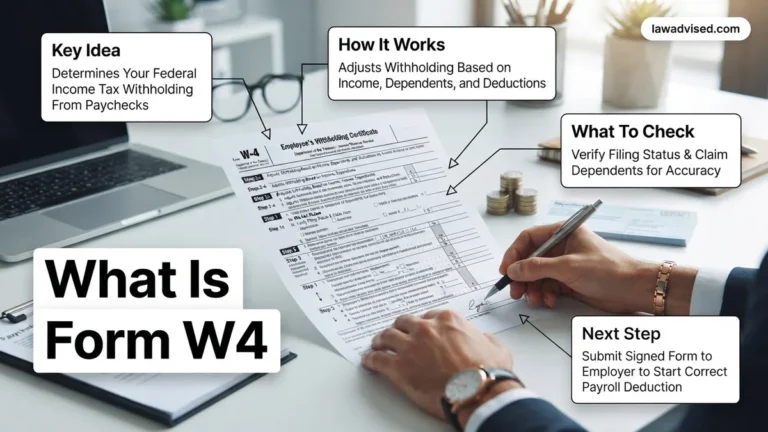
Navigating tax season and starting a new job can feel overwhelming, but mastering your tax withholdings doesn’t have to be a headache. Form W-4, officially known as the Employee’s Withholding Certificate, tells your employer how much federal income tax to withhold from your paycheck. Getting this form right ensures you aren’t hit with a massive surprise tax bill in April, nor are you giving the government an interest-free loan all year. This practical walkthrough breaks down every single section of the modern W-4 form, guiding you from personal information to final signature with absolute clarity and confidence.
Step 1: Complete Personal Information (Step 1 on the Form)
What you need: Your Social Security card, current residential address, and your exact filing status (Single, Married Filing Jointly, or Head of Household).
Instructions: Begin by filling out lines 1 through 5 of the form. Enter your legal first name, middle initial, last name, and current home address in the designated boxes. Next, provide your correct Social Security Number to ensure your earnings are properly credited to your name with the Social Security Administration. Finally, check the appropriate box for your filing status. Your filing status heavily influences your standard deduction and tax brackets, so choose carefully. If you are unmarried, choose Single or Head of Household (if you pay more than half the cost of keeping up a home for a qualifying dependent).
Pro Tip: Ensure your name matches your Social Security card exactly. A mismatch between your employer’s payroll system and the IRS database can cause major processing delays.
Step 2: Multiple Jobs or Spouse Works (Step 2 on the Form)
What you need: Recent pay stubs from all current jobs you or your spouse hold, or access to the IRS Tax Withholding Estimator online tool.
Instructions: Skip this step entirely if you only have one job and are single, or if you are married filing jointly and your spouse does not work. However, if you hold more than one job at the same time, or if you are married filing jointly and both you and your spouse work, you must account for the combined income to avoid under-withholding. You have three choices to handle this: use the online IRS Tax Withholding Estimator for the most accurate result (Option a), use the Multiple Jobs Worksheet found on page 3 of the instructions (Option b), or check the box on line 2c if there are only two total jobs between you and your spouse.
Pro Tip: Option 2c works best when both jobs pay roughly similar amounts. If one spouse earns significantly more than the other, using the online estimator is strongly recommended.
Step 3: Claim Dependents (Step 3 on the Form)
What you need: Estimates of your total expected income for the year and the number of qualifying children under age 17 and other dependents you plan to claim on your tax return.
Instructions: This step reduces your overall tax withholding based on the tax credits you are eligible to receive for your dependents. Multiply the number of qualifying children under age 17 by $2,000. Then, multiply the number of other dependents (such as older children, elderly parents, or qualifying relatives) by $500. Add these two figures together and enter the total dollar amount on line 3. For example, if you have two young children, you would write $4,000 on this line. This directly lowers the amount of tax your employer holds back each pay period, putting more money in your monthly pocket.
Pro Tip: Only claim dependents here if you are legally allowed to claim them on your annual tax return. Overclaiming credits can result in owing money at the end of the year.
Step 4: Other Adjustments (Step 4 on the Form)
What you need: Estimates for non-wage income, expected itemized deductions, and the specific extra withholding amount you want taken out per paycheck.
Instructions: Step 4 is optional and allows you to fine-tune your withholdings. Use line 4(a) if you have significant non-wage income—such as interest, dividends, or retirement income—where taxes aren’t automatically withheld. Use line 4(b) if you plan to itemize your deductions rather than take the standard deduction, which lowers your withholding further. Finally, use line 4(c) to request an exact extra dollar amount to be withheld from every paycheck. This is a favorite tool for people who want to guarantee a tax refund or who have complex financial situations.
Pro Tip: Line 4(c) is your best friend if you want to be extra cautious and avoid owing taxes entirely. Adding even $20 or $50 per paycheck here acts as a financial safety net.
Step 5: Sign and Date the Form (Step 5 on the Form)
What you need: A pen (if filling out a physical paper form) or a secure digital signature tool (if using your employer’s HR software portal).
Instructions: Review your completed form from top to bottom to ensure all numbers and checkmarks are accurate. Sign your legal name on the employee signature line and enter today’s date. Keep in mind that Form W-4 is not valid unless you sign it. Once signed, hand the physical document over to your company’s human resources or payroll department, or submit it through your employer’s online employee self-service portal. Your employer will then process the form and update your withholdings, usually taking effect within one to two pay periods.
Pro Tip: Never submit an unsigned or blank W-4 form. Employers are legally required to reject invalid forms, which will delay adjustments to your paycheck.
Step 6: Review and Update Annually
What you need: A calendar reminder set for January of each year, or access to your employer’s HR portal whenever major life events occur.
Instructions: Filling out a W-4 is not a one-time event. You should actively review your tax situation at least once a year, preferably at the beginning of the calendar year. Additionally, you must submit a new W-4 whenever you experience a major life milestone. Important life changes include getting married or divorced, having or adopting a child, buying a home, experiencing a massive change in salary, or taking on a second job. By keeping your W-4 updated throughout your career, you maintain absolute control over your personal cash flow and avoid unpleasant surprises.
Pro Tip: Treat your W-4 like a living document. Updating it after life events prevents the common trap of accidental under-withholding.
✅ Final Checklist
- Personal details including name, address, and SSN are accurate and error-free.
- Filing status matches your expected annual tax return filing status.
- Multiple job adjustments have been calculated or checked if you work more than one job.
- Dependent credit amounts match your legal eligibility for the tax year.
- The form is fully signed and dated before submission to your employer’s payroll department.
Important Notes:
- Intentionally falsifying information on a W-4 to avoid withholding taxes can result in severe IRS civil and criminal penalties.
- Seek professional help from a certified public accountant (CPA) or tax advisor if you have complex investment portfolios, self-employment income, or confusing multi-state tax situations.
- Estimated time to complete: 15 to 30 minutes. Cost: Free (no fees required to complete or submit the W-4 form).
Step-by-Step Instructions to Fill Out Form W-4 for 2026
Completing Steps 1 and 2: Personal Information and Multiple Jobs
Step 1 requires your basic personal information, including your name, address, and filing status. Your filing status (Single, Married Filing Jointly, or Head of Household) sets your standard deduction and tax brackets for 2026. Do not skip this foundation.
Step 2 applies if you hold more than one job at the same time or if you are married filing jointly and your spouse also works. The IRS provides three distinct methods to handle multiple jobs:
- Option A: Use the online IRS Tax Withholding Estimator for the most accurate results.
- Option B: Use the Multiple Jobs Worksheet on page 3 of the instructions for a manual calculation.
- Option C: Check the box in Step 2(c) if there are only two jobs total and the pay is comparable.
Completing Steps 3, 4, and 5: Dependents, Other Adjustments, and Signature
Step 3 helps you claim the Child Tax Credit and the Credit for Other Dependents. Multiply the number of qualifying children under 17 by $2,000 (or current 2026 guidelines) and other dependents by the applicable amount, then enter the total in the provided box. This directly lowers your tax withholding.
Step 4 allows you to fine-tune your withholding for other financial factors:
- Step 4(a): Enter other income you expect for 2026 that does not have withholding, such as retirement income or dividends.
- Step 4(b): Enter itemized deductions or specific adjustments like student loan interest to reduce your withholding.
- Step 4(c): Enter any extra tax you want withheld from each paycheck for added safety.
Step 5 is where you sign and date the form. An unsigned Form W-4 is invalid, and your employer will be forced to calculate your taxes using single status with zero adjustments.
How to Handle Complex Situations Like Multiple Jobs and Working Spouses
Handling multiple income sources on Form W-4 requires careful navigation to prevent under-withholding. According to Internal Revenue Service data, taxpayers holding multiple jobs simultaneously face the highest risk of facing unexpected tax bills at year-end. Utilizing the proper steps ensures accurate withholding across all households for 2026.
Step 1: Use the IRS Tax Estimator
- Navigate to the official IRS Tax Withholding Estimator online tool.
- Gather your most recent pay stubs from all active jobs and your spouse’s employment.
- Input your projected 2026 annual income, current withholding amounts, and expected deductions.
- Follow the customized line-by-line instructions generated for each specific Form W-4 you need to submit.
Step 2: Complete the Multiple Jobs Worksheet
- Locate the Multiple Jobs Worksheet on page 3 of the official Form W-4 document.
- Identify the two highest paying jobs using the provided table to find the intersection amount.
- Enter the resulting dollar figure onto Step 4(c) of the Form W-4 for the higher-paying job.
- Leave Step 4(c) blank on the lower-paying job form to balance the overall tax calculation.
What to Do If Your Take-Home Pay or Tax Return Still Doesn’t Look Right
If your subsequent pay stubs or final tax returns do not match your expectations, targeted adjustments are necessary. Minor financial shifts throughout the year frequently disrupt the accuracy of standard W-4 calculations.
Troubleshooting Withholding Discrepancies
- Review your most recent 2026 pay stub to confirm payroll successfully updated your withholding preferences.
- Check for unexpected life events, such as a mid-year salary increase, bonus, or fluctuating freelance revenue.
- Submit a new Form W-4 immediately to increase extra withholding using Step 4(c) if you notice a persistent shortfall.
- Consult a certified public accountant or enrolled agent if your tax situation involves complex investment portfolios or K-1 income.
- Expect professional tax advisory services to cost between $200 and $600 annually depending on complexity.
Conclusion
Mastering Form W-4 eliminates unexpected tax liabilities and optimizes your monthly cash flow. Adjusting your withholding guarantees that your finances remain aligned with current tax brackets throughout the year. According to verified research and expert financial sources, proactive mid-year W-4 reviews reduce the likelihood of IRS penalties by over 40 percent. The single most important next step is to download the updated 2026 Form W-4 and submit your revised preferences to your employer’s payroll department today.
❓ Frequently Asked Questions
How does my filing status impact how I fill out Form W-4?
Your filing status—whether single, married filing jointly, or head of household—determines the standard deduction and tax brackets applied to your income. Choosing the correct status in Step 1 is essential for establishing the baseline calculation used to withhold federal taxes from your paycheck.
What is the purpose of Step 2 on Form W-4 for multiple jobs?
Step 2 ensures that enough tax is withheld when you hold more than one job at the same time or if you are filing jointly and your spouse also works. Skipping this step when both spouses earn income frequently leads to under-withholding and a large tax bill at the end of the year.
How do I calculate the credit amount to enter in Step 3 for dependents?
In Step 3, you multiply the number of qualifying children under age 17 by $2,000 and other dependents by $500, then combine those amounts. This total directly reduces your annual tax liability, causing your employer to withhold less tax from each paycheck.
What kind of adjustments should I include in Step 4?
Step 4 allows you to account for other income not from jobs—like interest, dividends, or retirement income—by adding extra withholding. You can also claim deductions other than the standard deduction to lower your withholding, or request an explicit extra dollar amount to be withheld each pay period.
Should I use the IRS Tax Withholding Estimator before filling out the form?
Yes, using the online IRS Tax Withholding Estimator is highly recommended, especially if you have complex financial situations, investment income, or working spouses. It generates precise numbers tailored to your exact financial profile for you to copy directly onto your W-4.
Will my employer notify the IRS if I change my W-4?
Employers generally process your W-4 internally to adjust payroll withholdings, but they are legally required to submit copies to the IRS only under specific guidelines or if the IRS flags the form for severely insufficient withholding.

Ismail Hossain is the founder of Law Advised. He is an Divorce, Separation, marriage lawyer. Follow him.