Loud Music Laws in California 2027 Expert Legal Guide
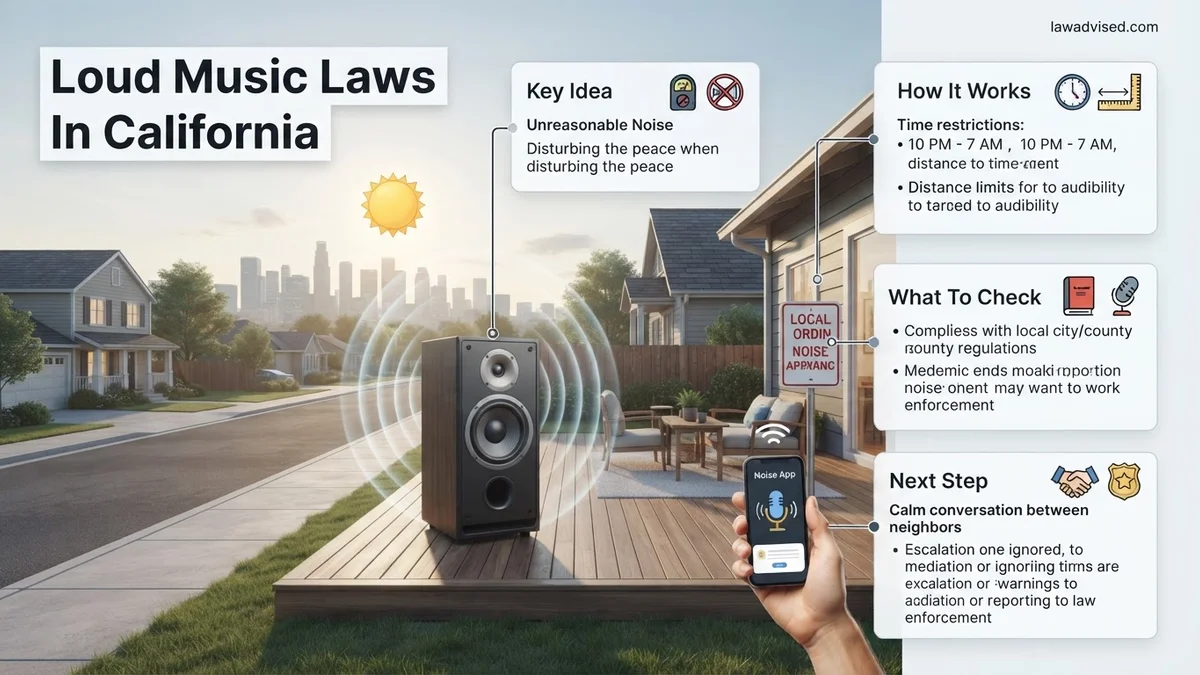
Navigating loud music laws in California requires understanding that noise regulations are primarily set by local city and county ordinances rather than a single state-level statute. Most municipalities enforce specific decibel limits and strict quiet hours, typically running from 10:00 PM to 7:00 AM, to protect residential peace.
California noise limits and decibel thresholds depend heavily on your specific municipality, but state guidelines generally restrict residential noise between 45 and 55 decibels during standard quiet hours, which typically run from 10:00 PM to 7:00 AM. Playing loud music that exceeds these limits or disturbs the peace can result in escalating civil fines, misdemeanor citations, and even equipment confiscation by local law enforcement.
Navigating these regulations requires understanding how local ordinances interact with state statutes in 2027. Whether you are dealing with a disruptive neighbor or trying to avoid a fine yourself, knowing the exact legal parameters keeps you protected.
Key Takeaways
- California noise limits depend entirely on your specific city or county municipal code.
- Standard quiet hours generally span from 10:00 PM to 7:00 AM statewide.
- Residential decibel thresholds usually range between 45 and 55 decibels at night.
- Violating local noise ordinances can result in municipal fines and misdemeanor citations.
- Documenting noise violations with dates and decibel readings strengthens your official complaint.
What Causes Noise Disputes and Violations of Loud Music Laws in California
Decibel Threshold Breaches and Local Ordinances
Most California cities use specific decibel (dB) limits measured from the property line of the complainant. During daytime hours, residential limits often hover around 55 dB, dropping to 45 or 50 dB at night. Playing a home stereo or outdoor speaker system that pushes past these thresholds instantly triggers a violation. Cities like Los Angeles, San Diego, and San Francisco enforce strict quantitative standards where officers use sound meters rather than subjective judgment.
Disturbing the Peace and Unreasonable Noise
Even if music stays below a specific decibel cap, you can still violate California Penal Code 415 if the audio is considered “unreasonable.” Law enforcement officers look at factors like the time of day, repetition, and proximity to sensitive locations like schools or hospitals. Common triggers for disputes include:
- Late-night backyard parties with uncontained bass frequencies
- Car stereos rattling windows in residential zones
- Continuous daytime practicing of amplified instruments without acoustic mitigation
How to Fix Excessive Neighborhood Noise Issues Step by Step
Communication and Documentation Strategies
Before involving authorities, addressing the issue directly often yields the fastest resolution. Approach your neighbor politely during daylight hours to explain how the music impacts your home. If informal talks fail, start building a clear log of violations for your records in 2027.
- Record dates, exact times, and the duration of the loud music.
- Measure sound levels using a decibel meter app from your property line if possible.
- Save any text messages or written communications with the offending party.
Involving Law Enforcement and Mediation Services
When direct communication fails, you need to escalate the matter through official channels. Non-emergency police dispatchers handle ongoing noise complaints, though response times vary based on local department priorities. For chronic issues, local city code enforcement offices can issue administrative citations that carry heavy financial penalties. Many California counties also offer free or low-cost neighborhood mediation services to resolve recurring disputes without court intervention.
Step-by-Step Guide to Filing Official Noise Complaints and Working with Authorities
When informal mediation fails, navigating the official channels requires a structured approach. Law enforcement agencies in California prioritize calls based on active public safety threats, making documentation critical for persistent noise issues.
Documenting the Decibel Violation
According to municipal code enforcement data, verifiable evidence significantly increases citation rates. Residents must record audio logs noting exact dates, times, and estimated decibel levels using smartphone measurement applications calibrated to state standards. Keeping a detailed journal establishes a clear pattern of disruption that prosecutors require for misdemeanor citations.
Engaging Local Code Enforcement
Filing a formal complaint involves a specific sequence of actions to ensure municipal response in 2027:
- Contact the non-emergency dispatch line for your local police department or sheriff’s office while the loud music is actively occurring.
- Provide the dispatcher with exact addresses, specific vehicle descriptions if music originates from a car, and your prior attempts at direct communication.
- Request an incident report number for your personal records to track municipal responsiveness over time.
- Submit a written nuisance complaint form through your city or county’s online code enforcement portal if the disturbance happens repeatedly during daylight hours.
- Follow up with the assigned code enforcement officer weekly to provide updated audio logs and witness statements from other affected neighbors.
What If Local Enforcement Fails to Stop the Loud Music
When municipal police departments or code enforcement officers fail to resolve chronic noise disturbances, affected residents retain civil remedies under California law. Persistent acoustic violations breach the legal covenant of quiet enjoyment, opening pathways for formal legal intervention.
Escalation Protocols
If standard municipal channels prove ineffective, consider these advanced recovery steps:
- Hire a licensed private acoustic consultant to conduct professional sound testing and generate an admissible legal report, with testing fees typically ranging from $500 to $1,500.
- Consult a real estate or civil litigation attorney to issue a formal demand letter outlining potential damages for private nuisance.
- File a civil lawsuit in small claims court or superior court to seek statutory damages and permanent injunctions against the offending property owner or tenant.
- Submit formal complaints to corporate landlords or homeowners associations (HOAs) demanding lease enforcement under residential nuisance clauses.
Conclusion
Resolving chronic loud music issues in California requires balancing direct communication with strict adherence to local municipal codes and state decibel thresholds. Documenting violations meticulously and escalating through official channels protects your right to a peaceful home environment. According to verified research and expert sources from the California Department of Public Health, consistent legal documentation remains the single most effective tool for compelling compliance from disruptive neighbors. Take your next actionable step today by downloading a certified decibel meter application and initiating a formal written log of all future disturbances.
❓ Frequently Asked Questions
Do state laws set exact decibel limits for music in California?
No, California does not have a single statewide decibel limit for residential music. Instead, the state delegates authority to individual cities and counties to establish their own municipal noise ordinances and decibel thresholds.
What constitutes a disturbance under California penal code?
Under California Penal Code 415, maliciously and willfully disturbing another person by loud and unreasonable noise can be classified as a misdemeanor offense, though it is usually handled through local citations first.
How can I legally measure how loud my neighbor’s music is?
You can use a calibrated decibel (dB) meter or a reliable smartphone sound-level app. Measurements should ideally be taken from your own property line or inside your home to verify if the sound exceeds local daytime or nighttime limits.
Can I sue a neighbor in small claims court for playing loud music?
Yes, you can file a civil lawsuit or small claims action for private nuisance if the loud music substantially and unreasonably interferes with the use and enjoyment of your property, provided you have kept detailed records.
What steps should I take before calling the police on a noisy neighbor?
It is generally recommended to speak with your neighbor politely when things are quiet to explain the issue. If that fails, contact your landlord or HOA if you live in a managed community before involving local law enforcement.
Are commercial venues held to different noise standards than residents?
Yes, commercial businesses, bars, and entertainment venues must adhere to commercial zoning noise limits, which are often higher than residential limits but still heavily regulated by local permits and conditional use restrictions.

Ismail Hossain is the founder of Law Advised. He is an Divorce, Separation, marriage lawyer. Follow him.