
Pocket Knife Laws in California 2027 Expert Legal Guide
Navigating pocket knife laws in California requires understanding strict regulations on concealed carry, switchblades, and local ordinances. While standard folding pocket knives can be carried openly without length limits, concealing certain knives or carrying restricted mechanisms can lead to criminal charges. Legal compliance depends heavily on how the knife is carried and its specific mechanical design.
Navigating pocket knife laws in California requires understanding that state statutes draw a sharp line between folding pocket knives, switchblades, and fixed-blade tools like dirks and daggers. Under California Penal Code, ordinary folding pocket knives—even those with a locking mechanism—can generally be carried concealed on your person without a length restriction, provided they are kept in the folded position. However, switchblades with blades over two inches are strictly illegal to carry, sell, or possess in public.
As you plan your EDC (Everyday Carry) setup for 2027, staying compliant means knowing the exact legal classifications that separate a legal utility tool from a concealed weapon. Failing to understand these nuances can lead to misdemeanor or felony charges, depending on where and how you carry your blade.
Key Takeaways
- Standard folding pocket knives have no statewide blade length limit for open carry.
- Concealed carry of a non-locking folding knife is generally legal, but locking folders face strict interpretations.
- Switchblades with blades 2 inches or longer are strictly illegal to carry or possess in public.
- Local cities and counties can enforce stricter blade length limits than state law.
- Intent to use any knife as a weapon transforms it into an illegal concealed dirk or dagger.
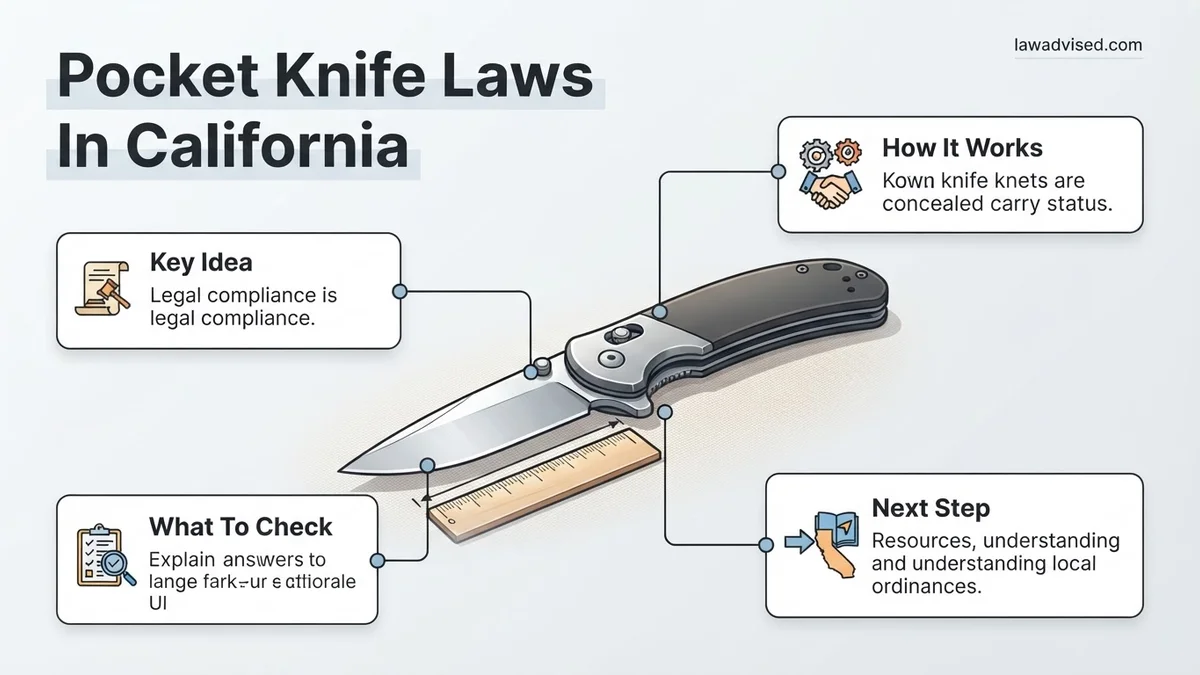
What Causes Legal Violations Under California Knife Statutes
Most legal violations occur because carriers misunderstand the strict definitions surrounding concealed carry and fixed blades. California law treats how you carry a knife just as importantly as the knife itself.
Concealed Carry Violations of Dirks and Daggers
Any knife that can be used as a stabbing weapon—including fixed blades, stilettos, and even folding knives locked in the open position—is legally classified as a “dirk or dagger.” Under California Penal Code 21310, carrying a dirk or dagger concealed on your person is a wobbler offense, meaning it can be prosecuted as a misdemeanor or a felony. If your pocket knife locks open and you slip it into your jacket pocket hidden from view, you may accidentally be committing a serious crime.
Switchblade and Automatic Knife Infractions
Carrying an automatic knife, spring-loaded blade, or switchblade with a blade length exceeding two inches violates California Penal Code 21510. Even though federal restrictions on switchblades have loosened in recent years, California state law maintains this strict two-inch limit for automatic deployment. Violating this statute can result in up to a year in county jail and steep fines.
How to Fix Your Carry Habits and Comply With State Law
Adjusting your daily carry habits ensures you stay safely within the boundaries of California state law while still having a functional tool when you need it.
Shift to Open Carry for Fixed Blades and Non-Standard Knives
If you prefer carrying a fixed-blade knife for camping, work, or utility tasks, you must carry it openly. California law prohibits concealed carry for dirks and daggers, but open carry—such as wearing a sheath visibly on your belt—is legal under state statutes. To stay compliant:
- Keep fixed-blade knives completely visible on your hip or belt.
- Never tuck a fixed blade into your waistband under a shirt or jacket.
- Ensure non-folding utility knives are not concealed inside closed pockets without visible clipping.
Verify Local Municipal Ordinances
State law sets the baseline, but cities and counties in California often enforce stricter rules. For example, Los Angeles, San Francisco, and Oakland enforce local ordinances that restrict the blade length of any knife carried openly or restrict pocket knives on public transit, in schools, and inside government buildings. Always research the specific municipal codes of the cities you visit in 2027 to avoid local citations.
What If Local Ordinances and Restrictions Still Apply
Navigating California knife laws requires understanding that state preemption does not cover every municipal rule. While the state regulates folding knives and switchblades, cities and counties retain authority over specific public spaces. As of 2027, legal experts emphasize that local municipal codes can impose stricter regulations than the California Penal Code.
Public Parks and Schools
State law generally permits carrying legal folding knives, but local ordinances frequently prohibit any blade in sensitive areas. According to municipal compliance studies, carrying a pocket knife into a public park, library, or civic center can trigger local misdemeanor charges. School zones enforce zero-tolerance policies regardless of blade length or folding mechanisms.
Public Transit Systems
Transit authorities across California maintain independent rules regarding weapons on buses, trains, and platforms. Security personnel and transit police enforce tariffs that forbid carrying any knife with a blade over a specific threshold, typically 2.5 inches. Violating transit regulations results in immediate ejection, fines, or criminal trespassing charges.
- Review the specific municipal code of every city or county you plan to visit before carrying your pocket knife.
- Avoid bringing any blade into government buildings, public schools, or university campuses regardless of state exemptions.
- Check transit authority regulations online if you commute using regional bus or rail networks.
- Leave restricted pocket knives at home when attending public demonstrations, rallies, or permitted public events where local emergency ordinances may temporarily ban all edged tools.
What If It Still Doesn’t Work?
If you face criminal charges or uncertainty regarding a confiscated pocket knife, standard compliance measures may no longer suffice. Resolving complex legal disputes requires specialized intervention to protect your record and rights.
- Consult with a qualified criminal defense attorney who specializes in California weapons laws and municipal code violations immediately.
- Request formal written documentation from law enforcement detailing the exact weight, length, and mechanism of the confiscated blade.
- Avoid making statements to police officers about your intent or the origin of the knife without legal representation present.
- Prepare for potential legal defense expenses, noting that private criminal defense representation in California typically ranges from $2,500 to $7,500 depending on court appearances and case complexity.
Conclusion
Mastering pocket knife laws in California requires continuous attention to both state penal codes and localized municipal ordinances. Failing to account for blade length limits, concealed carry restrictions, or restricted public zones can lead to severe criminal penalties. According to verified research and expert legal sources, proactive compliance remains the single most effective way to avoid legal repercussions. One actionable next step is to audit your current everyday carry collection against the 2027 California Penal Code standards and leave any questionable blades securely at home.
❓ Frequently Asked Questions
What is the legal definition of a dirk or dagger in California?
Under California Penal Code, a dirk or dagger is defined as a knife or other instrument that is capable of being used as a stabbing weapon that may inflict great bodily injury or death. This includes any fixed-blade knife and certain locking folding knives if carried in a locked-open position.
How does California law treat open carry versus concealed carry for knives?
Open carry is generally permitted for standard folding knives and utility tools if they are carried openly and not concealed. Conversely, concealed carry laws are much stricter, penalizing the hidden transport of fixed blades and certain folding knives.
Are assisted-opening knives legal in California?
Assisted-opening knives—where you manually push a thumb stud or flipper and a spring finishes the open—are generally legal under state law, provided they do not meet the strict definition of a switchblade activated by a button on the handle.
Can I carry a pocket knife while hiking or camping in California?
Yes, outdoor recreational activities provide a strong context for lawful utility use, but you must still adhere to restrictions regarding specific knife types and federal or state park regulations.
What happens if a police officer finds an illegal knife in my possession?
Possessing an illegal knife, such as a switchblade over 2 inches or carrying a concealed dirk or dagger, is typically charged as a misdemeanor, which can result in fines and up to a year in county jail.
Do local California cities have stricter knife laws than the state?
Yes, many cities and counties enforce municipal codes that limit blade lengths further—such as restricting blades over 3 inches in public spaces—so you must check local ordinances.

Ismail Hossain is the founder of Law Advised. He is an Divorce, Separation, marriage lawyer. Follow him.