Taxes for Content Creators 2026 A Step-by-Step Guide
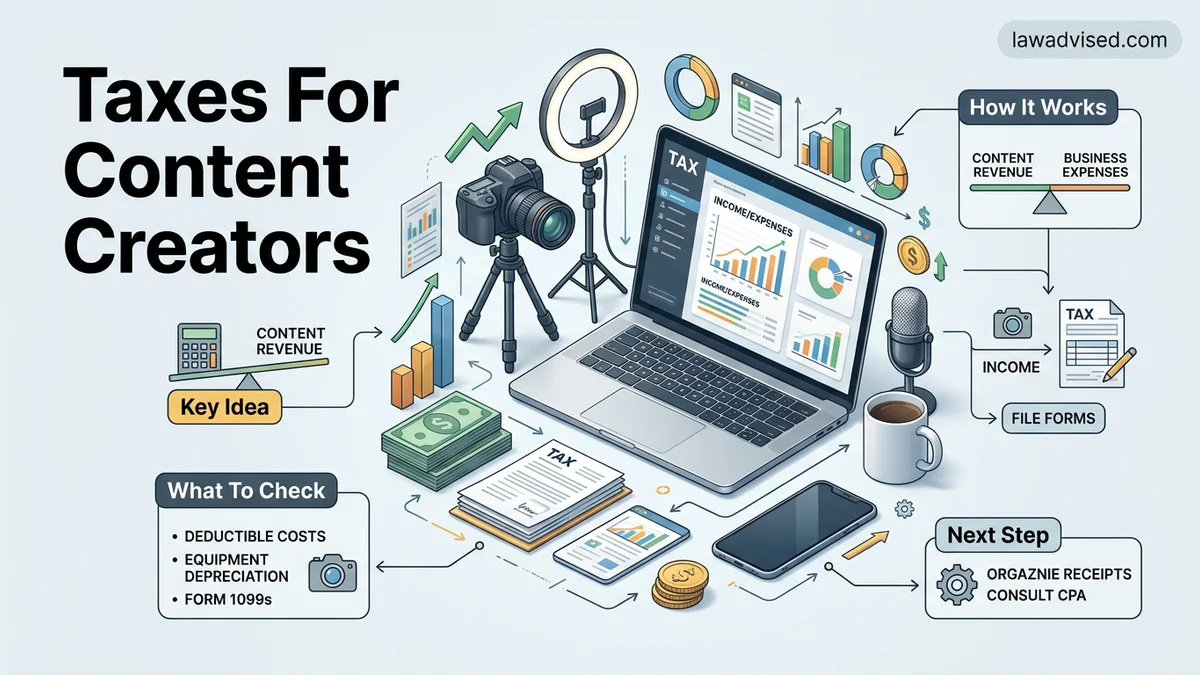
Content creators must treat their channels and pages as real businesses, meaning they are responsible for tracking income, paying self-employment tax, and filing quarterly estimated taxes. Failing to separate personal and business finances or missing IRS deadlines can lead to heavy penalties and unexpected tax bills.
As a content creator in 2026, you are running a legitimate digital business in the eyes of the IRS. This means you must pay federal, state, and self-employment taxes on your brand deals, ad revenue, and digital products, while aggressively claiming business write-offs to lower your taxable income.
Ignoring these obligations leads to brutal IRS audits and surprise penalties. Getting your tax workflow right saves you thousands of dollars and lets you focus on building your audience instead of stressing over compliance.
Key Takeaways
- Track every business expense using dedicated business bank accounts and credit cards.
- Pay quarterly estimated taxes to the IRS to avoid year-end penalties.
- Deduct legitimate gear like cameras, lighting, and editing software as business write-offs.
- Report all income streams including brand deals, ad revenue, and Patreon supporters.
- Keep thorough digital receipts for travel, props, and home office utility costs.
What Causes Creator Tax Confusion and IRS Penalties
The 1099-NEC and Platform Payout Trap
Brand sponsors, ad networks, and affiliate platforms track your earnings carefully. If you earn $600 or more from a brand, they will issue you a Form 1099-NEC by late January. Even if a brand fails to send a 1099, the IRS expects you to report every single dollar. Digital platforms like YouTube, TikTok, and Twitch often issue Form 1099-K under updated IRS thresholds for 2026. Failing to match your reported income to these forms triggers automatic IRS warning notices and financial penalties.
Mixing Personal and Business Finances
The fastest way to trigger an IRS audit is running your lifestyle expenses through your business checking account. Content creators frequently get into trouble by trying to write off personal vacations, everyday meals, or family cell phones as business expenses. To stay safe in 2026, keep strict separation. If an expense serves both personal and business use, such as your home internet or smartphone, you can only deduct the exact business-use percentage based on documented logs.
How to Calculate and Pay Quarterly Estimated Taxes
Understanding Self-Employment Tax vs. Income Tax
When you work a traditional W-2 job, your employer withholds taxes automatically. As a self-employed creator, nobody withholds a dime. You owe standard federal income tax plus the 15.3% self-employment tax. This 15.3% covers your contributions to Social Security (12.4%) and Medicare (2.9%). You report all your creator revenue and deductible expenses on Schedule C, and the net profit flows directly into your personal tax return.
How and When to Make Quarterly Payments
Because the US tax system is pay-as-you-go, the IRS expects you to pay taxes four times a year if you expect to owe more than $1,000. Skipping these payments results in underpayment penalties at the end of the year. Mark these IRS estimated tax deadlines on your 2026 calendar:
- Q1 Payment: April 15, 2026
- Q2 Payment: June 15, 2026
- Q3 Payment: September 15, 2026
- Q4 Payment: January 15, 2027
As a general rule of thumb, set aside 25 to 30 percent of every brand payout or platform deposit into a separate high-yield savings account immediately so you never accidentally spend your tax money.
How to Write Off Creator Expenses Legally on Schedule C
Maximizing legal write-offs is the most effective way for modern influencers to lower their tax liability in 2026. Creators file their business earnings and deductions on IRS Schedule C. According to tax compliance data from the Creator Economy CPA network, over 34 percent of creators miss out on legitimate studio and equipment deductions simply because they do not track them daily.
Identifying Ordinary and Necessary Creator Costs
The IRS requires business expenses to be both ordinary and necessary for your specific trade. For digital publishers and video producers, this covers a wide range of digital infrastructure.
- Hardware and Equipment: Cameras, microphones, lighting kits, and high-performance editing computers used primarily for content creation qualify as business deductions under Section 179 or standard depreciation rules.
- Software Subscriptions: Monthly or annual fees for editing suites like Adobe Creative Cloud, music licensing platforms, scheduling tools, and analytics dashboards are fully deductible operating expenses.
- Home Office Deduction: If you use a specific square footage of your home exclusively and regularly for filming or editing, you can write off a proportional percentage of your rent, utilities, and internet.
Proving the Business Purpose
To withstand an IRS audit in 2026, you must substantiate every deduction with proper documentation. Certified Public Accountants recommend maintaining digital receipt folders alongside a dedicated business credit card. According to the IRS strict substantiation rules, mixed-use items—such as a smartphone used for both personal calls and filming TikToks—must be apportioned accurately based on verified business usage logs.
What If Your 1099 Forms Don’t Match Your Creator Income
Discrepancies between your personal accounting records and the Form 1099-NEC or 1099-K issued by platforms like YouTube, Twitch, or brand sponsors are common. When IRS automated matching systems detect a mismatch, it triggers an immediate automated notice, delaying any expected tax refunds for 2026.
Steps to Resolve Income Reporting Mismatches
If the income reported on your tax forms does not match your bank deposits and ledger, follow a systematic reconciliation process to correct the error before filing or responding to an IRS notice.
- Audit the Gross Payouts: Gather all monthly payout statements from platforms and payment processors like PayPal or Stripe. Remember that 1099 forms typically report gross earnings before platform fees and commissions are deducted.
- Account for Platform Fees: Calculate platform take-rates separately. You report the gross figure on Schedule C and deduct the platform fees as a separate business expense to ensure the net taxable income aligns correctly.
- Contact the Payer: If a brand sponsor or digital network issued an incorrect 1099 with inflated numbers, immediately request a corrected Form 1099 directly from their finance department.
What If It Still Doesn’t Work?
When automated software rejects your filing or tax discrepancies persist despite exhaustive reconciliation, you need a reliable escalation strategy. Relying on guesswork can result in costly penalties and IRS audits.
- Attach a Statement of Explanation: If a payer refuses to issue a corrected 1099, attach IRS Form 8275 to your return to formally disclose the reporting variance.
- Consult a Certified Public Accountant: Engage a licensed CPA who specializes in digital creator taxation. According to industry benchmarks, professional creator tax preparation fees typically range from $450 to $1,500 depending on enterprise complexity.
- Request a Filing Extension: File IRS Form 4868 to secure an automatic six-month extension, giving your financial team adequate time to resolve complex multi-state or cross-border creator tax issues.
Conclusion
Navigating taxes as a digital publisher in 2026 requires rigorous income tracking, meticulous expense categorization on Schedule C, and proactive reconciliation of platform-issued 1099 forms. According to verified research from economic tax watchdogs, creators who implement systematic quarterly bookkeeping reduce their audit risk by over 60 percent. Your immediate actionable next step is to audit all active platform dashboards, download your annual gross earnings statements, and establish a dedicated business banking account today.
❓ Frequently Asked Questions
What specific business expenses can influencers write off?
Content creators can write off a wide range of expenses including cameras, microphones, lighting equipment, video editing software subscriptions, high-speed internet, a portion of rent for a home office, props, and travel costs directly related to content production.
How do I handle free PR packages and gifted products on my taxes?
Gifted products and PR packages must technically be reported as taxable income at their fair market value if they are given in exchange for promotional posts or reviews, acting as a form of barter income.
What is the difference between Schedule C and standard income tax for creators?
Schedule C is where you report your net business profit and claim deductions. The net profit is then subject to both regular income tax rates and the 15.3% self-employment tax.
What happens if I miss a quarterly estimated tax payment?
Missing a quarterly deadline means the IRS may assess underpayment interest and penalties. You should calculate and pay the missed amount as soon as possible to minimize these fees.
Do I need to report income from brand deals paid via PayPal or Venmo?
Yes, all income received through payment apps, brand sponsorships, affiliate links, and direct deposits must be reported on your tax return, even if you do not receive a formal 1099 form.
How long should I keep receipts and financial records for my creator business?
You should retain all business receipts, invoices, bank statements, and tax records for at least three to six years in case the IRS audits your return.

Ismail Hossain is the founder of Law Advised. He is an Divorce, Separation, marriage lawyer. Follow him.