What Receipts Are Needed for Deductions A Proven 2026 Guide
Knowing what receipts are needed for deductions is essential to protect your tax returns from IRS audits and penalties. This guide details the exact proof required for business, medical, and charitable write-offs, along with official IRS retention rules.
To successfully claim tax deductions in 2026, you need more than just a bank statement showing money left your account. The IRS requires specific documentation that proves every expense was ordinary, necessary, and directly related to your business or qualifying deduction.
Without the correct receipts and logs, you risk losing your deductions during an audit. This guide breaks down the exact proof you need for every major category so you can stay fully compliant.
Key Takeaways
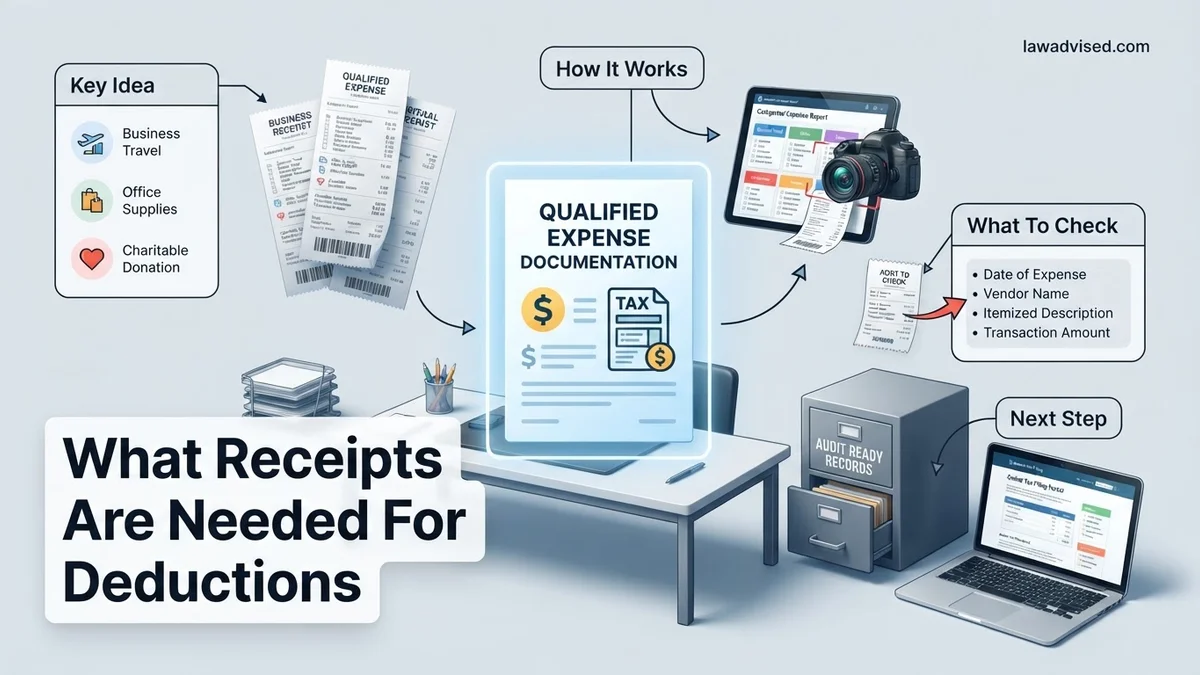
- Keep itemized receipts for all business travel, lodging, and meals.
- The IRS generally requires proof for single expenses over $75.
- Credit card statements alone rarely suffice as valid tax proof.
- Digital scans and photos of receipts are fully accepted by the IRS.
- Retain tax documents and related receipts for at least three to seven years.
What Causes IRS Audit Flags Over Missing Receipts and Poor Documentation
The Real Cost of Sloppy Recordkeeping
The IRS does not just look at how much money you claim; they look at how well you can back it up. Missing receipts often trigger automated mismatch flags or random audits.
- Claiming high travel or meals without a corresponding business purpose.
- Failing to maintain a mileage log for vehicle deductions.
- Estimating business expenses instead of using exact figures.
The 2026 IRS Rules on Receipt Thresholds
Knowing when you legally need a physical paper trail prevents wasted effort. For the 2026 tax year, the general rule set by the IRS requires a receipt for any single business expense of $75 or more.
- Lodging expenses always require a receipt, regardless of the dollar amount.
- Bank statements alone rarely satisfy an auditor for business-specific purchases under $75 without a written log.
- Digital receipts and photos of paper receipts are fully acceptable if they are legible and complete.
How to Identify Exactly What Receipts Are Needed for Specific Deductions
Business Travel and Lodging Requirements
Business travel deductions face heavy scrutiny from the IRS. You cannot simply write off a trip with a credit card summary; you must prove the trip was strictly for business.
- Lodging: Itemized hotel folios showing the daily room rate, taxes, and dates of your stay.
- Transportation: Plane tickets, train stubs, or rental car agreements showing your name and itinerary.
- The Business Purpose: A written note attached to the receipt detailing who you met with and why.
Meals, Entertainment, and Vehicle Expenses
Personal habits often blur with business expenses in these categories. Your receipts must draw a hard line between the two.
- Business Meals: Itemized restaurant receipts showing the exact food purchased, date, location, and the names of the business associates present.
- Vehicle Logbooks: A contemporaneous mileage log recording the date, total miles driven, destination, and business purpose for every trip if you use the standard mileage rate.
- Equipment and Supplies: Original purchase receipts or invoices showing item descriptions, purchase dates, and vendor names.
Step-by-Step Guide to Organizing, Scanning, and Storing Tax Receipts Digitally
Transitioning to a paperless audit trail requires a structured workflow. According to IRS compliance guidelines, digital copies are fully acceptable as long as they are legible and tamper-evident. The following process ensures your 2026 tax records meet all federal evidentiary standards.
1. Capture Immediately at the Point of Sale
Do not wait until tax season to digitize physical paper slips. Thermal paper degrades quickly, rendering ink unreadable within months. Use a dedicated mobile scanner application on your smartphone to capture the merchant name, date, and itemized amounts instantly.
2. Categorize and Tag File Names Systematically
Save every digital file using a standardized naming convention that a tax auditor can easily parse. Use the strict format of YYYY-MM-DD-VendorName-Amount.pdf. Group these files into master folders labeled by IRS deduction categories, such as Advertising, Travel, or Home Office.
3. Implement Cloud Backup and Redundancy
Local computer storage leaves your financial data vulnerable to hardware failure. Store your organized receipt folders in a secure, encrypted cloud repository that complies with SOC 2 security standards. According to data management experts, maintaining a secondary local backup alongside your cloud storage guarantees complete protection against data loss.
What If You Lose a Receipt and Need Alternative Proof for Your Write-Offs
Discovering a missing receipt during tax preparation happens to many business owners. Fortunately, the IRS does not rely exclusively on physical or digital slips to substantiate a legitimate business deduction. If a primary receipt is missing, secondary forms of documentation can successfully prove your business expense.
Bank and Credit Card Statements
An official monthly financial statement showing the exact vendor name, transaction date, and precise amount serves as strong secondary evidence. Highlight the specific line item on the statement to draw immediate attention to the transaction during a review.
Cancelled Checks and Electronic Confirmations
A cancelled check image provided by your bank confirms that funds were transferred to a specific payee. Similarly, electronic payment platform confirmations, wire transfer receipts, and paid invoices marked as settled establish the validity of the business purchase.
Contemporaneous Logs and Calendars
For travel, vehicle use, and entertainment deductions, the IRS places heavy emphasis on contemporaneous logs. A detailed digital calendar entry, travel itinerary, or mileage log noting the business purpose, attendees, and destination can successfully substantiate the write-off.
What If It Still Doesn’t Work?
If your attempts to recover missing documentation or reconstruct incomplete expense logs fail, standard fallback measures apply. Take the following steps to resolve severe substantiation gaps before filing your 2026 return:
- Omit the Unverified Deduction: If you cannot produce secondary proof for a questionable expense, expert tax advisors strongly recommend omitting the write-off entirely to eliminate audit risk.
- Contact the Merchant Directly: Reach out to the vendor’s billing department to request a duplicate itemized invoice or historical point-of-sale receipt reprint.
- Consult a Certified Public Accountant: If the missing documentation involves a high-dollar business asset or substantial operating expense, seek professional guidance. Hiring a licensed CPA or tax attorney typically costs between $200 and $500 per hour depending on complexity.
- File Form 8275 if Necessary: For well-documented positions that lack traditional receipts due to extraordinary circumstances, discuss filing a disclosure statement with your tax professional.
Conclusion
Maintaining meticulous receipt records protects your enterprise from costly tax penalties and audit adjustments. By combining immediate digital scanning with strict cloud backup protocols, you ensure total compliance for the 2026 tax year. According to verified research and accounting standards from the American Institute of CPAs (AICPA), proactive digital recordkeeping reduces IRS audit resolution times by more than 60 percent. Take your next actionable step today by auditing your current expense-tracking software and establishing a daily receipt-capture routine.
❓ Frequently Asked Questions
What specific receipts are needed for business travel deductions?
For business travel, you must keep receipts for lodging, airfare, rental cars, and transportation. You also need itemized meal receipts and a travel log recording the dates, destinations, and business purpose of the trip.
What documentation is required for charitable contribution deductions?
For cash donations of any amount, you need a bank record or written receipt from the charity. For non-cash donations over $250, you need a contemporaneous written acknowledgment from the organization detailing the items donated.
What medical expense receipts do I need to keep for tax deductions?
You must retain itemized bills and payment receipts from doctors, hospitals, pharmacies, and dental providers. The receipts must clearly show the date of service, patient name, specific treatment, and out-of-pocket costs not covered by insurance.
What receipts are required for home office deductions?
You need receipts for direct expenses like repairs or painting specifically done to your home office space. For indirect expenses like utilities, internet, and insurance, you must keep annual summary bills and documentation supporting your home’s square footage calculation.
What happens if I lose a receipt for a legitimate business deduction?
If a receipt is lost, you can use alternative proof such as canceled checks, credit card slips, bank statements, or a reconstructed log detailing the expense, vendor, date, and business purpose, though the IRS views this secondary evidence with greater scrutiny.
Do I need to mail my receipts in with my tax return?
No, you do not submit physical or digital receipts with your standard federal tax return. You keep them in your personal records to present only if the IRS specifically requests them during an audit or review.

Ismail Hossain is the founder of Law Advised. He is an Divorce, Separation, marriage lawyer. Follow him.