1099 R Explained Step-by-Step Guide for 2026 Taxes
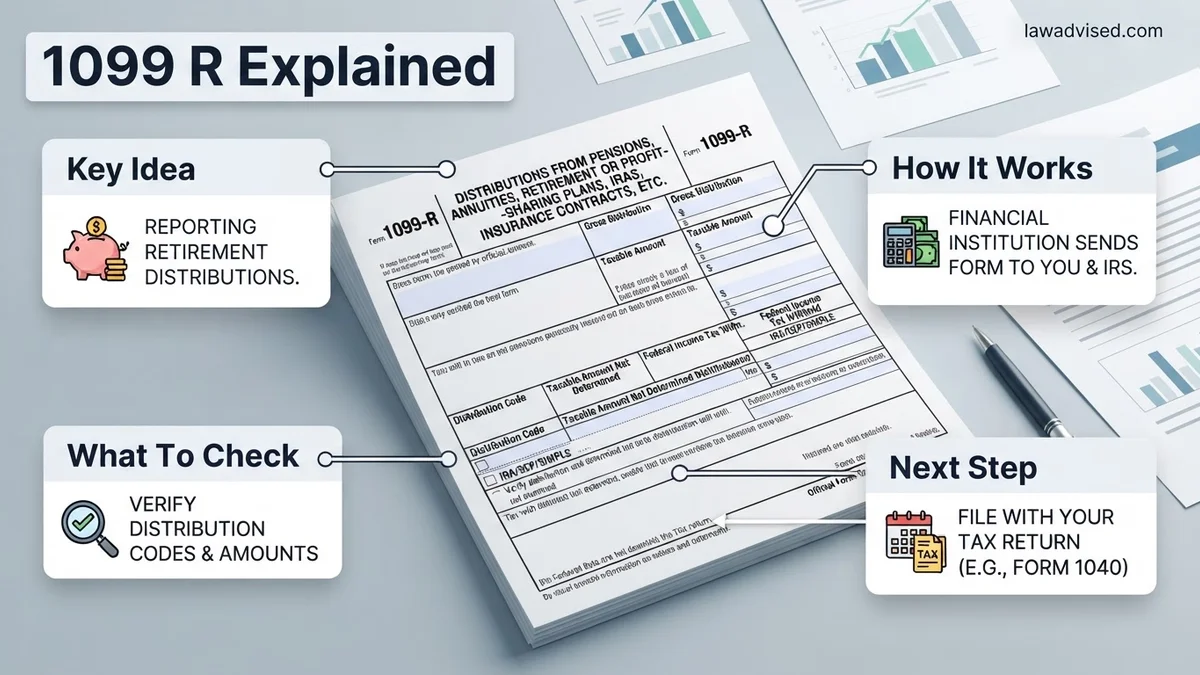
Form 1099-R reports distributions from pensions, annuities, retirement or profit-sharing plans, IRAs, or insurance contracts. You must report this income on your tax return, and the specific distribution code in Box 7 determines whether penalties apply.
IRS Form 1099-R is the tax document you receive when money is paid out of a retirement plan, such as a traditional IRA, 401(k), pension, or annuity. If you took a withdrawal, moved funds via a rollover, or converted a pre-tax account to a Roth account during 2025, the financial institution that holds your account is required to send you this form by early 2026. This document reports the total amount distributed and tells the IRS whether that money is taxable.
Handling your 1099-R correctly prevents processing delays and ensures you do not overpay taxes or face unexpected IRS penalties. Every dollar withdrawn from a tax-deferred account must be accounted for on your 2026 tax return. Knowing how to interpret the numbers and codes on this form will save you from costly reporting mistakes.
Key Takeaways
- Box 1 shows the total gross distribution amount received during the tax year.
- Box 2a indicates the taxable amount of your distribution subject to income tax.
- Box 7 uses specific codes to identify whether a distribution is normal, early, or a rollover.
- Direct rollovers to another retirement account are generally not taxable.
- Report your 1099-R details directly onto your Form 1040 when filing taxes.
What Causes You to Receive a 1099-R Form
Common Retirement Account Transactions
You will receive a 1099-R whenever money leaves your tax-advantaged retirement accounts. Even if you did not actually cash out the money—such as when you move funds directly to a new provider—a form is still generated to track the movement. The most frequent triggers include:
- Taking standard cash withdrawals from a traditional IRA or 401(k) after reaching age 59½.
- Making an early withdrawal from a retirement account before turning 59½.
- Executing a direct or indirect rollover of retirement funds to another eligible account.
- Converting a traditional pre-tax account into a Roth IRA.
- Taking Required Minimum Distributions (RMDs) if you have reached the mandatory age.
Special Distribution Triggers
Beyond standard withdrawals and rollovers, certain life events and administrative actions will prompt a 1099-R. If you inherit a retirement account and take distributions as a beneficiary, you will receive this form. Plan terminations, disability payouts, and loans from a 401(k) that go into default (deemed distributions) also trigger the issuance of a 1099-R. No matter the reason, if money left your retirement plan last year, expect this document.
How to Read the Key Boxes on Your 1099-R
Gross Distribution Versus Taxable Amount
The most critical part of reading your 1099-R is understanding the difference between Box 1 and Box 2a. Box 1 shows the Gross Distribution, which is the total dollar amount paid out to you during the tax year. Box 2a shows the Taxable Amount. For many pre-tax accounts, these two numbers will be identical. However, if your account included after-tax contributions, Box 2a may be lower than Box 1 because you already paid taxes on that portion of the money.
Handling Rollovers and Direct Transfers
If you rolled over your retirement funds, Box 2a might show a taxable amount of zero, or it might list the full distribution with a specific code indicating a rollover. If you completed a 60-day indirect rollover—meaning the check was made out to you rather than the new financial institution—the full amount typically appears in Box 1. You must correctly report this on your 2026 tax return to prove the funds were redeposited within the allowable window, ensuring the transaction remains tax-free.
Step-by-Step Guide to Filing Your 1099-R on Your Tax Return
Filing your Form 1099-R accurately on your 2026 tax return prevents costly processing delays and IRS matching notices. Most tax software walks you through this, but understanding the underlying mechanics ensures your distribution is taxed correctly.
Inputting Data into Tax Software
- Locate the retirement income section in your software, typically labeled as “Pensions, Annuities, and IRAs (Form 1099-R).”
- Enter the Payer’s Federal Identification Number (EIN) exactly as shown in Box 1 of your physical or digital form.
- Input the exact figures from Box 1 (Gross Distribution) and Box 2a (Taxable Amount) into their corresponding data fields.
- Select the matching distribution code from the drop-down menu that corresponds to the character printed in Box 7.
- Double-check checkboxes such as “IRA/SEP/SIMPLE” in Box 7 to ensure proper categorization by the IRS processing algorithms.
Reporting Tax Withheld
- Locate Box 4 on your Form 1099-R, which displays any federal income tax withheld from your distribution.
- Enter this precise amount into the federal withholding section of your tax software or paper return line.
- Verify state and local tax withholding in Boxes 12 through 16, transferring those specific figures to your state tax return forms.
What If Your 1099-R Has Errors or Is Missing
Tax season relies on precise document matching, and receiving an incorrect 1099-R or missing one entirely requires immediate proactive steps to protect your filing status.
Handling Incorrect Form Data
If Box 2a (taxable amount) or Box 7 (distribution code) appears incorrect, do not guess the fix. Contact the plan administrator or financial institution immediately. Request a corrected Form 1099-R, which will clearly feature the “Corrected” box checked at the top. The IRS matching system relies on the administrator transmitting this corrected data electronically.
Missing Form Protocols
Plan administrators are legally required to furnish Form 1099-R by January 31, 2026. If you have not received yours by mid-February, contact the payer directly to request a duplicate copy. According to IRS guidelines, if you still do not receive the form by late February, you can estimate the distribution using year-end statements and file using Form 4852 (Substitute for Form 1099-R).
What If It Still Doesn’t Work?
When software integration fails or complex multi-state distributions cause calculation errors, specific fallback procedures ensure compliance without incurring penalties.
- Switch from automated import tools to manual entry, carefully cross-referencing every box against the official IRS Form 1099-R instructions.
- Verify that your previous year’s tax return properly tracked any nondeductible IRA basis using Form 8606, as software often miscalculates taxable portions without this historical data.
- Consult a certified public accountant (CPA) or Enrolled Agent (EA) if you are dealing with complex direct rollovers that were miscoded by the financial institution.
- Expect professional tax representation fees for resolving complex retirement distribution audits or amended returns to range between $300 and $900, depending on geographic location and the complexity of the return.
Conclusion
Navigating Form 1099-R for the 2026 tax year requires careful attention to Box 7 distribution codes and accurate data transfer to prevent IRS matching errors. When faced with incorrect data or missing documents, requesting corrected statements immediately protects against automated underreporting notices. According to verified research and tax compliance experts from the IRS and AICPA, filing with estimated figures via Form 4852 acts as a reliable safety net when administrators fail to deliver documents on time. Your next actionable step is to audit your retirement account year-end statements against your received 1099-R forms to verify that every dollar is accounted for prior to submission.
❓ Frequently Asked Questions
What do the different numbers in Box 7 mean?
Box 7 codes indicate the type of distribution. For example, Code 7 represents a normal distribution for someone over 59½, Code 1 represents an early distribution subject to a potential 10% penalty, and Code 4 signifies a distribution due to death.
Do I have to pay tax on a 1099-R if I rolled it over?
If you directly rolled over your retirement distribution into a traditional IRA or another eligible retirement plan within 60 days, the distribution is generally not taxable, but you still must report the form on your tax return.
What should I do if my 1099-R lists the wrong taxable amount?
Contact the payer or financial institution that issued the form immediately to request a corrected 1099-R. Filing with incorrect figures can trigger an IRS notice.
Will I face an early withdrawal penalty on a Code 1 distribution?
Yes, if you received a distribution with Code 1 and you are under age 59½, you will generally owe ordinary income tax plus a 10% early withdrawal penalty, unless an IRS exception applies.
What if I never received my 1099-R form in the mail?
You can typically access your 1099-R by logging into your retirement account online or by contacting the plan administrator directly. You can also view your wage and income transcript via the IRS website.
Do I need to attach the physical 1099-R form to my tax return?
If you file your taxes electronically, you generally do not need to attach a physical copy of the 1099-R, but you must enter all the matching data correctly into your tax software.

Ismail Hossain is the founder of Law Advised. He is an Divorce, Separation, marriage lawyer. Follow him.