1099 B Explained A Step-by-Step Guide for 2026
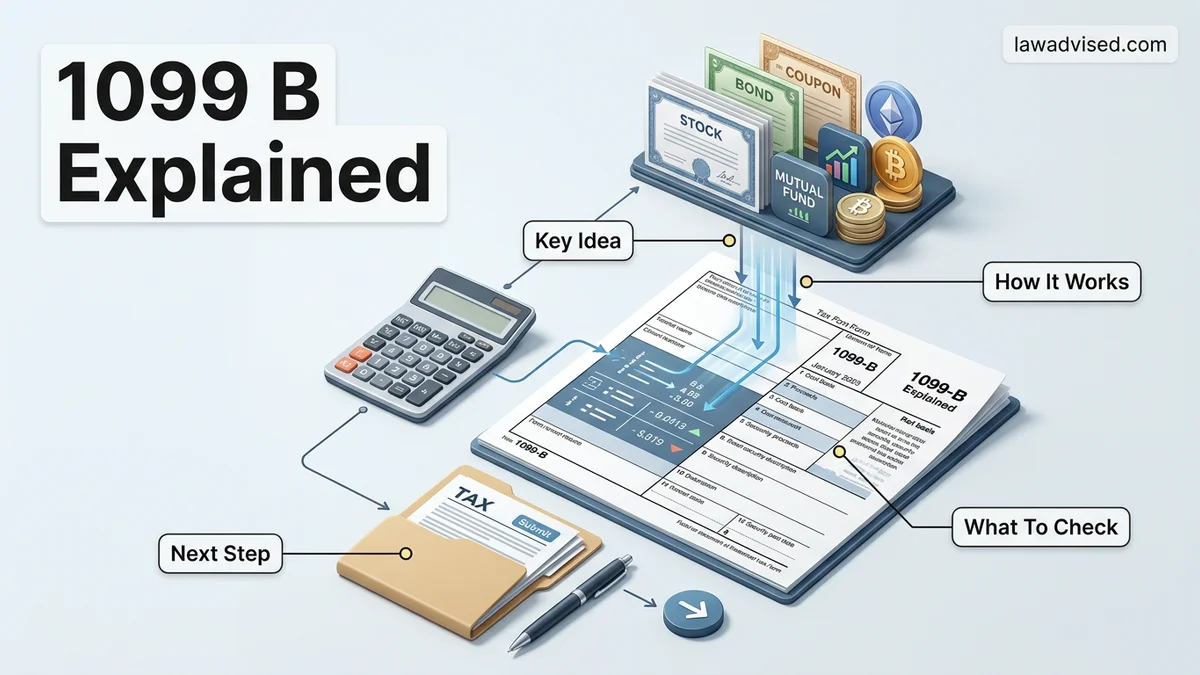
Form 1099-B reports the proceeds from stock, bond, and security sales issued by your brokerage firm. You must use the data from this form to calculate your capital gains and losses for your annual tax return.
Form 1099-B is the official tax document your brokerage issues to report proceeds from the sale or exchange of stocks, bonds, and other securities. If you sold an asset through a platform like Robinhood, Fidelity, or Charles Schwab during the tax year, you will receive this form to account for your capital gains or losses to the IRS.
Filing your 2026 taxes correctly requires you to take the data straight from this form, calculate your net profit or loss, and transfer those figures to Form 8949 and Schedule D. Missing or misreporting these numbers can easily trigger an IRS automated mismatch notice.
Key Takeaways
- Form 1099-B reports the total proceeds and cost basis from your investment sales.
- Box 1a through 1g detail the specific asset, sale date, and proceeds amount.
- Covered securities show your cost basis to the IRS; noncovered securities require manual tracking.
- You must report every transaction listed on Form 1099-B using IRS Form 8949.
- Net gains or losses flow from Form 8949 directly onto your Schedule D.
What Causes Confusion With Form 1099-B Tax Reporting
The Cost Basis Reporting Gap
Investors often get stuck on Form 1099-B because the IRS distinguishes heavily between covered and noncovered securities. A covered security means your broker is legally required to report your cost basis to the IRS. If you trade noncovered securities—often older assets or specific types of options—your broker might report your proceeds in Box 1d, but leave the cost basis box completely blank. You are then responsible for hunting down your historical purchase price to avoid being taxed on the entire gross sale amount.
Short-Term Versus Long-Term Holding Periods
Another major hurdle is sorting transactions by how long you held the asset before selling. Your 1099-B breaks down transactions into distinct categories:
- Short-term transactions: Assets held for one year or less, taxed at your ordinary income tax bracket.
- Long-term transactions: Assets held for more than one year, benefiting from preferential capital gains tax rates.
- Undetermined holding periods: Transactions where the broker could not track the exact purchase date, requiring you to supply the missing history on your tax return.
How to Read Form 1099-B Boxes and Calculate Gains
Decoding Box 1a Through Box 1g
Your 1099-B contains a grid of specific data boxes detailing every single trade you executed. Scanning these fields helps you quickly identify what the IRS already knows about your trading activity:
- Box 1a (Description of property): The name of the stock, fund, or asset you sold.
- Box 1b (Date acquired): When you originally bought the asset (marked as “Various” if multiple purchases were bundled).
- Box 1c (Date sold or disposed): The exact date you closed the position.
- Box 1d (Proceeds): The total cash amount you received from the sale before any fees.
- Box 1e (Cost or other basis): What you originally paid for the asset, plus any standard commissions.
- Box 1g (Wash sale loss disallowed): The adjustment applied if you repurchased a substantially identical stock within 30 days of selling it at a loss.
Calculating Your Capital Gain or Loss
To find out if you owe tax or can claim a deduction, you must subtract your cost basis from your total proceeds for each trade. If your proceeds in Box 1d exceed your cost basis in Box 1e, you have a capital gain. If your cost basis is higher, you have a capital loss that can offset your other taxable income up to annual limits. For your 2026 tax filing, make sure you factor in any adjustments listed in Box 1g before moving your final numbers over to Form 8949.
Step-by-Step Guide to Filing Form 8949 and Schedule D
Filing your taxes with a Form 1099-B requires transferring your trading data onto IRS Form 8949 and summarizing the results on Schedule D. According to tax preparation guidelines, this process ensures the government accounts for every capital gain or loss accurately for the 2026 tax year.
Sorting Your Transactions
Before filling out forms, you must separate your transactions into covered and non-covered categories. Covered transactions have the cost basis reported to the IRS, while non-covered transactions require you to supply the missing cost basis yourself.
- Separate short-term transactions (assets held for one year or less) from long-term transactions (assets held for more than one year).
- Group your trades by whether your broker reported the cost basis to the IRS on your Form 1099-B.
- Check Part I of Form 8949 for short-term trades and Part II for long-term trades.
Transferring Data to Schedule D
Once you complete Form 8949, you must aggregate the totals and move them to Schedule D. Financial authorities emphasize precision here to avoid triggering automated IRS matching notices.
- Sum the proceeds and cost bases from all pages of Form 8949.
- Transfer the combined totals from Form 8949 to the corresponding lines on Schedule D.
- Calculate your net capital gain or loss on Schedule D and carry that final number over to your Form 1040.
What If Your 1099-B Contains Missing Cost Basis Errors
Brokerages sometimes issue Form 1099-Bs with missing or incorrect cost bases, particularly for older assets or transferred accounts. Failing to correct these errors can result in the IRS taxing your gross proceeds rather than your actual net profit.
Reconciling Discrepancies
If you spot a discrepancy, you must investigate prior trade confirmations or account statements to find the correct purchase price. Tax professionals note that reporting an incorrect cost basis is a primary trigger for IRS audits.
- Locate your original purchase confirmation statements or monthly brokerage statements from the year you acquired the asset.
- Calculate the adjusted cost basis, factoring in corporate actions like stock splits or dividend reinvestments.
- Report the correct cost basis on Form 8949, and attach an explanatory statement if the reported figure differs from the broker’s initial 1099-B filing.
What If It Still Doesn’t Work?
If manual reconciliation fails or your brokerage refuses to correct a glaring 1099-B error, you need a reliable fallback plan to protect your tax return for 2026.
- Contact your brokerage’s compliance or tax reporting department to request a corrected Form 1099-B, known as a corrected 1099-B or 1099-B/C.
- Attach a detailed explanation statement to your tax return explaining why the reported 1099-B numbers differ from your reported Form 8949 figures.
- Consult a certified public accountant (CPA) or an enrolled agent to handle complex multi-brokerage reconciliations or wash sale adjustments. Professional tax advisory services typically cost between $300 and $1,200 depending on trading volume and portfolio complexity.
Conclusion
Navigating a Form 1099-B requires careful attention to cost basis reporting, accurate categorization on Form 8949, and seamless integration with Schedule D. By reconciling discrepancies before filing, you protect yourself against costly IRS matching errors. According to verified research and tax compliance expert sources, utilizing automated tax software or consulting a licensed professional significantly reduces the risk of costly reporting mistakes. Your next actionable step is to download your complete consolidated 1099 statement from your broker and cross-reference every transaction against your internal trade logs.
❓ Frequently Asked Questions
What should I do if my 1099-B shows missing cost basis information?
If your cost basis is missing, usually for noncovered securities, you will need to reference your personal trade history or purchase confirmations to calculate the original buy price before filing.
How do short-term and long-term capital gains differ on a 1099-B?
Short-term transactions involve assets held for one year or less and are taxed at ordinary income rates, while long-term transactions involve assets held for over a year and qualify for lower capital gains tax rates.
Can I ignore a 1099-B if I lost money on my trades?
No, you must still report the transactions even if you experienced a net loss, as capital losses can offset your capital gains and up to $3,000 of ordinary income.
What happens if the information on my 1099-B is incorrect?
Contact your brokerage firm immediately to request a corrected 1099-B, and wait for the updated form before filing your taxes to avoid discrepancies with the IRS.
Do cryptocurrency transactions appear on a 1099-B?
Yes, centralized crypto exchanges are increasingly required to issue Form 1099-B to report digital asset sales and exchanges similar to traditional brokerages.
Where do the totals from Form 8949 go on my tax return?
The total net short-term and long-term gains or losses calculated on Form 8949 are transferred directly to lines within your Schedule D, which then feeds into your Form 1040.

Ismail Hossain is the founder of Law Advised. He is an Divorce, Separation, marriage lawyer. Follow him.