Taxes for Teaching Assistants Step-by-Step Guide 2026
Navigating taxes for teaching assistants requires understanding how your university classifies your compensation, stipends, and tuition waivers. Most TAs are considered W-2 employees whose cash wages are fully taxable, while qualified tuition reductions may be tax-exempt under IRS rules. Proper tracking of your income and eligible student tax credits ensures you avoid costly filing mistakes.
Teaching assistants face a uniquely confusing tax situation because your income often combines W-2 wages with 1098-T tuition waivers, straddling the line between employee and student. If you work as a TA in 2026, you likely receive a monthly stipend for teaching services alongside a tuition reduction, and figuring out what the IRS considers taxable compensation dictates whether you owe money or get a refund.
Sorting out these dual classifications prevents costly filing mistakes and IRS notices. Because universities handle graduate and undergraduate assistantships differently, knowing how to categorize your funding sources ensures you claim every applicable education credit while properly reporting your earned income for the 2026 tax year.
Key Takeaways
- Teaching assistant cash stipends are fully taxable income reported on a W-2.
- Qualified tuition waivers used for teaching services are generally tax-exempt under IRC Section 117.
- International TAs must navigate tax treaties, FICA exemptions, and nonresident alien filing status rules.
- Eligible TAs can claim education credits like the Lifetime Learning Credit to lower liabilities.
- W-2 employees generally cannot deduct unreimbursed classroom or supply expenses on federal returns.
What Causes Tax Confusion for Teaching Assistants
Tax season brings stress for many TAs because university finance departments issue multiple tax forms that do not always match standard employment setups. You are providing a service to the university, yet you are also pursuing a degree. This dual role creates immediate confusion around income reporting and withholding requirements.
W-2 Wages Versus Fellowships and Scholarships
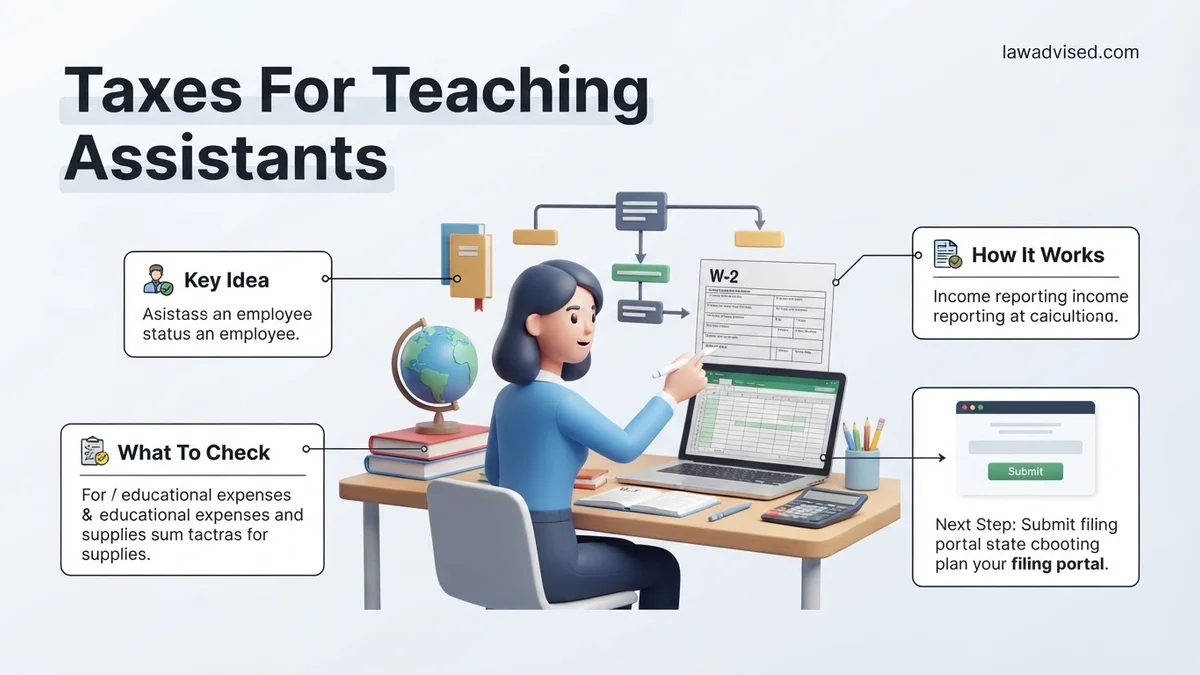
Your paycheck as a teaching assistant usually arrives as W-2 wages because you perform a service, such as grading papers or leading discussion sections, in exchange for compensation. However, many TAs also receive fellowships or tuition waivers that do not require a service commitment.
- W-2 Income: Fully taxable compensation subject to federal, state, and local income tax withholding.
- Fellowships: Taxable if used for living expenses, but tax-free if used exclusively for qualified tuition and related expenses under Internal Revenue Code Section 117.
- The Service Quid Pro Quo: The IRS treats any stipend tied directly to mandatory teaching duties as taxable wages, even if the funding originates from a research grant or training fellowship.
The Trap of Tuition Waivers Under IRC Section 117
Under IRC Section 117(d), graduate tuition reductions provided by a university are generally excluded from your gross taxable income, provided you are a graduate student performing teaching or research for the institution.
- Qualified Tuition Reductions: Waivers for undergraduate education or graduate education at the institution where you teach are tax-free.
- The Catch: If your tuition waiver is provided in addition to or instead of taxable cash compensation for your teaching duties, the rules tighten. If the waiver is strictly compensation for services rendered rather than a qualified scholarship, the university may be required to report it as taxable income.
- FICA Tax Exemptions: Many student TAs qualify for the Student FICA Exception, meaning you are exempt from Social Security and Medicare taxes during academic terms when you are enrolled at least half-time and work for the university.
How to Fix and File Your Teaching Assistant Taxes Step-by-Step
Filing your 2026 tax return as a teaching assistant requires gathering the correct documentation before you touch any tax preparation software. Missing a form or mislabeling your funding streams can trigger an automatic review or delay your expected refund.
Gathering and Reconciling Your Tax Documents
You cannot file accurately until all institutional paperwork clears your university portal, typically by late January or early February 2026.
- Form W-2: Reports your teaching stipend wages and the federal and state taxes withheld throughout the year.
- Form 1098-T: Issued by your university’s bursar office, detailing payments received for qualified tuition and related expenses, as well as any scholarship or grant amounts processed.
- Form 1099-NEC or 1099-MISC: Occasionally issued if you receive separate miscellaneous grants, travel awards, or independent contractor payments that bypass the standard payroll system.
- Reconciliation Step: Compare your December pay stub year-to-date totals against Box 1 of your W-2 to ensure your taxable wages match your actual earnings.
Claiming Eligible Deductions and Education Credits
As a student-employee, you must evaluate which deductions and credits lower your overall tax burden without violating IRS double-dipping rules.
- Lifetime Learning Credit (LLC): Available for graduate and undergraduate students, offering up to $2,000 per tax return for qualified tuition and fee expenses paid out of pocket or via loans.
- Educator Expense Rules: Traditional K-12 educator deductions do not apply to university TAs, meaning you generally cannot write off out-of-pocket classroom supply purchases under that specific rule unless you operate as a W-2 employee with unreimbursed business expenses (which are suspended for federal filings through 2025/2026).
- Student Loan Interest Deduction: You can deduct up to $2,500 of interest paid on qualified student loans, even if you do not itemize deductions.
What to Do If Your Tuition Waiver Is Incorrectly Taxed
Receiving a Form 1098-T or a W-2 that incorrectly taxes your qualified tuition reduction creates immediate financial stress for teaching assistants. Under Internal Revenue Code Section 117, graduate tuition waivers for teaching or research services are generally excludable from gross income if they meet specific statutory criteria. When payroll departments mistakenly treat these waivers as taxable compensation, timely intervention prevents overpayment.
Immediate Correction Steps
- Review your monthly paystubs alongside your institutional bursar account statement to isolate the exact erroneous withholding amount.
- Contact your university payroll or human resources department in writing to cite Internal Revenue Code Section 117(d) regarding qualified tuition reductions.
- Request a corrected Form W-2c (Corrected Wage and Tax Statement) from your employer if taxes were improperly withheld throughout 2026.
- File Form 4852 (Substitute for Form W-2) with your federal tax return if the employer fails to issue corrections before the filing deadline.
Advanced Filing Tips for International and Graduate Teaching Assistants
International teaching assistants face complex tax treaty provisions and residency status determinations that significantly impact their 2026 filings. Navigating nonresident versus resident alien status dictates whether F-1 or J-1 visa holders file Form 1040-NR or standard Form 1040. Tax treaties between the United States and specific countries often exempt limited amounts of compensation from federal income tax, requiring careful coordination with institutional payroll offices.
Filing Procedures for Nonresident TAs
- Determine your tax residency status for 2026 using the Substantial Presence Test outlined in IRS Publication 519.
- Complete Form 8833 if you are claiming a tax treaty exemption to report treaty-based return positions clearly to the IRS.
- Utilize specialized tax preparation software designed specifically for international students and scholars, such as Sprintax or Glacier Tax Prep.
- File Form 8843 every year you are present in the United States on an F or J visa, even if you earned zero income during 2026.
What If It Still Doesn’t Work?
Tax situations for teaching assistants occasionally involve complex multi-state residency rules or uncooperative payroll departments that require specialized intervention. When standard administrative fixes fail to resolve withholding errors or missing forms, structured fallback strategies protect your financial standing.
- Utilize university-sponsored legal aid or student government tax assistance programs, which often provide free or discounted filing support during peak tax season.
- Contact the IRS Taxpayer Advocate Service if your university payroll department refuses to issue corrected tax documents after multiple written requests.
- Engage a Certified Public Accountant (CPA) or Enrolled Agent (EA) who specializes in higher education and nonresident alien taxation; professional fees typically range from $200 to $500 depending on complexity.
- File an amended tax return using Form 1040-X within the three-year statutory window if you discover an unresolved tuition waiver or fellowship error after submitting your initial 2026 return.
Conclusion
Managing taxes as a teaching assistant requires distinguishing between taxable stipends and tax-exempt tuition waivers while accurately tracking every deductible education expense. Resolving reporting discrepancies promptly ensures you retain your hard-earned academic compensation without incurring unnecessary penalties. According to verified research and expert sources from higher education payroll associations, proactive documentation remains the most effective defense against withholding errors. Take your next actionable step today by downloading your institutional 1098-T and matching every line item against your 2026 earnings records.
❓ Frequently Asked Questions
How do W-2 status and fellowship stipends differ on a TA tax return?
W-2 income represents payment for services rendered (teaching, grading) and has taxes withheld by the university. Fellowships that do not require service may not have taxes withheld automatically, requiring estimated quarterly tax payments in some cases.
What happens if my university mistakenly taxes my tuition waiver?
If your taxable wages box on your W-2 incorrectly includes a non-taxable tuition waiver, contact your university payroll or human resources department immediately to request a corrected W-2c form before filing.
Can teaching assistants claim the Lifetime Learning Credit?
Yes, TAs who pay out-of-pocket tuition not covered by waivers—or whose spouses/dependents take courses—may qualify for the Lifetime Learning Credit if their modified adjusted gross income falls below statutory limits.
Do graduate teaching assistants need to pay self-employment tax?
No. Because teaching assistants are classified as W-2 employees or scholarship recipients, they do not pay self-employment tax unless they engage in separate independent contractor work.
How do international teaching assistants determine their tax residency status?
International TAs must use the Substantial Presence Test to determine whether they are nonresident aliens or resident aliens for tax purposes, which dictates whether they file Form 1040-NR or Form 1040.
Are mandatory student fees covered by tax-exempt tuition waivers?
Generally, only charges specifically designated as tuition qualify for the exclusion under Section 117. Fees for health insurance, recreation, or technology are often taxable unless explicitly covered by a specialized institutional policy.

Ismail Hossain is the founder of Law Advised. He is an Divorce, Separation, marriage lawyer. Follow him.