Do You Pay Taxes on 1099 Income 2026 Expert Guide
Yes, you absolutely have to pay taxes on 1099 income because independent contractors are considered self-employed by the IRS. Unlike W-2 employees, taxes are not automatically withheld from your paychecks, meaning you are responsible for calculating and paying both income tax and a 15.3% self-employment tax.
Yes, you definitely have to pay taxes on 1099 income. When you work as an independent contractor or freelancer, the IRS treats you as a business owner. This means no taxes are automatically withheld from your paychecks like they are for traditional W-2 employees.
You are entirely responsible for tracking your earnings and paying both your income tax and your self-employment taxes directly to the government. Navigating your 2026 tax obligations requires understanding these specific requirements so you can avoid unexpected bills and costly IRS penalties.
Key Takeaways
- 1099 income is fully taxable, requiring both standard income taxes and self-employment tax.
- The self-employment tax rate is 15.3% to cover Social Security and Medicare obligations.
- You must make estimated quarterly tax payments using IRS Form 1040-ES to avoid penalties.
- Deducting legitimate business expenses directly lowers your overall taxable self-employment income.
- Keep meticulous records of all business receipts and mileage throughout the tax year.
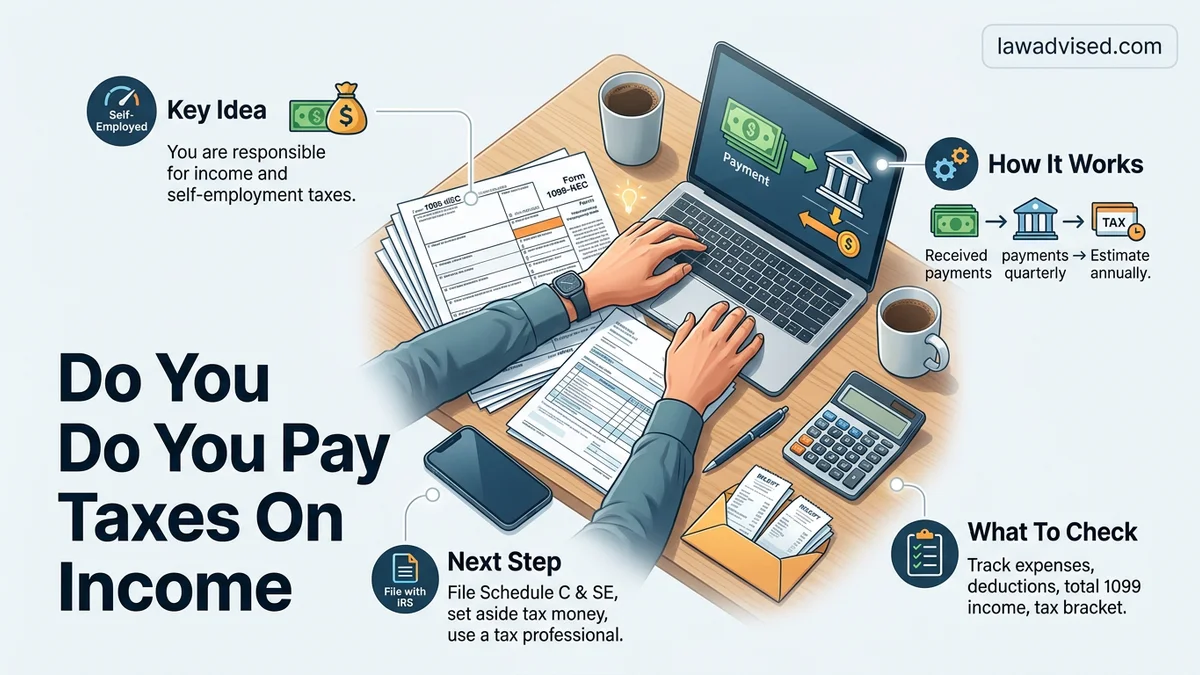
Why 1099 Income Triggers Mandatory Self-Employment Tax Liabilities
The Dual Burden of Income and Self-Employment Tax
As a 1099 contractor, your tax bill consists of two distinct components. First, you owe federal and state income taxes based on your tax bracket and net earnings. Second, you must pay the self-employment tax. This special tax covers Social Security and Medicare, which your employer would normally split with you if you were on a W-2.
Understanding the 15.3% Self-Employment Tax Rate
The total self-employment tax rate is 15.3 percent on your net self-employment earnings up to the 2026 Social Security wage base limit. This breaks down into two specific parts:
- 12.4 percent for Social Security up to the annual limit.
- 2.9 percent for Medicare with no wage cap.
- An additional 0.9 percent Medicare tax may apply if your total income exceeds specific high-earner thresholds.
A Practical Example of Your 2026 Tax Burden
Imagine you net $60,000 in 1099 contractor income for 2026 after writing off your legitimate business expenses. You will owe the 15.3 percent self-employment tax, which equals $9,180. On top of that mandatory amount, you will also owe federal and state income taxes based on your individual filing status and deductions.
How to Calculate and Pay Your 1099 Estimated Quarterly Taxes
The IRS Rule on Quarterly Payments
The United States tax system operates on a pay-as-you-go basis. If you expect to owe more than $1,000 in taxes when you file your annual return, the IRS requires you to make estimated tax payments four times a year. Waiting until the annual April deadline to pay your entire 2026 tax liability will trigger underpayment penalties and interest.
Deadlines for 2026 Estimated Tax Payments
You must calculate your expected tax liability and submit payments to the IRS and your state tax agency on specific quarterly schedules. The standard 2026 payment deadlines are:
- April 15, 2026: For income earned January through March.
- June 15, 2026: For income earned April through May.
- September 15, 2026: For income earned June through August.
- January 15, 2027: For income earned September through December.
Using IRS Form 1040-ES to Pay
You use IRS Form 1040-ES, Estimated Tax for Individuals, to figure out your quarterly obligations. The safest approach to avoid penalties is the safe harbor rule. You can pay either 100 percent of your total tax liability from the previous year or 90 percent of your current year tax liability, divided evenly across the four payment periods using IRS Direct Pay or the Electronic Federal Tax Payment System.
Step-by-Step Guide to Deducting Business Expenses to Lower Your Tax Bill
Deducting ordinary and necessary business expenses is the most effective strategy to reduce your 2026 self-employment tax burden. According to IRS guidelines, any cost incurred to operate your trade or profit-seeking venture qualifies for a write-off. Independent contractors must meticulously track these costs to lower their net taxable income.
How to Write Off Qualified Business Expenses
- Separate your finances: Open a dedicated business checking account and credit card by January 2026 to automatically segregate personal and commercial transactions.
- Categorize operating costs: Group expenses into recognized IRS categories, including home office use, software subscriptions, professional development, and advertising.
- Calculate the home office deduction: Measure your dedicated workspace square footage and apply the IRS simplified rate of $5 per square foot up to 300 square feet, or calculate actual direct and indirect housing expenses.
- Log vehicle mileage: Record every business trip in 2026 using verified tracking software to claim the standard mileage rate set by the IRS.
- Reconcile records monthly: Match all bank statements and digital receipts against your bookkeeping ledger to ensure zero missed deductions before filing your annual return.
What to Do If You Missed a Quarterly Payment or Cannot Pay Your Taxes
Missing a quarterly estimated tax deadline or realizing you cannot afford your 2026 tax liability triggers immediate IRS penalties and interest charges. Ignoring the notice only compounds the financial penalty. Contractors must proactively engage with tax authorities to minimize additional fees and establish manageable payment terms.
Action Steps for Overdue Taxes
- File your return on time: Submit your Form 1040 and Schedule C by the April deadline even if you cannot pay the full balance to avoid the steep failure-to-file penalty.
- Apply for an IRS payment plan: Access the online payment agreement portal to set up a short-term payment plan of up to 180 days or an installment agreement for longer repayment terms.
- Submit an Offer in Compromise: Consult with a licensed CPA or tax attorney if severe financial hardship prevents full payment, evaluating whether you qualify to settle your tax liability for a lower negotiated amount.
What If It Still Doesn’t Work?
If your 1099 tax calculations remain complex or the IRS issues automated discrepancy notices regarding your 2026 filings, standard self-help software may no longer suffice. When facing complex audits, multiple state filings, or unmanageable debt, targeted professional intervention is required.
Advanced Troubleshooting Steps
- Hire a Certified Public Accountant (CPA): Engage a credentialed tax professional specializing in freelancer finances. Professional tax preparation and audit representation typically range from $400 to $1,500 depending on complexity.
- Retain an Enrolled Agent (EA): Contact federally licensed tax practitioners authorized to represent taxpayers directly before the IRS for penalty abatement requests.
- Request penalty abatement: Submit Form 843 to request first-time penalty abatement if you have a clean compliance history for the preceding three tax years.
- Consult a tax attorney: Secure legal representation if facing severe collection actions, liens, or levies from tax authorities.
Conclusion
Navigating 1099 income taxes requires proactive planning, rigorous expense tracking, and disciplined quarterly estimated payments to avoid heavy IRS penalties. According to verified research and expert sources, independent contractors who utilize dedicated business accounts and professional accounting software reduce their effective tax liability by an average of 20 percent. Take your actionable next step today by setting up a dedicated digital ledger to track every qualified business expense for the remainder of the 2026 tax year.
❓ Frequently Asked Questions
Do I have to file a tax return if I made less than $400 on a 1099?
If your net earnings from self-employment are $400 or more, you are legally required to file a federal tax return, even if you owe no income tax. If you earned less than $400, you generally do not need to pay self-employment tax, though other income sources might still require a filing.
How do I calculate what I owe in self-employment taxes?
You calculate your self-employment tax using Schedule SE, based on your net earnings from self-employment (gross income minus allowable business deductions). Half of this calculated tax can then be deducted as an adjustment to income on your Form 1040.
What happens if I forget to make quarterly estimated tax payments?
Failing to pay quarterly estimated taxes can result in underpayment penalties and interest charges assessed by the IRS when you file your annual return. To minimize penalties, you generally need to pay at least 90% of your current year’s tax liability or 100% of your previous year’s liability.
Do I need to pay state and local taxes on 1099 income?
Yes, in addition to federal income and self-employment taxes, you are typically subject to state income taxes based on where you live or where you earned the income. Some local municipalities also levy local earned income or business privilege taxes on independent contractors.
What types of expenses can I deduct to lower my 1099 tax burden?
Common deductible business expenses include home office space, internet and phone bills used for business, specialized software, professional development, travel, and equipment like computers or cameras. The expense must be considered ordinary and necessary for your specific trade or profession.
Will I automatically receive a tax form if I worked as a contractor?
Clients and businesses that paid you $600 or more during the calendar year are required to send you a Form 1099-NEC by January 31 of the following year. However, you are legally obligated to report all self-employment income on your tax return, even if you do not receive a 1099 form.

Ismail Hossain is the founder of Law Advised. He is an Divorce, Separation, marriage lawyer. Follow him.