Why Tax Refund Is Delayed 2026 Real Fixes & Timelines
Your tax refund is likely delayed due to processing errors, identity verification checks, or statutory holds like the PATH Act for credits. Most e-filed returns with direct deposit issue within 21 days, but specific flags require manual IRS review. Here is how to check your status and resolve the hold.
If you are frantically refreshing your online banking app wondering why your tax refund hasn’t hit your account yet, you are far from alone. For the 2026 tax season, millions of filers are experiencing unexpected holdups that push standard 21-day direct deposit timelines far into the past.
Knowing exactly why your money is stuck helps you take immediate, corrective action instead of blindly waiting. Let us cut straight to the core reasons your refund is delayed and how you can track down your missing cash.
Key Takeaways
- E-filed returns with direct deposit typically process within 21 days unless flagged.
- The PATH Act mandates IRS holds on refunds claiming EITC or ACTC until mid-February.
- Math errors or mismatched Social Security numbers automatically trigger manual processing delays.
- Use the official IRS ‘Where’s My Refund?’ tool to track specific status updates.
- Avoid calling the IRS unless automated tools direct you to speak with a representative.
What Causes a Tax Refund Delay and Why Your Money Is Stuck
The PATH Act Hold on EITC and ACTC Refunds
If you claimed the Earned Income Tax Credit (EITC) or the Additional Child Tax Credit (ACTC), federal law legally mandates the IRS to hold your entire refund. Even if you filed early in January 2026, the IRS cannot release these funds before mid-February. This mandatory hold prevents revenue loss from identity theft and fraudulent claims. If your return triggered this specific freeze, your processing status will simply remain paused until the statutory lift date passes.
Math Errors and Identity Verification Flags
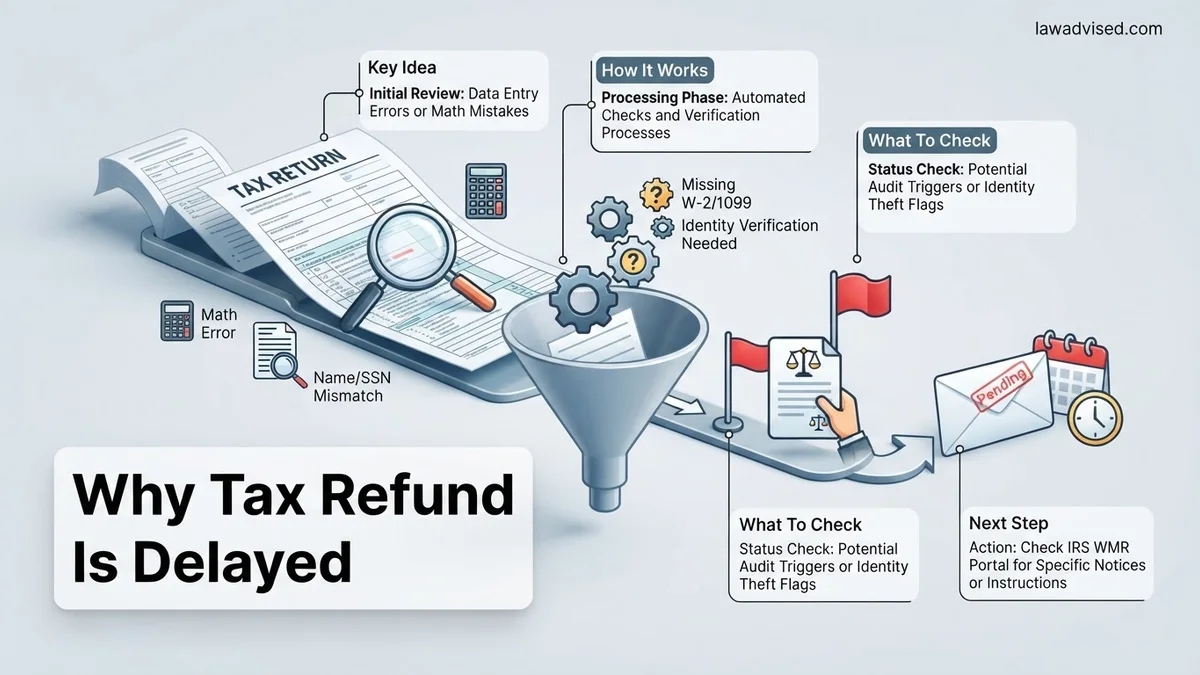
Automated IRS systems scan millions of 2026 returns daily, instantly flagging discrepancies that require manual review. Common triggers include:
- Mismatched Social Security Numbers or dependent birthdates
- Discrepancies between your W-2 or 1099 forms and the income you manually reported
- Simple arithmetic mistakes when calculating deductions or credits
- Security flags requiring you to complete an identity verification quiz online or via IRS Letter 5071C
Step-by-Step Guide to Fixing and Tracking a Delayed Tax Refund
How to Use IRS Where’s My Refund Effectively
Stop guessing and go straight to the official source. The IRS Where’s My Refund tool or the IRS2Go mobile app provide the most accurate, updated data for the 2026 filing season. Updates happen strictly once a day, usually overnight between midnight and 6:00 AM. When you log in, you will typically see one of three primary status bars or notification codes:
- Return Received: The IRS has your electronic paperwork but has not yet approved or processed it.
- Refund Approved: Your return is processed, and a specific direct deposit date is scheduled.
- Refund Sent: The money is on its way to your bank, though your financial institution may take 1 to 5 business days to post it.
Actionable Steps When Your Refund Status Stalls
If your refund status has been stuck on a generic processing message for over 21 days for e-filed returns (or 6 weeks for paper returns), you need to take targeted action. Do not call the IRS immediately, as phone representatives generally cannot override automated processing holds.
- Check your online IRS account for pending notices or letters regarding identity verification or missing documentation.
- Verify that your bank routing and account numbers listed on your 2026 Form 1040 are entirely accurate.
- Contact your tax preparer or review your software summary to check for reported W-2 data mismatches.
How to Contact the IRS When Your Tax Refund Is Seriously Delayed
When standard tracking tools fail and your refund timeline stretches far past the 21-day mark, direct communication becomes necessary. According to the Taxpayer Advocate Service (TAS), reaching out prematurely wastes time, but waiting past 45 days warrants direct action.
Steps to Speak With an IRS Representative
- Call the IRS individual taxpayer assistance line at 1-800-829-1040 between 7 a.m. and 7 p.m. local time.
- Skip the initial prompts by dialing carefully: select your language preference, then press 2 for personal income tax, followed by 1 for questions about your form or tax return.
- Press 3 for all other questions, and finally press 2 to reach an actual human agent instead of automated messages.
- Prepare your Social Security Number, filing status, and a copy of your 2026 tax return before placing the call.
- Request a formal status update and ask if a specific department has flagged your account for identity verification or mathematical review.
If phone lines remain jammed, taxpayers can schedule an appointment at a local Taxpayer Assistance Center for in-person support.
What to Do If Your Tax Refund Is Offset for Owed Debts
Sometimes a delay is not caused by an IRS processing error, but by the Treasury Offset Program (TOP). The Bureau of the Fiscal Service reduces federal refunds to pay unpaid federal student loans, back child support, state income taxes, or past-due state unemployment compensation debts.
Handling a Refund Offset
- Watch your mail for an official offset notice sent by the Bureau of the Fiscal Service explaining the exact reduction amount and destination agency.
- Call the dedicated TOP call center at 1-800-304-3107 to verify which specific agency seized your funds and how much debt remains.
- Contact the creditor agency directly if you believe the offset was executed in error or if your spouse qualifies for injured spouse allocation.
- File IRS Form 8379 (Injured Spouse Allocation) if your joint refund was seized to pay debts owed solely by your spouse.
Processing Form 8379 can take up to 14 weeks if filed electronically, or up to 11 weeks if mailed separately from the original return.
What If It Still Doesn’t Work?
If standard tracking, phone calls, and offset checks fail to resolve your delayed 2026 tax refund, deeper systemic intervention is required. Try these fallback steps:
- Submit IRS Form 911 to request assistance from the Taxpayer Advocate Service if the delay creates a severe economic hardship, such as eviction notices or utility shut-off warnings.
- Engage a certified public accountant (CPA) or Enrolled Agent (EA) to review your filed return for hidden calculation errors or missing schedules. Professional fees for amended return reviews typically range from $200 to $600 depending on complexity.
- Contact your local congressional representative or federal senator to request a congressional inquiry on your behalf, which often forces the IRS to assign a caseworker to your file within 30 days.
- Verify that your bank account information was not closed or flagged for suspicious activity by contacting your financial institution’s fraud department.
Conclusion
Navigating a delayed tax refund requires patience, accurate documentation, and strategic follow-up through official IRS channels. While digital filing errors and security reviews cause temporary setbacks, verifying your transcripts and utilizing formal escalation paths will eventually unlock your funds. According to verified research and expert sources from the National Taxpayer Advocate, proactive communication remains the single most effective method to resolve frozen tax accounts. Your immediate next step is to log into your online IRS account today to check your official account transcript for unaddressed processing codes.
❓ Frequently Asked Questions
Why is my tax refund taking longer than 21 days?
A timeline exceeding 21 days generally indicates a math error, missing documentation, an identity theft review, or a random compliance audit by the IRS.
What is the PATH Act and how does it affect my refund?
The Protecting Americans from Tax Hikes (PATH) Act requires the IRS to hold refunds containing the Earned Income Tax Credit or Child Tax Credit until February 27.
What should I do if I receive an IRS letter regarding my refund?
Read the notice carefully, follow any instructions to verify your identity or provide missing documents, and respond online or by mail as quickly as possible.
Can I call the IRS to find out why my refund is delayed?
While you can call, phone representatives rarely have access to more information than the ‘Where’s My Refund?’ tool unless 21 days have passed and you have no status updates.
Why did my refund amount change from what I expected?
The IRS frequently corrects math errors, removes ineligible credits, or offsets the funds against unpaid state taxes, child support, or federal student loans.
Does direct deposit guarantee a faster refund?
Direct deposit is the fastest delivery method, but it only works after the IRS successfully finishes processing and approving your tax return.

Ismail Hossain is the founder of Law Advised. He is an Divorce, Separation, marriage lawyer. Follow him.