How Tax Refunds Work Step-by-Step Guide for 2026
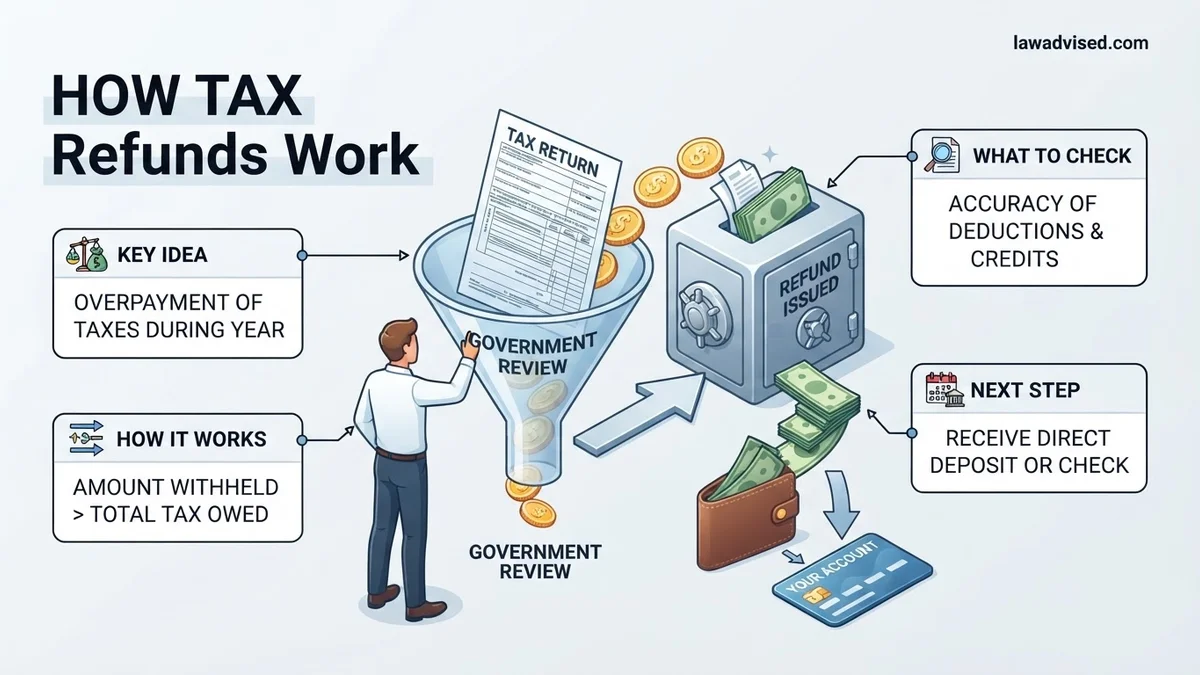
A tax refund is not a bonus from the government, but rather your own overpaid money returned to you after filing your annual tax return. Throughout the year, portions of your income are withheld and paid toward your anticipated tax liability.
A tax refund is not a bonus or a gift from the government. It is simply the return of your own hard-earned money that you overpaid throughout the year via paycheck withholding or estimated tax payments. When your total tax payments exceed your actual calculated tax liability for the year, the IRS refunds the exact difference back to your bank account.
For the 2026 tax season, understanding this core mechanism prevents you from giving the government an interest-free loan. Knowing how the math works empowers you to adjust your withholdings, keep more cash in your monthly budget, and navigate the filing process with total confidence.
Key Takeaways
- A refund simply means you paid more in taxes than you actually owed.
- Employers use your W-4 form to calculate how much tax to withhold.
- Filing electronically with direct deposit is the fastest way to get your money.
- Tax credits and deductions directly lower your tax liability and boost refunds.
- Errors on your return or claiming specific credits can cause processing delays.
What Causes Tax Refunds and Where the Money Comes From
The Overpayment Mechanism
Every time you get paid, your employer holds back a portion of your earnings to cover federal, state, and local income taxes. If you are self-employed, you send quarterly estimated payments to the IRS. These payments are essentially estimates of what you will owe when you file your annual return in 2026. If you experience major life changes, such as getting married, having a child, or buying a home, you may qualify for new tax credits and deductions that lower your final tax bill. Because your employer kept withholding taxes based on your old financial situation, the gap between what you paid and what you actually owe widens, resulting in a refund.
Where the Refund Money Actually Comes From
The money deposited into your account comes directly from the U.S. Treasury’s general fund. It is literally your own money returned to you. Think of it like paying too much at the grocery store register. If your total bill for groceries is fifty dollars and you hand the cashier a one-hundred-dollar bill, you receive fifty dollars in change. A tax refund operates on the exact same principle. The government calculates your exact tax liability at the end of the year, subtracts what you already paid through paycheck withholdings, and returns your leftover cash.
-
Key factors driving overpayment include:
- Overestimating annual income on Form W-4
- Qualifying for lucrative tax credits like the Child Tax Credit
- Claiming unexpected deductions that lower taxable income
- Making larger quarterly estimated payments than necessary
Step-by-Step Guide on How to File and Claim Your Refund
Step One: Gather Documents and File Your Return
You cannot receive a tax refund without officially telling the IRS what you earned and what you paid. In early 2026, you will receive tax forms like the W-2 from your employer, 1099s from freelance clients, and 1098s for mortgage interest. You plug this information into tax software or hand it to a professional. Once you submit your tax return electronically, the IRS officially begins the process of calculating your final refund amount.
Step Two: IRS Processing and Issuance
After submission, the IRS reviews your return for accuracy and matches your reported data against documents provided by your employer and financial institutions. Most taxpayers who file electronically and choose direct deposit receive their refunds within 21 days. If you claim specific credits like the Earned Income Tax Credit, the IRS must hold your refund by law until mid-February, pushing your actual deposit date slightly later into the season.
-
The chronological issuance steps:
- IRS accepts your electronically filed tax return
- Automated systems process and verify your withholding data
- Refund is approved and scheduled for release
- Funds hit your bank account via direct deposit or a paper check arrives via mail
Factors That Influence Refund Timing and Amount
Several variables dictate when your 2026 tax refund arrives and how much money ends up in your bank account. According to data from the Internal Revenue Service (IRS), the method you choose to file your return is the single biggest driver of speed. Electronic filing combined with direct deposit remains the fastest route, yielding refunds in less than 21 calendar days for most filers. Paper returns processed through the mail regularly take six to eight weeks or longer.
Credits and Legally Mandated Holds
If you claim specific federal tax benefits, federal law explicitly delays your refund. Under the Protecting Americans from Tax Hikes (PATH) Act, the IRS cannot issue refunds containing the Earned Income Tax Credit (EITC) or the Additional Child Tax Credit (ACTC) before mid-February. Financial experts recommend factoring this delay into your annual budgeting to avoid short-term cash flow crunches.
Math Errors and Identity Verification
Accuracy directly dictates your final refund amount and processing speed. The IRS automated systems flag arithmetic mistakes, mismatched Social Security numbers, and discrepancies with reported W-2 or 1099 income. According to recent tax compliance research, manual error resolution adds an average of four to six weeks of processing time and frequently alters the expected refund amount downward.
What If Your Refund Is Delayed or Doesn’t Match What You Expected
Discovering that your 2026 tax refund is missing, delayed, or different from your calculation can be stressful. Financial advisors recommend a systematic approach to diagnose the discrepancy before panicking. Federal systems update overnight, so checking the status tracker constantly will not speed up the resolution.
- Check the IRS Where’s My Refund Tool: Log into your official IRS account to view specific error codes or notices explaining adjustments made to your return.
- Review Your Filed Return Line-by-Line: Compare the copy of your submitted 2026 tax return against your actual income documents, such as W-2s and 1099s, to spot transcription errors.
- Wait for Official Correspondence: The IRS typically mails a formal notice explaining why your refund amount changed or why processing is paused.
- Contact a Tax Professional: If the issue involves complex tax law, an audit flag, or unresolved delays exceeding 120 days, consult a Certified Public Accountant (CPA) or Enrolled Agent (EA). Professional assistance for tax resolution services generally ranges from $200 to $600 depending on complexity.
Conclusion
Navigating how tax refunds work in 2026 requires understanding the interplay between filing methods, legal holds like the PATH Act, and mathematical accuracy. Delays and discrepancies typically stem from simple data entry mistakes or mandatory government verification protocols. According to verified research and expert financial sources, the most reliable way to secure your full refund quickly is filing electronically with direct deposit and verifying all income documents beforehand. Your actionable next step for this tax season is to gather all complete tax documents and file your return through IRS Free File or certified tax software as early as possible.
❓ Frequently Asked Questions
Why did I get a tax refund if I earned less money this year?
Your refund depends on the relationship between your total tax liability and your withholdings. If your employer withheld more tax than your lower income required, you will receive a refund.
How can I track the status of my tax refund?
You can use the official ‘Where’s My Refund?’ tool on the IRS website or IRS2Go mobile app, usually available within 24 hours after e-filing.
What common mistakes cause a tax refund to be delayed?
Math errors, incorrect Social Security numbers, mismatched names, and failing to sign the return can trigger manual reviews and significant delays.
Do tax credits increase the size of a tax refund?
Yes, refundable tax credits like the Earned Income Tax Credit can reduce your tax liability below zero, resulting in a larger refund check.
What should I do if my direct deposit refund hasn’t arrived after 21 days?
Check the ‘Where’s My Refund?’ tool for updates or potential notices from the IRS requiring identity verification or document correction.
Is it better to get a large tax refund or owe nothing?
Financial experts generally advise aiming for a break-even scenario so you have access to your hard-earned cash throughout the year rather than giving the government an interest-free loan.

Ismail Hossain is the founder of Law Advised. He is an Divorce, Separation, marriage lawyer. Follow him.