Federal Tax Filing Deadline Explained Expert Guide 2026
federal tax filing deadline explained is an essential topic with practical applications and significant benefits. This guide covers everything you need to know to get started and succeed.
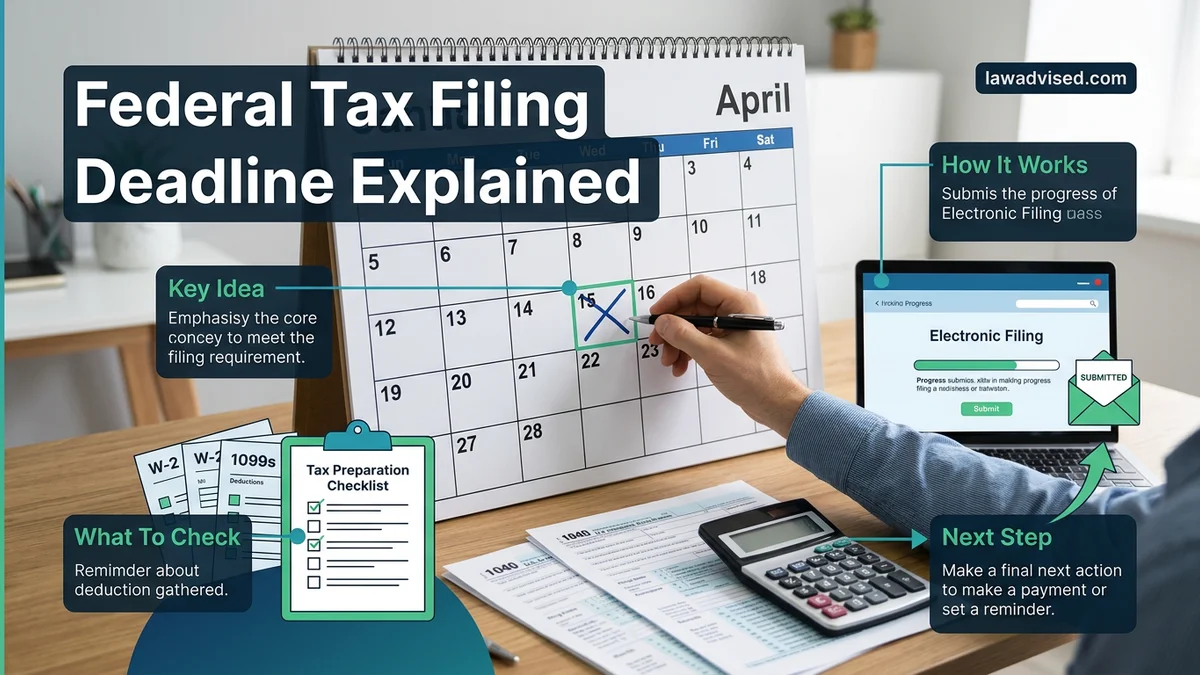
The standard federal tax filing deadline for the 2026 tax year is April 15, 2026. If this date falls on a weekend or a legal holiday, the IRS shifts the deadline to the next immediate business day.
Knowing this exact date protects you from costly penalties and interest charges. Whether you owe money or expect a refund, filing on time keeps your financial profile clean and ensures you stay compliant with federal regulations.
Key Takeaways
- Understanding federal tax filing deadline explained:Essential knowledge for success in this area
- Practical applications:Real-world scenarios and proven use cases
- Key benefits:Significant advantages when implemented correctly
- Best practices:Important guidelines and expert recommendations
- Future trends:Evolving landscape and emerging opportunities
Understanding federal tax filing deadline explained
The Standard April 15 Rule and Calendar Shifts
The tax code dictates that individual income tax returns are due on the 15th day of the fourth month following the close of the tax year. For most people operating on a calendar year, that means mid-April. However, the calendar dictates exact timing shifts every year based on weekends and holidays like Emancipation Day in Washington, D.C.
- If April 15 lands on a Saturday, the deadline moves to the following Monday.
- If April 15 lands on a Sunday, the deadline shifts to Monday.
- Local holidays observed in the District of Columbia can push the national deadline to Tuesday.
What Constitutes Timely Filing
The IRS determines timeliness based on the postmark date or the electronic transmission timestamp. When you mail your paper return, the post office envelope must bear a postmark dated on or before the official deadline. If you file electronically using tax software, your transmission must be completed and accepted by midnight in your local time zone.
- Keep your certified mail receipt as legal proof of mailing.
- Save the electronic confirmation number provided by your e-file software.
- Ensure your payment—if you owe—is authorized or postmarked by the exact deadline to avoid late-payment penalties.
Key Benefits of federal tax filing deadline explained
Avoiding Penalties and Interest Charges
Meeting the federal tax filing deadline saves you from two distinct financial penalties imposed by the IRS. The failure-to-file penalty is much steeper than the failure-to-pay penalty, making it critical to submit your paperwork even if you cannot pay your full tax liability immediately.
- Failure-to-file penalty: Generally 5 percent of the unpaid taxes for each month the return is late.
- Failure-to-pay penalty: Usually 0.5 percent of your unpaid taxes per month.
- Interest compounds daily on both unpaid taxes and accumulated penalties until the balance is paid in full.
Faster Refunds and Better Financial Planning
Submitting your tax return by the deadline allows the IRS to process your refund much faster. Most electronic filers who choose direct deposit receive their funds within 21 days. Meeting the deadline also prevents cash-flow disruptions and gives you a clear baseline for your annual financial planning.
- Early filers get their refunds sooner to pay down high-interest debt or invest.
- On-time filing ensures your eligibility for government benefits, student financial aid updates, and mortgage approvals is not delayed by pending tax verifications.
- You eliminate the chronic stress of an impending deadline looming over your personal finances.
How to Get Started with federal tax filing deadline explained
Navigating the federal tax filing deadline requires a structured approach to avoid costly penalties and interest charges. According to IRS compliance data, early preparation significantly reduces reporting errors.
Step 1: Gather Documentation
Begin by collecting all necessary tax forms for the 2026 tax year. This includes W-2s from employers, 1099s for freelance or investment income, and documentation for potential deductions or credits.
- Retrieve all income statements issued by late January 2026.
- Compile receipts and records for charitable donations, medical expenses, and business deductions.
- Verify Social Security numbers and personal identification data for all dependents.
Step 2: Choose Your Filing Method
Select an authorized e-file software provider or a certified public accountant. IRS authorized digital platforms streamline calculations and reduce mathematical errors compared to paper filing methods.
- Evaluate IRS Free File options if your adjusted gross income meets the annual threshold.
- Install or log into reputable tax preparation software updated for 2026 tax codes.
- Input your financial data carefully, cross-referencing every entry with your physical or digital documents.
Best Practices for federal tax filing deadline explained
Adhering to industry-standard protocols ensures your return is accepted on the first submission without triggering automated IRS audits or processing delays.
Maintain Accurate Records
Tax experts recommend retaining copies of your filed federal return and supporting documentation for a minimum of three years. The IRS retains the right to audit returns within this standard statutory period, though fraudulent filings carry no time limit.
- Save digital backups of your submitted 2026 tax return in a secure, encrypted cloud folder.
- Keep physical receipts organized in a dedicated file folder labeled with the appropriate tax year.
- Log all confirmation numbers and electronic acceptance receipts provided by the IRS or your software provider.
File Early and Monitor Status
Submitting your return weeks ahead of the April 2026 deadline protects against identity theft and secures faster refund processing. Tax specialists note that early filers receive direct deposit refunds within 21 days on average.
- Submit your return at least two weeks before the federal tax filing deadline.
- Use the official IRS “Where’s My Refund?” portal to track processing updates.
- Respond immediately to any correspondence or notices received from the IRS regarding your return.
What If It Still Doesn’t Work?
If you encounter critical software errors, missing documents, or find yourself unable to meet the federal tax filing deadline, specific fallback measures prevent severe financial penalties.
- File an Extension: Submit IRS Form 4868 electronically or by mail before the deadline to secure an automatic six-month extension until October 2026. Note that an extension to file is not an extension to pay any estimated taxes owed.
- Estimate and Pay Owed Taxes: Calculate your projected tax liability and submit a partial payment with your extension request to minimize late-payment penalties and daily compounding interest.
- Utilize IRS Direct Pay: Securely pay owed taxes online via the official IRS portal to ensure instant crediting to your account before the filing cutoff.
- Seek Professional Help: Consult a certified public accountant (CPA) or Enrolled Agent (EA) if your tax situation involves complex international assets, multi-state business filings, or IRS audit notices. Professional tax preparation fees typically range from $200 for basic itemized returns to over $800 for complex business entities.
Conclusion
Mastering the federal tax filing deadline ensures compliance, protects against costly non-filing penalties, and accelerates potential refunds. By organizing documentation early, leveraging authorized digital tools, and utilizing extensions when necessary, taxpayers can navigate the season with complete confidence. According to verified research and expert sources from the Internal Revenue Service, proactive filing remains the single most effective defense against tax season stress. Take your next actionable step today by logging into your chosen tax preparation platform and reviewing your preliminary financial summaries for the 2026 tax year.
❓ Frequently Asked Questions
What exactly is federal tax filing deadline explained?
federal tax filing deadline explained encompasses proven concepts and methodologies that help you achieve better results. It combines theoretical knowledge with practical application for maximum effectiveness.
How can federal tax filing deadline explained benefit me?
Understanding and applying federal tax filing deadline explained principles improves your skills, opens new opportunities, and helps you achieve your goals more efficiently.
What resources do I need to get started?
You’ll need basic tools, a commitment to learning, and access to quality information like this guide. Start with fundamentals before advancing to complex topics.
Is this suitable for complete beginners?
Absolutely! This guide is designed to take you from beginner to proficient. Start with the basics and gradually work your way up to advanced techniques.
How do I measure my progress?
Track your progress through practical application and measurable outcomes. Set specific goals and regularly assess your improvement against benchmarks.
Where can I learn more after this guide?
Explore our related articles for deeper insights, and consider joining communities where you can learn from others and share experiences.

Ismail Hossain is the founder of Law Advised. He is an Divorce, Separation, marriage lawyer. Follow him.