How to Resolve Federal Tax Problems in 2026 Expert Guide
Dealing with the IRS can be intimidating, but facing tax issues head-on is the only way to prevent severe penalties, liens, and levies. Understanding your official IRS relief options and following a structured action plan will help you legally resolve unpaid taxes and disputes.
Resolving federal tax problems with the IRS requires immediate action, exact document gathering, and selecting the correct statutory relief program like an Installment Agreement or Offer in Compromise. Ignoring a notice accelerates collection actions, leading directly to federal tax liens and bank levies.
Facing the IRS in 2026 demands a structured strategy. Whether you are dealing with unfiled returns, a sudden audit notification, or a mounting tax balance, knowing the precise procedural steps prevents costly mistakes and stops enforcement before it damages your financial standing.
Key Takeaways
- Open every official IRS notice immediately to identify deadlines and exact debt amounts.
- File all missing tax returns, even if you cannot afford to pay the owed balance.
- Set up an Installment Agreement for structured monthly payments over up to 72 months.
- Qualify for an Offer in Compromise to settle tax debt for less than you owe.
- Vet tax professionals carefully to avoid predatory resolution companies charging upfront fees.
What Causes Federal Tax Problems and IRS Escalations
Federal tax disputes rarely materialize overnight. They typically stem from specific reporting discrepancies, processing errors, or simple failure to pay assessed liabilities on time. Understanding what triggers an IRS escalation helps you identify the severity of your current situation.
Common IRS Triggers and Audit Catalysts
- Information Return Mismatches: The IRS automated matching system flags your return when W-2 or 1099 data does not match what you reported.
- Unfiled Tax Returns: Failing to file for multiple years prompts the IRS to create a Substitute for Return, which rarely accounts for your legitimate deductions.
- High-Risk Deductions: Claiming large business losses, excessive charitable contributions, or complex home office deductions significantly increases audit risk.
The IRS Escalation Timeline
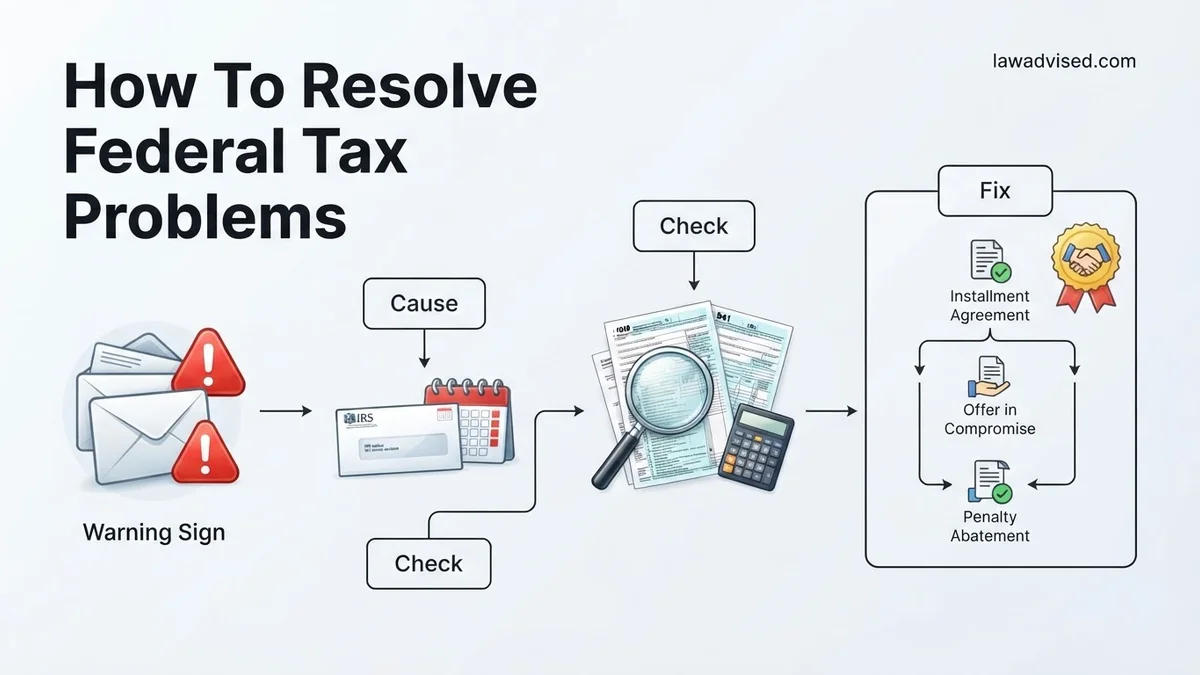
The agency follows a rigid collection lifecycle. If you ignore the initial balance due notice CP14, the IRS sends follow-up letters leading to a Final Notice of Intent to Levy. Once this 30-day notice window closes, the agency can legally seize your wages or freeze your bank accounts without a court order.
Master Federal Tax Problems in 7 Simple Steps
Facing a dispute or debt with the Internal Revenue Service can feel overwhelming, but ignoring the issue will only compound penalties and interest. This comprehensive guide walks you through the exact process required to diagnose your tax liability, communicate effectively with the government, and set up a realistic resolution plan to protect your assets and restore your financial peace of mind.
Step 1: Gather Your IRS Transcripts
What you need: Access to the internet, a printer, your Social Security Number, and prior-year tax returns.
Instructions: Before you can fix a federal tax problem, you must know what the IRS sees on their end. Navigate to the official IRS website and use the “Get Transcript Online” tool, or file Form 4506-T by mail. You will want to pull both your Account Transcript and your Wage and Income Transcript for every year you have an issue. The account transcript shows the history of your tax return, including payments, penalties, and balance adjustments. The wage transcript shows what employers and financial institutions reported you earned.
Pro Tip: Setting up an ID.me account online is the fastest way to download these transcripts immediately, saving you weeks of waiting for mail delivery.
Step 2: Identify the Root Cause of the Notice
What you need: The IRS notice you received, your pulled transcripts, and a calculator.
Instructions: Carefully read the specific IRS notice number (found in the top right corner, such as CP2000 or LT11). Cross-reference the numbers on the notice with your own records and wage transcripts. Determine if the IRS is simply missing a form, if they adjusted your return due to unreported income, or if you simply failed to pay an assessed balance. Understanding the precise trigger allows you to formulate an accurate defense or acceptance of the debt.
Pro Tip: Do not panic over threatening language like “Intent to Levy.” This is standard automated language designed to prompt action, but it does mean you must act within the stated 30-day window.
Step 3: File Any Missing Tax Returns
What you need: Past-year tax software, W-2s, 1099s, and all other historical financial documents.
Instructions: The IRS will generally refuse to negotiate any payment plan or settlement until all legally required tax returns are formally filed. If you haven’t filed for the past one, three, or five years, purchase a downloadable desktop version of professional tax software for those specific tax years. Fill out the returns accurately, making sure to claim all legitimate deductions and credits you are entitled to, and mail them via certified mail with a return receipt requested.
Pro Tip: Keep the certified mail tracking receipt stapled to your copy of the filed return. This serves as your legal proof of timely mailing if the IRS claims they never received it.
Step 4: Request Penalty Abatement if Eligible
What you need: Form 843 (Claim for Refund and Request for Abatement) or a written letter, plus documentation of hardship.
Instructions: Penalties and interest often make up a massive percentage of your overall federal tax debt. If you have a clean compliance history for the preceding three years, you may qualify for First-Time Penalty Abatement by simply calling the IRS customer service line. If not, you must prove “reasonable cause”—such as a prolonged serious illness, natural disaster, or destruction of records. Submit your request in writing detailing the exact timeline of events that prevented you from filing or paying on time.
Pro Tip: Interest generally cannot be abated by law unless the IRS made an official unreasonable error or delay, so focus your penalty arguments on proving reasonable cause.
Step 5: Choose Your Resolution Strategy
What you need: Form 9465 (Installment Agreement Request), Form 656 (Offer in Compromise booklet), or Form 433-A/F collection information statements.
Instructions: Evaluate your financial capacity to pay. If you can pay the debt within 72 months, apply for a Streamlined Installment Agreement online or via phone. If you truly cannot afford the monthly payments and meet strict financial criteria, look into Currently Not Collectible (CNC) status, which temporarily halts IRS collections. Alternatively, if your assets and income are significantly lower than your total tax liability, prepare an Offer in Compromise to settle your tax debt for a fraction of what you owe.
Pro Tip: For installment agreements under $50,000 for individuals, you can usually set up an automatic monthly payment plan directly through the IRS self-service portal without submitting detailed financial disclosures.
Step 6: Submit and Confirm Your Payment Plan
What you need: Bank routing and account numbers for direct debit setups, or your approved IRS agreement confirmation letter.
Instructions: Once you submit your chosen resolution path, maintain strict compliance. If you opted for a payment plan, ensure your bank account has sufficient funds on the designated withdrawal date each month. If you submitted an Offer in Compromise, make the required application fee and initial proposed payments on time. Watch your mail for a formal acceptance letter from the IRS, which officially locks in your resolution terms and stops active collection levies.
Pro Tip: Missing even a single payment on an IRS installment agreement can default the entire arrangement instantly, forcing you to restart the negotiation process from scratch.
Step 7: Maintain Future Tax Compliance
What you need: A calendar for estimated tax payments and a reliable system for withholding adjustments.
Instructions: The golden rule of resolving IRS problems is ensuring you never create a new one. If you are a W-2 employee, submit a new Form W-4 to your employer’s human resources department to increase your tax withholding. If you are self-employed or run a business, calculate and pay your quarterly estimated federal taxes (Form 1040-ES) religiously every April 15, June 15, September 15, and January 15.
Pro Tip: Keep all tax documents, receipts, and bank statements organized in a digital folder system for at least seven years to make future filing seamless.
✅ Final Checklist
- Retrieved and reviewed all official IRS account and wage transcripts
- Successfully filed all delinquent or missing historical tax returns via certified mail
- Requested first-time penalty abatement or documented reasonable cause
- Selected and formally applied for an appropriate resolution track (Installment Agreement, OIC, or CNC)
- Updated W-4 withholdings or scheduled quarterly estimated tax payments to prevent future liabilities
Important Notes:
- Never ignore certified letters from the IRS; swift action prevents aggressive enforcement actions like wage garnishments and bank levies.
- Seek professional help from a Certified Public Accountant (CPA), Enrolled Agent (EA), or tax attorney if your total liability exceeds $50,000, involves payroll taxes, or includes complex asset valuations.
- Estimated time frame to completely resolve a tax problem ranges from 30 days for simple payment plans to 6 to 12 months for complex Offers in Compromise; costs vary from free (self-service) to several thousand dollars in professional representation fees.
How to Fix Federal Tax Problems Step-by-Step
Resolving tax problems successfully is a linear process. You cannot apply for formal relief programs until you know the exact scope of your liability and have brought your filing compliance completely up to date.
Step 1: Assess Your Liability and Pull Your Transcripts
Never guess what you owe the IRS. Log into your online IRS account to pull your Wage and Income Transcripts and Account Transcripts for the disputed tax years. These documents show exact balances, accrued penalties, interest, and any enforcement actions currently active against you.
Step 2: Ensure Filing Compliance
The IRS will reject any formal payment plan or tax settlement application if you have unfiled tax returns. You must file all missing returns for the past six years before a revenue officer will review your case for structural debt relief.
Step 3: Respond to Notices Immediately
Every IRS notice includes a specific response deadline, usually 30 days. Sending a timely, written response prevents the account from moving to the automated collection or levy stage, buying you the necessary time to assemble a comprehensive financial disclosure package.
Official IRS Relief Programs Explained
When you cannot pay your federal tax liability in full, the IRS offers several formal relief programs designed to bring accounts into compliance. Selecting the correct program depends strictly on your current financial capacity, asset equity, and historical tax compliance records.
1. Installment Agreements
An Installment Agreement allows you to pay your tax debt through monthly payments over an extended period. For balances under $50,000, taxpayers can often secure a streamlined agreement online without submitting detailed financial disclosures. According to IRS operational data, setup fees range from $31 for direct debit arrangements up to $130 for standard setups, though low-income taxpayers frequently qualify for fee waivers or reductions.
2. Offer in Compromise (OIC)
An Offer in Compromise permits eligible taxpayers to resolve their total tax liability with the IRS for a significantly lower amount than what is actually owed. The IRS evaluates these applications based on your ability to pay, income, expenses, and asset equity. Research indicates that successful OIC applicants must prove that collecting the full amount would create severe economic hardship or that collection is doubtful. The standard application fee is $205, alongside a mandatory initial payment toward the proposed offer amount.
3. Currently Not Collectible (CNC) Status
If your monthly living expenses leave zero disposable income to put toward back taxes, requesting Currently Not Collectible status halts active IRS collection activities. While penalties and interest continue to accrue, the agency temporarily stops levies and wage garnishments. Financial transparency is mandatory, as applicants must submit Form 433-F detailing all household income and allowable living expenses.
What If It Still Doesn’t Work?
If direct negotiations stall, automated collection notices escalate, or the IRS rejects your initial relief applications, navigating the system independently becomes high-risk. Implementing advanced fallback measures protects your assets and prevents severe collection actions like bank levies or federal tax liens.
- Request an Appeals Conference: File Form 12153 within the designated timeframe to challenge rejected installment agreements, proposed levies, or liens before an independent IRS Office of Appeals.
- Contact the Taxpayer Advocate Service (TAS): Utilize this independent organization within the IRS if you are experiencing systemic hardship or financial emergencies because tax issues refuse to resolve through normal channels.
- Hire a Qualified Tax Professional: Engage a Certified Public Accountant (CPA), Enrolled Agent (EA), or tax attorney with specific experience in federal tax resolution. According to industry data, professional representation for complex audits or appeals generally ranges from $1,500 to $5,000 depending on the total liability and case complexity.
- Pursue Innocent Spouse Relief: File Form 8857 if your current tax debt stems from errors or unpaid liabilities originating entirely from a current or former spouse’s fraudulent reporting.
Conclusion
Resolving federal tax problems requires swift action, transparent financial disclosure, and a clear understanding of official IRS relief programs like installment agreements and offers in compromise. Delaying communication only escalates penalties, interest charges, and aggressive collection enforcement. According to verified research and expert tax sources, early proactive engagement drastically improves settlement outcomes and reduces total financial strain. Take your actionable next step today by pulling your official IRS tax transcripts to assess your exact liability and begin targeted compliance.
❓ Frequently Asked Questions
How do I find out how much I owe the IRS?
You can view your tax account balance, payment history, and official transcripts online by creating an account on the official IRS website. Alternatively, you can call the IRS directly or submit Form 4506-T to request your transcripts by mail.
What is the difference between a tax lien and a tax levy?
A federal tax lien is a legal claim against your property when you neglect to pay a tax debt, securing the government’s interest. A tax levy, on the other hand, is the actual legal seizure of your property or assets, such as wages or bank accounts, to satisfy that debt.
Can IRS penalties be removed or reduced?
Yes, through penalty abatement. The IRS frequently grants relief for first-time offenders with a clean compliance history or for taxpayers who can demonstrate reasonable cause, such as a serious illness, natural disaster, or other unavoidable circumstances.
What is Currently Not Collectible (CNC) status?
If the IRS determines that you cannot pay your tax debt and basic living expenses at the same time, they may place your account in CNC status. This temporarily halts all IRS collection activity, though penalties and interest continue to accrue.
Who should I hire to help resolve my tax problems?
Look for credentialed professionals such as Certified Public Accountants (CPAs), Enrolled Agents (EAs), or tax attorneys. These professionals have unlimited representation rights before the IRS and adhere to strict ethical standards.
How long does it take the IRS to review an Offer in Compromise?
The IRS legally has up to two years to evaluate an Offer in Compromise application. If they do not make a decision within 24 months of the receipt date, the offer is automatically accepted by default.

Ismail Hossain is the founder of Law Advised. He is an Divorce, Separation, marriage lawyer. Follow him.