Difference Between Federal and State Income Tax 2026 Guide
Understanding the difference between federal and state income tax is essential for managing your annual tax liability and avoiding unexpected bills. While federal taxes fund nationwide programs through a progressive bracket system, state taxes fund local public services using varying rate structures. Knowing how these two systems interact helps you accurately prepare your tax returns.
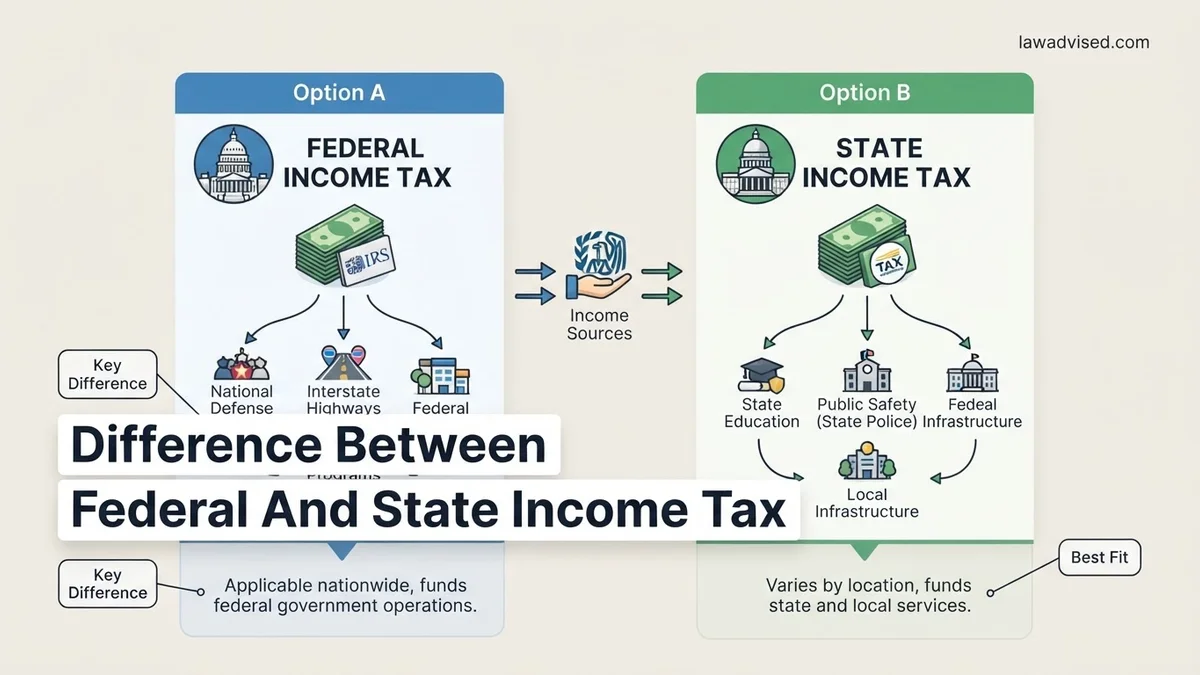
Federal income tax is levied by the federal government and applies nationwide, funding things like national defense and entitlement programs using a progressive tax bracket system. State income tax is levied by individual state governments to fund local public services, and it uses either progressive brackets or a flat tax rate depending on where you live.
Navigating your tax obligations in 2026 requires understanding that these are two entirely separate financial systems. You must file returns for both entities, and the rules, deductions, and rates for each operate independently.
Key Takeaways
- Federal income tax is collected by the IRS and applies nationwide using progressive tax brackets.
- State income tax is collected by state revenue departments and varies significantly by geographic location.
- Nine U.S. states currently do not levy a traditional broad-based personal income tax on earned wages.
- Federal funds support national defense and social programs, whereas state funds finance local education and infrastructure.
- State tax rules often operate independently, though some states allow deductions for federal taxes paid.
What Causes Confusion Over the Difference Between Federal and State Income Tax
Tax season brings a mountain of paperwork, and seeing two distinct tax deductions on your paystub creates immediate confusion. Most taxpayers lump these obligations together as a single tax burden, but they serve completely different masters and fund entirely separate programs.
Governing Authority and Geographical Reach
The primary source of confusion stems from jurisdiction. The Internal Revenue Service manages federal taxes across all fifty states. Meanwhile, your state department of revenue handles only the residents and income generated within its specific borders.
- Federal Authority: Set by Congress and collected nationwide under uniform rules.
- State Authority: Determined by state legislatures, meaning your tax rules change completely if you cross state lines.
- Geographical Scope: Federal taxes apply to all earned income regardless of location, while state taxes generally target residents and non-residents earning money inside that specific state.
Allocation of Funds and Public Services
Another major reason taxpayers get mixed up is where the money actually goes. When you pay federal income tax in 2026, your dollars support national defense, federal infrastructure, foreign aid, and safety net programs like Social Security. Your state income tax dollars never touch the federal budget.
Instead, state revenue directly impacts your immediate surroundings. It pays for local public K-12 schools, state highway maintenance, state parks, and localized law enforcement.
How to Identify and Calculate Your Federal Versus State Tax Obligations
Calculating what you owe requires looking at how tax rates are applied to your paycheck. The fundamental mechanics of federal and state calculations differ significantly, especially when it comes to rate structures.
Federal Versus State Rate Structures
The federal government relies exclusively on a progressive tax system. As your income increases, successive portions of your income are taxed at higher marginal rates.
State governments take two different approaches:
- Progressive States: Similar to the federal model, states like California and New York apply higher tax rates to higher income brackets.
- Flat Tax States: States like Pennsylvania and Illinois apply a single, uniform tax percentage to all taxable income, regardless of how much you earn.
- No-Tax States: States like Texas and Florida levy zero state income tax, relying instead on high sales or property taxes.
Practical Calculation Example
Imagine you are a single filer earning 75,000 dollars in taxable income in 2026. For your federal return, you apply the IRS progressive brackets, meaning only the money crossing specific thresholds gets taxed at higher percentages.
For your state return, the math changes based on geography. If you live in a flat tax state with a 4 percent rate, you owe 4 percent on your taxable state income. If you live in a state with no income tax, that portion of your calculation drops to zero entirely.
What If Your State Does Not Have an Income Tax or Withholds Incorrectly
Navigating the complex landscape of 2026 tax obligations requires understanding that not all jurisdictions operate the same way. While the federal government collects taxes from every working resident, state policies vary wildly. Knowing how your specific jurisdiction handles withholding discrepancies protects you from unexpected tax bills.
States Without an Income Tax
As of 2026, nine U.S. states levy no traditional earned income tax: Alaska, Florida, Nevada, New Hampshire, South Dakota, Tennessee, Texas, Washington, and Wyoming. If you live and work in one of these locations, you only file a federal income tax return. However, remember that these states often rely heavily on higher property taxes, sales taxes, or specialized gross receipts taxes to fund public infrastructure.
Correcting State Withholding Errors
If your state paycheck deductions appear incorrect or do not match your current financial situation, you must take proactive steps to fix the error. Failing to address withholding mistakes can lead to large end-of-year penalties and interest charges from your state department of revenue.
- Review your most recent pay stub to identify the exact federal and state withholding amounts.
- Compare your current life circumstances—such as marriage, the birth of a child, or a second job—with your active withholding elections.
- Obtain and complete a new state-specific withholding certificate (often equivalent to the federal Form W-4) from your employer’s human resources department.
- Submit the updated form to your payroll provider and monitor your next two pay stubs to confirm the adjustments took effect.
- Contact your state’s department of revenue directly if your employer fails to apply the corrected withholding within 30 days.
What If It Still Doesn’t Work?
If adjusting your withholding elections or filing software does not resolve persistent tax calculation errors, deeper systemic issues may exist. Complex multi-state residency situations or employer reporting mistakes often require specialized intervention. Consider these fallback steps:
- Request a formal wage and income transcript directly from the IRS and your state tax agency to verify what your employers have officially reported.
- Consult a certified public accountant (CPA) or an Enrolled Agent (EA) who specializes in multi-state taxation to untangle complicated employer errors. Professional tax representation typically costs between $200 and $500 per hour depending on complexity.
- File a formal payroll dispute with your state’s department of labor if your employer refuses to correct documented state withholding mistakes.
- Utilize IRS Free File or state-sponsored electronic filing portals to ensure your tax software calculations are not overriding manual adjustments.
Conclusion
Understanding the fundamental differences between federal and state income tax ensures accurate budgeting and prevents costly compliance mistakes during the 2026 tax season. While federal taxes fund nationwide programs, state taxes support local infrastructure, education, and public safety. According to verified research and expert financial sources, proactive withholding management remains the single most effective tool for avoiding unexpected tax liabilities. Take action today by reviewing your latest pay stub and updating your withholding forms to match your current financial reality.
❓ Frequently Asked Questions
What is the primary structural difference between federal and state income taxes?
The primary difference lies in the governing authority and geographical reach. Federal income tax is levied by the federal government under uniform nationwide rules, while state income tax is levied independently by individual state governments based on localized laws and budgets.
Why do some states have no income tax and how do they fund public services?
States without an income tax typically rely more heavily on other revenue sources, such as higher sales taxes, property taxes, severance taxes on natural resources, or tourism-related fees to fund public schools and infrastructure.
Are retirement benefits taxed differently at the federal and state levels?
Yes, retirement income rules vary widely. While the federal government taxes most retirement distributions, individual states have their own exemption rules, with some states completely exempting Social Security or pension income from state taxation.
How does the flat tax system work in certain states?
A flat tax system applies a single, uniform tax percentage to all taxable income regardless of how much an individual earns, unlike the federal progressive system where rates increase as income tiers rise.
What happens if I move to a different state in the middle of the tax year?
If you move between states, you generally must file part-year resident tax returns for each state where you earned income, dividing your tax liability based on where you lived and worked during specific periods.
Do local municipalities also levy income taxes on top of state taxes?
Yes, certain cities and local jurisdictions in specific states impose an additional local income or earnings tax, which is separate from both federal and state income tax obligations.

Ismail Hossain is the founder of Law Advised. He is an Divorce, Separation, marriage lawyer. Follow him.