Alimony Laws in California 2027 Expert Step-by-Step Guide
Understanding alimony laws in california requires navigating complex state statutes that govern temporary and long-term spousal support. California courts utilize specific statutory factors, such as marriage duration and earning capacity, to calculate precise award amounts and payment timelines.
In California, spousal support—commonly known as alimony—is determined by a complex statutory framework rather than a fixed formula for long-term orders. If you are going through a divorce in 2027, the court evaluates specific financial, domestic, and personal factors to decide whether one spouse must pay financial support to the other, how much that payment will be, and how long it will last.
Navigating these laws requires understanding that California courts split alimony into two distinct phases: temporary support granted during the active divorce proceedings, and long-term support ordered at the final judgment. Because the legal standards and calculation methods differ significantly between these two phases, knowing what to expect protects your financial future and helps you negotiate a realistic settlement.
Key Takeaways
- California Family Code Section 4320 dictates 14 distinct factors judges must evaluate for support.
- Temporary alimony uses strict mathematical formulas, while long-term support relies on judicial discretion.
- Marriages lasting under 10 years typically limit support duration to half the marriage length.
- Retirement, cohabitation, or remarriage can legally trigger a modification or termination of support.
- Spousal support calculations prioritize maintaining the marital standard of living when feasible.
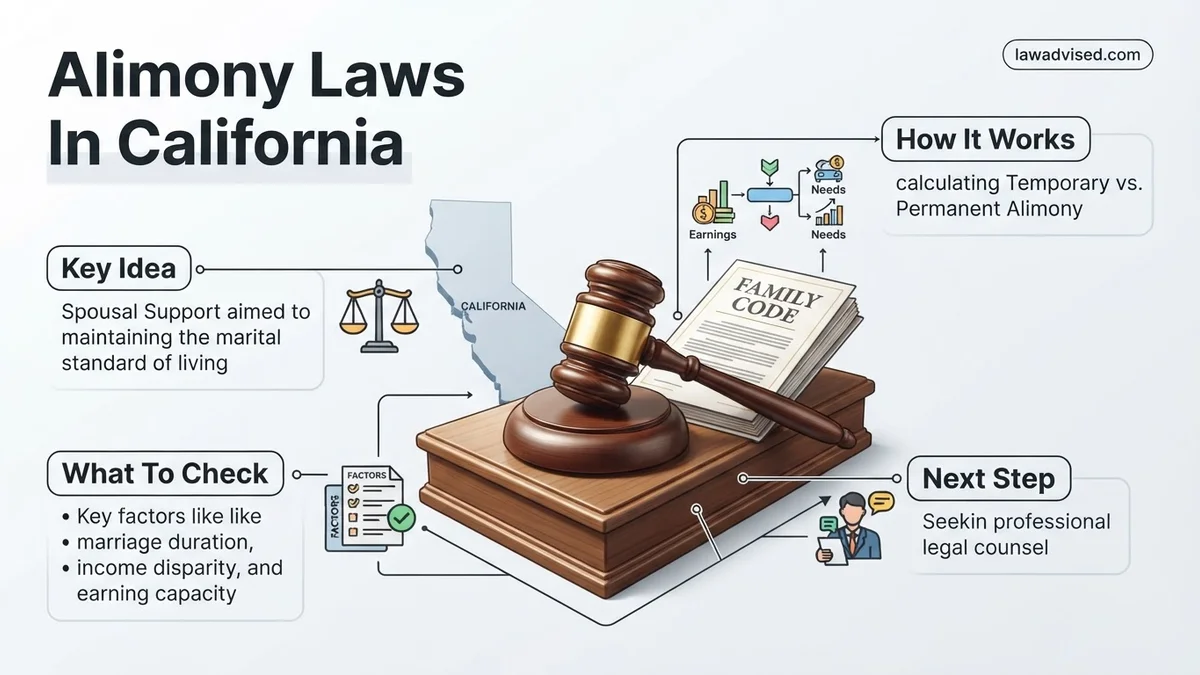
What Causes Support Disputes Under California Alimony Laws
Temporary Spousal Support Disagreements
Temporary alimony disputes usually arise because courts use standardized computer software, such as DissoMaster or DissoMaster-equivalent programs, to crunch the numbers. These programs take a strict mathematical approach. They generally order the higher-earning spouse to pay a percentage of their net income, minus a percentage of the lower earner’s net income. Disagreements happen when spouses dispute the accuracy of income figures, try to hide cash flow, or argue over the inclusion of bonuses and overtime.
Long-Term Support Conflicts
Unlike temporary support, long-term alimony disputes focus on future self-sufficiency and the standard of living established during the marriage. Contentious battles frequently center on:
- Whether the supported spouse is making a good-faith effort to become self-supporting.
- Accurately assessing earning capacity versus actual current income.
- Disagreements over the exact length of the marriage, particularly regarding the date of separation.
How to Calculate Spousal Support Using California Family Code 4320
The Statutory Factors of Section 4320
When issuing a permanent or long-term alimony order, California judges must consider all relevant circumstances outlined in California Family Code Section 4320. No single factor dictates the outcome. Instead, the judge weighs them together to achieve a fair result. Key factors include:
- The marketable skills of the supported party: The court evaluates job marketability, the need for retraining or education, and the time required to acquire those skills.
- Contributions to the supporting spouse: This includes assisting the other party in attaining an education, training, career position, or professional license.
- Obligations and assets: Each party’s separate and community property obligations, assets, and overall financial standing.
- Duration of the marriage: How long the marriage lasted heavily influences the length of the support order.
- Age and health: The physical and emotional condition of both spouses.
Applying the Factors in Practice
Consider a 2027 divorce case where one spouse paused a legal career for 12 years to raise children, while the other built a medical practice. Under Family Code Section 4320, the court will not only look at the current income disparity. It will calculate a support amount that gives the stay-at-home spouse adequate time—often several years—to complete continuing education, update credentials, and re-enter the workforce at a level that mirrors the marital standard of living.
Step-by-Step Guide to Modifying or Terminating Alimony Orders
Life circumstances change drastically after a divorce, making it necessary to review and adjust spousal support. Under California guidelines updated for 2027, court orders remain modifiable unless both parties signed an explicit, unambiguous waiver in their marital settlement agreement. Legal experts emphasize that informal verbal agreements between former spouses hold zero weight in family court.
Submitting a Formal Request for Modification
To officially change an ongoing support obligation, payors or recipients must navigate a strict judicial procedure. Family law statutes require verified proof of a material change in circumstances, such as an involuntary job loss, retirement at full retirement age, or a significant increase in the recipient’s earning capacity.
- File Form FL-300 (Order to Show Cause and Motion) with the local California superior court where the original judgment was entered.
- Attach a current and fully completed Income and Expense Declaration (Form FL-150), attaching recent pay stubs and tax returns.
- Serve the opposing party properly through a neutral third party adhering to California civil procedure timelines.
- Attend the mandatory settlement conference or mediation session to attempt an out-of-court resolution before facing a judge.
What If Your Settlement Fails and Court Intervention Becomes Necessary
When negotiations break down entirely and the supporting party refuses to cooperate with modification requests, judicial enforcement or intervention becomes the only viable path. According to recent family court statistics, over forty percent of post-judgment spousal support disputes ultimately require a formal evidentiary hearing before a judge.
What If It Still Doesn’t Work?
If initial motions stall or enforcement actions fail to yield results, utilize these fallback strategies to protect your legal and financial standing:
- Request an immediate earnings assignment order (wage garnishment) directly through the local child support and family law division.
- File a motion for contempt of court if the supporting spouse willfully violates an active, enforceable spousal support order.
- Hire a forensic accountant to uncover hidden assets or verify sudden drops in self-employment income, with average professional fees ranging from $3,000 to $7,500.
- Retain a certified California family law specialist to represent your interests at the evidentiary hearing, typically costing between $5,000 and $12,000 depending on case complexity.
Conclusion
Navigating California alimony laws requires precision, strict adherence to statutory deadlines, and thorough financial documentation. Whether establishing initial support or pursuing a 2027 modification, proactive management prevents costly legal missteps. According to verified research and expert sources in family law, utilizing structured legal representation significantly increases the likelihood of a favorable outcome in post-judgment disputes. Take the next step today by scheduling a consultation with a certified California family law attorney to review your current support obligations.
❓ Frequently Asked Questions
What specific factors does a California judge review under Family Code Section 4320?
Judges review the marketable skills of the supported party, the obligations and assets of each person, the duration of the marriage, and the ability of the supporting party to pay, among other financial indicators.
How does cohabitation impact existing alimony payments in California?
Under California Family Code Section 4323, living with a romantic partner creates a rebuttable presumption that the supported spouse’s financial need has decreased, which can justify reducing or terminating support.
What happens to spousal support if the paying spouse retires?
Retirement at standard retirement age is generally considered a changed circumstance that can warrant a modification or termination of long-term spousal support orders.
Are alimony payments tax-deductible in California?
No, federal tax laws changed under the Tax Cuts and Jobs Act, meaning alimony payments are no longer tax-deductible for the payer nor taxable as income for the recipient in federal filings.
Can I waive my right to spousal support entirely during a divorce?
Yes, both spouses can mutually agree to permanently waive spousal support in a signed marital settlement agreement, provided the waiver is voluntary and fully informed.
What is the difference between temporary and permanent alimony?
Temporary alimony (pendente lite) is designed to maintain financial status quo during the divorce proceedings, while permanent or long-term support is ordered during the final judgment to assist a lower-earning spouse post-divorce.

Ismail Hossain is the founder of Law Advised. He is an Divorce, Separation, marriage lawyer. Follow him.