On Call Laws in California 2027 A Practical Guide
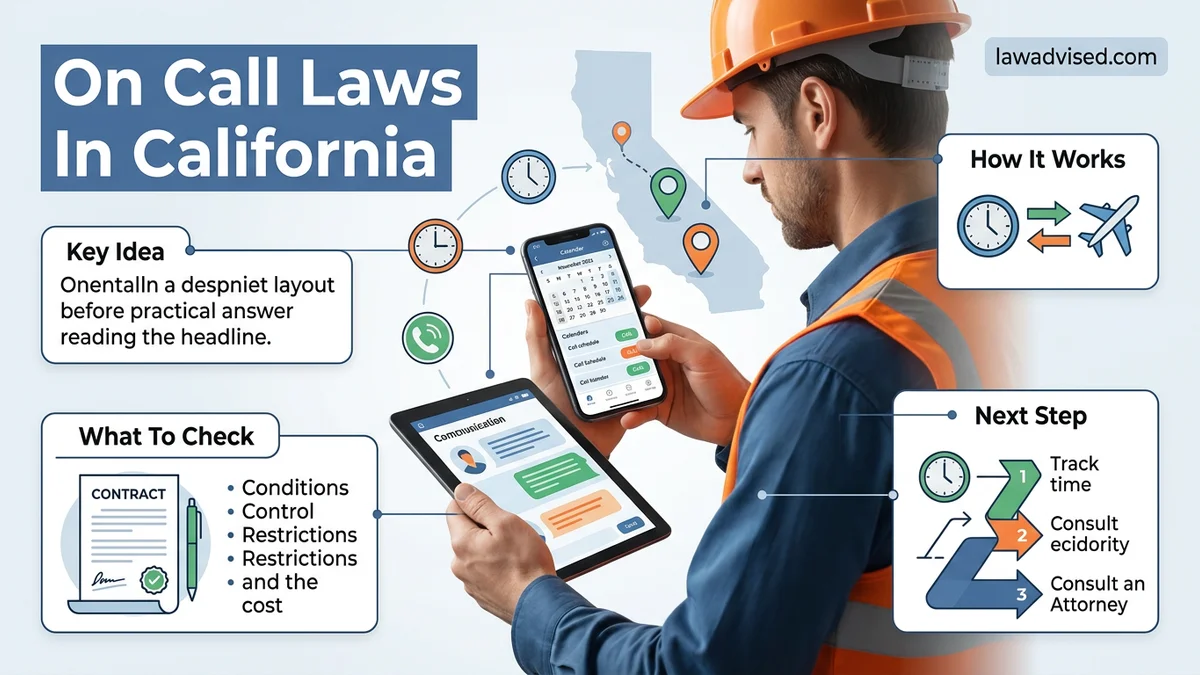
Under California labor laws, on-call time must be paid if the employer’s restrictions place heavy limits on the employee’s freedom. Employers must evaluate the degree of control exerted during standby shifts to determine if compensation is legally required.
California labor laws mandate that employers must pay employees for on-call time whenever that time is primarily spent for the benefit of the employer. If your employer restricts your personal freedom, movement, or activities while you wait for a shift, that waiting time is legally considered hours worked under 2027 state standards.
Navigating these rules is critical because misclassifying on-call shifts leads to massive wage and hour lawsuits. Whether you manage a team or work an hourly schedule, understanding the strict boundaries of California’s control test helps you prevent costly compliance violations or recover unpaid wages.
Key Takeaways
- California law mandates pay for on-call time if employee freedom is heavily restricted.
- Strict response time limits often convert waiting time into compensable hours.
- Geographical restrictions that prevent normal personal activities require standard wage payment.
- Reporting time pay applies when employees are called in for unexpected standby shifts.
- Exempt employees generally follow different rules regarding on-call availability expectations.
What Causes On Call Labor Law Violations in California
Employers frequently violate California labor laws by treating on-call availability as unpaid time when the reality on the ground strips away the worker’s personal freedom. Under the legal framework enforced in 2027, the line between waiting to work and working while waiting comes down to how much control the employer exerts.
The Strict California Control Test
Unlike federal standards, California looks closely at several specific factors to determine if on-call time is compensable. If your employer triggers these conditions, they must pay you at least the minimum wage—or overtime rates if applicable:
- Geographic Restrictions: You are required to stay within a very short distance of the workplace to report in person within a tight window.
- Fixed Response Time: You face strict, punitive consequences if you fail to answer a call or show up within an unrealistic timeframe, such as 15 or 20 minutes.
- Frequency of Calls: The sheer volume of calls you receive makes it practically impossible for you to engage in personal activities, run errands, or enjoy time off.
- Geographic Barriers: Public transit limits or severe traffic make the required response time nearly impossible to meet without staying parked right outside the facility.
Reporting Time Pay Triggers
Another major source of violations involves California’s strict reporting time pay requirements. If you are on-call and your employer orders you to report to the worksite, but then sends you home immediately because business is slow, you are owed money.
- Minimum Compensation: You must receive at least two hours of pay at your regular rate of pay, even if you work for only a few minutes.
- Shift Cancellations: If your employer cancels your scheduled on-call shift at the last minute without adequate notice under 2027 predictability pay guidelines, additional penalties may apply.
How to Fix On Call Pay Policies Step-by-Step
If you run a business or manage scheduling in California, you cannot rely on casual or vague availability agreements. Fixing your on-call policies requires a systematic overhaul to align with state labor codes and avoid expensive class-action exposure.
Step 1: Audit Current On-Call Schedules and Restrictions
You need to review how your teams actually experience being on-call right now. Look past written policies and examine actual operational behavior.
- Evaluate Response Windows: Are your employees forced to remain within a five-mile radius of the office, or can they realistically travel home and live their lives?
- Analyze Call Frequencies: Do your workers get interrupted constantly during their waiting periods, or do they experience long stretches of undisturbed personal time?
- Calculate Financial Exposure: Estimate what back-pay would look like if a court ruled your current on-call system constitutes hours worked.
Step 2: Redesign Compensation and Notification Systems
Once you identify restrictive practices, you must either loosen the rules to grant true freedom or compensate your workers fairly for the constraint.
- Implement Standby Pay: Pay employees a flat hourly rate for simply holding the phone, and bump them up to full minimum wage or overtime when they are actively dispatched.
- Extend Response Times: Widen the window for employees to report to work, allowing them to use public transit or travel from farther away without fear of discipline.
- Establish Clear Boundaries: Explicitly state in your employee handbook that workers have zero obligation to respond or report if they are not actively on a paid standby shift.
Step-by-Step Guide to Evaluating Employee Control Restrictions
Assessing whether your scheduling policies comply with 2027 California labor standards requires a systematic evaluation of employee freedom. According to the California Division of Labor Standards Enforcement (DLSE), employers must analyze the specific degree of control exerted over workers during standby hours.
1. Review Geographical and Response Constraints
First, analyze your geographic boundary rules and required response times. If an employee must physically arrive at the worksite within 15 to 30 minutes, California courts consistently rule this constitutes compensable control.
2. Analyze Personal Freedom Limitations
Second, audit restrictions placed on off-duty conduct. Rules prohibiting alcohol consumption, mandatory geographic tracking, or excessive call frequency severely restrict personal liberty and necessitate paid status under current state guidelines.
3. Calculate Historical Call-Back Frequencies
Third, review historical data over the past quarter to determine the actual probability of interruption. If data shows that more than 50 percent of on-call shifts result in active work duties, the entire standby period leans heavily toward compensable hours.
What If Employer On Call Rules Still Fail Compliance
If your internal audit reveals that your current standby framework fails California legal thresholds, immediate corrective action is mandatory to avoid severe statutory penalties. When preliminary adjustments to response times or geographical boundaries fail to resolve the underlying compliance risk, utilize the following escalation protocol:
- Transition to Active Scheduling: Convert high-frequency standby workers to formal split shifts or scheduled flexible hours, eliminating ambiguous on-call expectations entirely.
- Implement Strict Reporting Pay Structures: Ensure that any worker contacted during off-hours receives a minimum of two to four hours of reporting time pay, complying with California Industrial Welfare Commission (IWC) wage orders.
- Engage Specialized Legal Counsel: Consult an employment attorney certified by the California State Board of Legal Specialization to review updated 2027 enforcement trends and liability exposure. Professional compliance audits typically range from $2,500 to $6,000 depending on workforce size.
- Conduct Comprehensive HR Training: Retrain operational managers and schedulers regarding unlawful control metrics to prevent recurring violations across all department levels.
Conclusion
Navigating on-call laws in California demands constant vigilance regarding employee control, geographic limitations, and mandatory reporting compensation. Failing to appropriately classify standby hours exposes organizations to severe wage claims and statutory penalties. According to verified research and expert sources from the California Department of Industrial Relations, proactive scheduling audits remain the single most effective defense against costly litigation. The immediate actionable step for business leaders is to execute a complete review of current response-time policies and transition high-constraint standby roles to fully compensated active status today.
❓ Frequently Asked Questions
How do California on-call laws differ from federal FLSA standards?
California state law is significantly more employee-protective than federal guidelines. While federal rules focus heavily on whether an employee can effectively use the time for their own purposes, California heavily emphasizes the degree of employer control.
Does a 15-minute response time requirement mean on-call time is paid?
Yes, a strict and rapid response window like 15 minutes severely restricts personal freedom, making it nearly impossible to engage in normal activities. Under California law, this level of control almost always requires compensation at minimum wage or overtime rates.
Are employees entitled to overtime rates during paid on-call hours?
If the paid on-call hours push the employee’s total weekly or daily hours past standard overtime thresholds, those hours must be paid at overtime rates. If the employee is simply waiting and has not yet hit standard hour limits, minimum wage typically applies.
What role does the frequency of actual call-ins play in determining pay?
If an employee is frequently called back to work during their on-call shift, the California Department of Labor Standards Enforcement views their waiting time as heavily restricted. High call-back frequency strongly indicates that the employee is engaged to wait and must be paid.
Can employers prohibit employees from drinking alcohol while on-call?
Yes, restricting alcohol consumption during on-call hours is standard and legal, particularly for safety-sensitive roles. However, courts evaluate this restriction alongside other factors like geographic limits to determine if the overall control level warrants paid waiting time.
What should an employee do if they suspect on-call wage violations?
Employees who believe they are underpaid for mandatory on-call shifts should document all restrictions, response times, and call frequency. They can then file a wage claim with the California Division of Labor Standards Enforcement or consult an employment attorney.

Ismail Hossain is the founder of Law Advised. He is an Divorce, Separation, marriage lawyer. Follow him.