Assault Rifle Laws in California 2027 Expert Legal Guide
Navigating assault rifle laws in California requires strict adherence to complex feature-based bans and prohibited make-and-model lists. Firearm owners must understand the precise legal definitions separating illegal assault weapons from compliant featureless builds and fixed-magazine configurations.
California enforces some of the strictest firearm regulations in the United States, specifically targeting what state law defines as “assault weapons.” If you own or plan to acquire a semi-automatic rifle in the state as of 2027, you must navigate a complex web of feature-based restrictions, banned model lists, and strict registration mandates. Failure to comply with these statutes can lead to severe criminal penalties, including felony charges.
Understanding these laws is not just about legal compliance; it dictates how you must configure your firearms to remain on the right side of the law. Whether you are dealing with fixed-magazine requirements or featureless rifle builds, knowing the exact legal definitions will protect your rights and your freedom.
Key Takeaways
- California bans semi-automatic centerfire rifles possessing specific military-style features.
- Featureless builds eliminate banned traits like pistol grips and adjustable stocks.
- Fixed-magazine configurations prevent the rapid removal of ammunition feeding devices.
- Bullet buttons and older rapid-reload solutions are classified as illegal fixed magazines.
- Non-compliance with state registration and configuration laws carries severe criminal penalties.
What Causes Strict Restrictions on Assault Rifle Laws in California
California’s stringent gun control framework stems from a deliberate legislative effort to restrict semi-automatic rifles equipped with military-style characteristics. The state legislature and the Department of Justice (DOJ) continually update these statutes to close perceived loopholes. Understanding the root causes of these restrictions helps clarify why certain firearms are heavily regulated while others remain legal.
Statutory Definitions and Banned Make and Model Lists
The foundation of California assault weapon law relies on two distinct identification methods. The state maintains a banned by name list under the Roberti-Roos Assault Weapons Control Act and subsequent expansions, which explicitly outlaws specific series of firearms like the AR-15 and AK-47 variants regardless of their manufacturer. Beyond named firearms, the state uses a feature-based classification system. If a semi-automatic, centerfire rifle does not have a fixed magazine, incorporating certain ergonomic or functional characteristics immediately reclassifies it as an illegal assault weapon.
The Feature-Based Criteria Under State Law
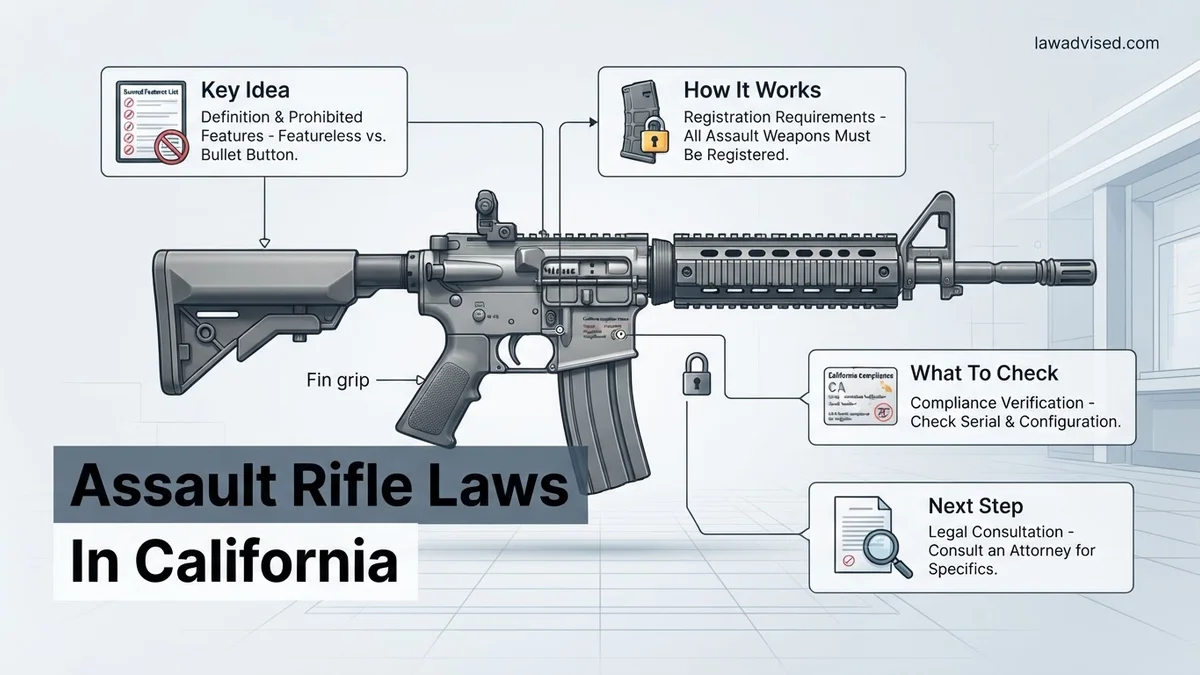
State regulations target specific physical traits historically associated with military combat weapons. To legally possess a semi-automatic, centerfire rifle with a detachable magazine in 2027, your firearm cannot feature any of the following:
- A pistol grip that protrudes conspicuously beneath the action of the weapon
- A thumbhole stock or telescopic/folding stock
- A grenade launcher or flare launcher
- A flash suppressor or forward pistol grip
Possessing a rifle with even one of these banned features and a detachable magazine places the firearm squarely in the assault weapon category under California Penal Code.
How to Fix and Comply With California Assault Weapon Definitions
Complying with California’s 2027 assault rifle laws requires you to modify your firearm into a legal configuration. Gun owners generally choose between two primary compliance paths: building a featureless rifle or utilizing a fixed-magazine solution. Both methods allow you to legally own and shoot semi-automatic rifles without violating state bans.
Building a Featureless Rifle Configuration
The featureless route relies on removing all prohibited ergonomic characteristics while keeping a standard magazine release mechanism. By altering the rifle’s exterior layout, you legally bypass the assault weapon classification.
- Replace standard pistol grips with fin grips or angled grips that prevent wrapping the thumb around the handle.
- Install a fixed stock to eliminate adjustable length-of-pull or folding capabilities.
- Remove any flash hiders and replace them with state-compliant muzzle brakes or thread protectors.
Implementing Fixed-Magazine Solutions
Alternatively, you can keep prohibited features like pistol grips and adjustable stocks if you render the magazine permanently unremovable without disassembly of the action. Fixed-magazine mechanisms require you to use tools or split the upper and lower receiver to release the ammunition feeding device, satisfying current legal exemptions.
Step-by-Step Guide to Building a Featureless or Fixed-Magazine Rifle
Complying with California assault rifle statutes in 2027 requires precision when modifying a semi-automatic centerfire rifle. Gun owners typically choose between two primary compliance paths: configuring the firearm as featureless or installing a fixed-magazine system. Expert legal sources and firearm manufacturers emphasize that exact measurements matter significantly during this process.
Configuring a Featureless Rifle
To remove all legally defined “assault weapon” characteristics under current California Department of Justice regulations, specific components must be swapped out. The following sequential process outlines the conversion:
- Unload the firearm completely and verify the chamber is clear before beginning any mechanical alterations.
- Remove the standard pistol grip and replace it with a designated featureless grip, such as a fin grip, that prevents the webbing of the trigger hand from resting below the top of the exposed trigger.
- Detach any adjustable telescoping stock and install a fixed stock of predetermined length, or pin the existing stock in place.
- Unscrew and remove any flash suppressors or grenade launchers from the barrel muzzle.
- Install a legal muzzle brake or compensator, ensuring it is permanently attached via pin-and-weld if needed to meet minimum rifle length requirements.
- Ensure that forward vertical grips, thumbhole stocks, and grenade launchers are completely absent from the build.
Installing a Fixed-Magazine Mechanism
Alternatively, firearm owners may retain prohibited features if the rifle utilizes a fixed magazine that cannot be removed without disassembly of the firearm action. Follow these procedural steps:
- Clear the firearm and disassemble the upper and lower receivers to access the standard magazine catch assembly.
- Remove the traditional push-button magazine release mechanism from the lower receiver.
- Install a fixed-magazine conversion kit, such as a magnetically locked mechanism or a split-action takedown pin system, per the manufacturer specifications.
- Verify that the magazine cannot be detached using standard finger pressure without separating the upper and lower receivers first.
- Test-feed dummy rounds to confirm reliable mechanical cycling before taking the firearm to a shooting range.
What If Your Firearm Configuration Still Does Not Meet Legal Standards
If initial modifications fail to bring a rifle into absolute compliance with 2027 California penal codes, or if parts fitment creates ambiguity, strict corrective measures are required. Gun owners should immediately cease all transport and use of the ambiguous firearm to avoid severe legal exposure.
- Disassemble the firearm completely into parts kits to remove constructive possession risks while sorting out compliance failures.
- Consult with a California-licensed firearms attorney specializing in Second Amendment law to review specific component geometries and measurements. Professional legal consultations typically range from $250 to $500 per hour.
- Take the lower receiver to a specialized California gunsmith certified in state-compliant builds to professionally pin muzzle devices or install fixed magazine solutions. Gunsmith labor costs for compliance remediation generally range from $75 to $200 depending on part complexity.
- Compare your final hardware against updated 2027 California Department of Justice regulatory bulletins and flowchart tools provided by civil rights organizations.
- Surrender or legally consign the firearm through a licensed Federal Firearms Licensee (FFL) if compliance cannot be definitively verified.
Conclusion
Navigating California assault rifle laws in 2027 demands rigorous attention to detail, strict adherence to state statutory definitions, and precise mechanical execution. Whether opting for a featureless build or a fixed-magazine conversion, eliminating prohibited components protects gun owners from severe criminal liabilities. According to verified research and expert legal sources, proactive compliance audits remain the single most effective defense against regulatory non-compliance. Take the next step today by scheduling a formal compliance inspection of your semi-automatic rifle with a certified California firearms professional.
❓ Frequently Asked Questions
What specific features classify a rifle as an assault weapon in California?
A semi-automatic centerfire rifle is classified as an assault weapon if it does not have a fixed magazine and includes any prohibited feature such as a pistol grip, thumbhole stock, folding or telescoping stock, grenade launcher, flash suppressor, or forward pistol grip.
How do fixed-magazine solutions differ from featureless builds?
Fixed-magazine builds retain standard ergonomic features like pistol grips because the magazine cannot be removed without disassembling the firearm action. Featureless builds allow normal magazine changes by eliminating prohibited ergonomic attachments entirely.
Are rimfire rifles subject to the same assault weapon restrictions?
Rimfire rifles generally enjoy exemptions from certain centerfire assault weapon restrictions, but owners must still verify that their specific rimfire configuration does not violate overall length requirements or specific banned models.
What are the penalties for violating California assault rifle laws?
Violations involving the manufacture, distribution, importation, or possession of unregistered assault weapons can result in heavy fines and felony convictions, depending on the specific circumstances of the offense.
How do recent court rulings impact California firearm restrictions?
Ongoing state and federal litigation continuously challenges various aspects of California’s gun control framework, though strict statutory limitations remain actively enforced pending final appellate decisions.
Can I transport an assault rifle through California if I am passing through?
Federal law provides limited protections for travelers transporting firearms, but California authorities strictly enforce state laws regarding assault weapon possession, making transit risky without strict compliance steps.

Ismail Hossain is the founder of Law Advised. He is an Divorce, Separation, marriage lawyer. Follow him.