Single Filing Status Explained Expert Guide for 2026
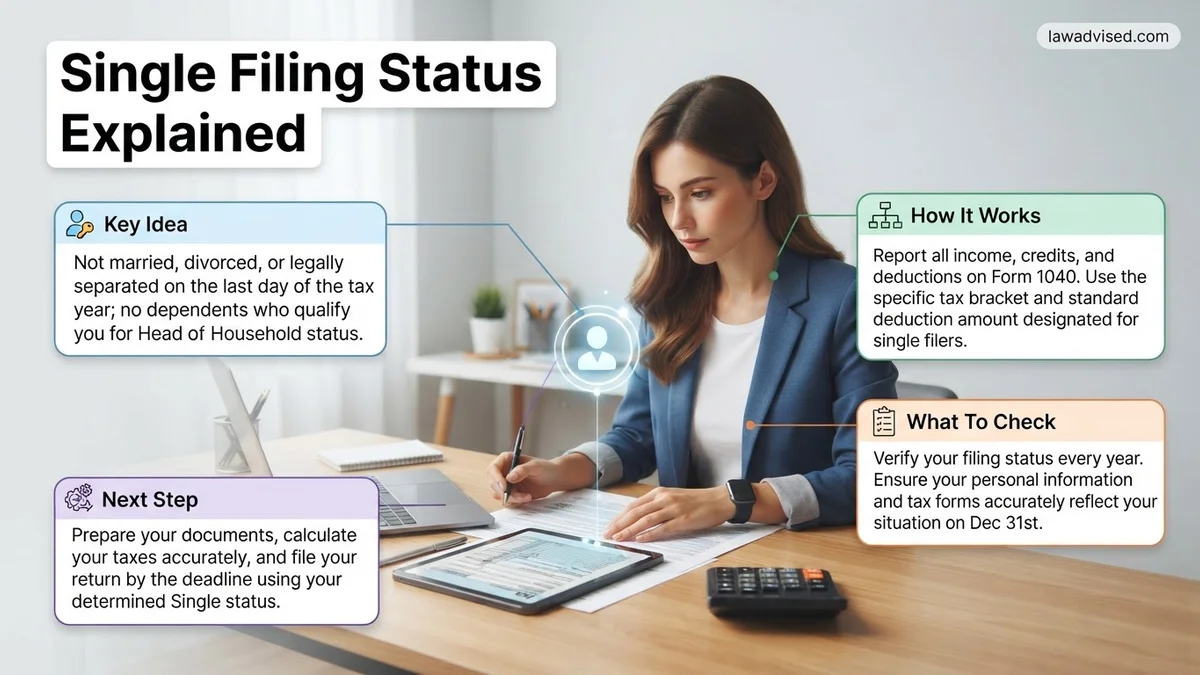
Filing as single depends strictly on your marital status on the last day of the tax year. Unmarried, divorced, or legally separated taxpayers use this status unless they qualify for a dependent-based category like head of household.
You qualify for the single tax filing status if, on the last day of the tax year 2026, you are unmarried, legally divorced, or legally separated under state law, and you do not have dependents that qualify you for a more favorable status. Your official marital status on December 31 dictates how you must file for the entire year.
Navigating this status correctly ensures you claim the right standard deduction and apply the proper tax brackets. Making a mistake here can trigger IRS automated matching notices, delay your tax refund, or cause you to overpay thousands of dollars to the government.
Key Takeaways
- Filing status is determined by your legal marital status on December 31.
- Single filers receive a specific standard deduction amount set by the IRS.
- Tax brackets for single filers apply to lower income thresholds than joint returns.
- Taxpayers with qualifying dependents should evaluate Head of Household status instead.
- Divorced individuals are considered unmarried for the entire tax year.
What Causes IRS Filing Status Errors for Single Taxpayers
Filing status errors often happen because taxpayers misunderstand how the IRS views specific life events and household situations. You might assume you qualify as single, but a technicality regarding your legal status or dependents changes the outcome.
The December 31 Marital Status Trap
The IRS determines your marital status for the entire tax year based strictly on your standing on December 31. If you finalized your divorce on December 30, you are single for the entire year. If your divorce decree is signed on January 2, you are still considered married for that tax year. Taxpayers frequently mess this up by filing as single too early after a separation.
Misunderstanding Head of Household Overlap
Many taxpayers filing as single actually qualify for the Head of Household status, which offers a higher standard deduction and wider tax brackets. To avoid filing errors, check these common pitfalls:
- Assuming living alone automatically makes you single in the eyes of the IRS.
- Failing to realize that maintaining a home for a qualifying dependent overrides the single status.
- Confusing a legal separation agreement with a final divorce decree.
- Overlooking state-specific laws regarding common-law marriage.
How to Fix Filing Status Mistakes and Determine Correct Qualification
If you realize you filed under the wrong status or need to verify your eligibility before submitting your 2026 tax return, you must take immediate corrective action. Fixing a mistake early prevents costly IRS audits and penalty assessments.
Evaluating Your Household and Dependent Situation
To confirm you belong in the single filing category rather than Head of Household, run through this quick evaluation checklist:
- Verify that you are legally unmarried or considered unmarried under IRS rules.
- Confirm you paid more than half the cost of keeping up your home.
- Check if you have a qualifying child, relative, or dependent living with you for more than half the year.
Steps to Correct an IRS Filing Status Error
If you already submitted your tax return with the wrong status, do not panic. The IRS requires you to file an amended return using Form 1040-X. Always wait until the IRS processes your original return and issues any refund before you submit the amendment. Attach any corrected schedules, and include a clear written explanation detailing why you are switching your status to single.
Step-by-Step Guide to Selecting Single Status on Form 1040
Completing your tax return accurately requires careful navigation of the IRS Form 1040 layout for the 2026 tax year. Selecting the incorrect filing status triggers automated IRS processing delays and potential math error notices. Tax preparation software and traditional paper forms require strict adherence to specific filing sequence protocols.
Filing Your 2026 Return
- Verify your marital status as of December 31, 2026, to ensure you legally meet the IRS definition of single.
- Locate the filing status section at the top of Form 1040, situated directly below your personal information fields.
- Check the box corresponding to “Single,” ensuring no other primary filing status boxes are marked.
- Enter your correct Social Security Number and verify that your name matches Social Security Administration records.
- Proceed to the standard deduction section, ensuring you apply the correct 2026 single baseline amount of $15,000.
What If Your Marital Status Changed or You Qualify for Head of Household
Life transitions during the 2026 tax year complicate simple filing status determinations. Taxpayers frequently mistake single status eligibility when they experience a divorce, separation, or undertake dependent care responsibilities. According to Internal Revenue Service guidelines, your legal status on the final day of the tax year dictates your entire annual filing category.
Evaluating Status Transitions
- Assess whether your divorce or legal separation was finalized by December 31, 2026; if not, the IRS considers you married for the entire tax year.
- Examine dependent support criteria if you maintain a home for a qualifying child or relative, as you may qualify for the more financially advantageous Head of Household status.
- Review the married filing separately status if your divorce is pending but you lived apart from your spouse for the last six months of 2026.
- Calculate whether Head of Household provisions offer a higher standard deduction and more favorable tax brackets than the standard single designation.
What If It Still Doesn’t Work?
Taxpayers who encounter persistent software rejections, IRS mismatch notices, or complex dependency determinations require advanced troubleshooting protocols. Resolving complex filing status errors independently risks costly penalties and delayed refunds. Consider these professional escalation steps when standard filing procedures fail:
- Review your previous year’s tax transcript directly from the IRS website to confirm your historical filing status trajectory.
- Consult a certified public accountant or an IRS Enrolled Agent to untangle complex mid-year marital status transitions.
- Engage a licensed tax professional, keeping in mind that typical expert consultation fees range from $250 to $600 depending on return complexity.
- Contact the IRS direct taxpayer assistance line or schedule an appointment at your local Taxpayer Assistance Center for official agency guidance.
Conclusion
Navigating the single filing status for the 2026 tax year demands strict attention to your legal status on December 31 and precise adherence to Form 1040 instructions. Selecting the correct designation ensures compliance with updated standard deduction thresholds and prevents costly processing delays. According to verified research and expert tax sources, reviewing your complete financial profile before submission significantly reduces audit triggers. Your actionable next step is to gather your official income documents and verify your status against current IRS guidelines today.
❓ Frequently Asked Questions
How does the IRS define ‘unmarried’ for the single filing status?
The IRS considers you unmarried if you were never married, your previous marriage was legally annulled, or you are legally divorced or separated under a final decree by December 31.
Should I choose single or head of household if I am a single parent?
If you have a qualifying dependent and paid more than half the cost of keeping up your home, Head of Household offers a higher standard deduction and more favorable tax brackets than the single status.
Are single tax brackets the same as married filing separately brackets?
While they share similar threshold structures, the specific income brackets and phase-outs differ between single filers and married individuals filing separate returns.
What if my spouse and I are separated but not legally divorced by December 31?
Under IRS rules, you are still considered married for tax purposes unless you have a final decree of divorce or separate maintenance, meaning you cannot file as single.
Does living with a partner mean we must file together?
No. Unmarried partners cannot file a joint return and must file separately using either the single or head of household status depending on dependents.
How do standard deduction age additions apply to single filers?
Single filers who are age 65 or older, or blind, are eligible for an increased standard deduction amount on their federal income tax return.

Ismail Hossain is the founder of Law Advised. He is an Divorce, Separation, marriage lawyer. Follow him.